All posts by tabsir

Ibn Taymiyya on Snake Oil

[Webshaykh’s Note: The Muslim World has made some of their articles available, perhaps only for a limited time, to non-subscribers. In the latest issue (Volume 99, Issue 1, Pages 1-20, 2009) there is an interesting article by Yahya Michot (“Between Entertainment and Religion: Ibn Taymiyya’s Views on Superstition”). I attach here a brief excerpt from the article.]

One day, Ibn Taymiyya was asked to answer the following questions in a fetwa: “Are there, in this community, virtuous persons whom God keeps absent to people’s eyes? They are only seen by those by who they want to be seen. Even if they are among people, they are, in the state which is theirs, veiled to these people’s eyes. And also, are there, on Mount Lebanon, forty men absent to the eyes of those who look there? Every time one of them dies, they take somebody else among the people, who absents himself with them just as they are absent. All those, the earth hides them. They perform the pilgrimage. They accomplish in an hour distant trips that would normally take a month or a year. There are some among them who fly like birds, speak of hidden things before they happen, eat bones and clay and find this nourishing and sweet, etc.”27 Continue reading Ibn Taymiyya on Snake Oil →
Al-Qaeda in Yemen

[Salon Magazine recently published an interview with Gregory Johnsen on the recent attacks against alleged al-Qaeda sites in Yemen. Here is a brief excerpt from the interview. The whole piece can be found at salon.com.]

Glenn Greenwald: My guest today on Salon Radio is Gregory Johnsen, who is an expert on Yemen; he’s a Ph.D. candidate in Near Eastern Studies at Princeton University and has advised the U.S. and British governments on issues relating to Yemen. Thanks very much for joining me today.

Glen Greenwald: How would you characterize what is being called al-Qaeda in Yemen in that spectrum, and how significant of a threat it is really to the United States, not within Yemen, but outside of Yemen and in the homeland?

Gregory Johnsen: Well, let me talk about it this way, if I can. This is the second incarnation of al-Qaeda in Yemen. Immediately after September 11th, we had what I like to term the first phase of the war against al-Qaeda. This lasted essentially from, say, the USS Cole attack in 2000 and really the September 11th attacks in 2001, up through November 2003. So, in this phase, the US and Yemeni governments partnered very closely. There was the drone strike in November 2002 that I mentioned earlier, and this was largely, at least for al-Qaeda, a reactionary war. Continue reading Al-Qaeda in Yemen →

A Moorish Girl and an Irish Poet


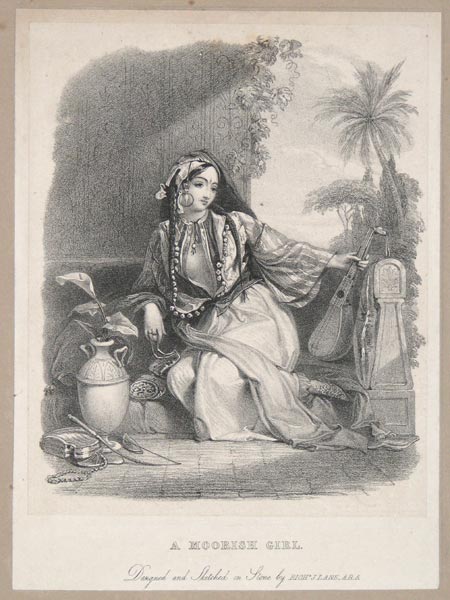
A Moorish Girl, ca. 1828

The image here is entitled “A Moorish Girl” and was designed by Richard James Lane. This lithograph was published in London by Engelmann, Graf, Coindet, & Co., ca. 1828. This would have exemplified the romanticized image conjured in Thomas Moore’s immensely popular Lalla Rookh, written in 1817. Often dismissed as a kind of quasi-pornographic Orientalist doggerel, the poem is a delightful read as a flight of fancy. The entire poem is online in an attractive format. Here is a sample excerpt:

Alas, poor ZELICA! it needed all
The fantasy which held thy mind in thrall
To see in that gay Haram’s glowing maids
A sainted colony for Eden’s shades;
Or dream that he, –of whose unholy flame
Thou wert too soon the victim, –shining came
From Paradise to people its pure sphere
With souls like thine which he hath ruined here!
No– had not reason’s light totally set,
And left thee dark thou hadst an amulet
In the loved image graven on thy heart
Which would have saved thee from the tempter’s art,
And kept alive in all its bloom of breath
That purity whose fading is love’s death!–
But lost, inflamed, –a restless zeal took place
Of the mild virgin’s still and feminine grace;
First of the Prophets favorites, proudly first
In zeal and charms, too well the Impostor nurst
Her soul’s delirium in whose active flame,
Thus lighting up a young, luxuriant frame,
He saw more potent sorceries to bind
To his dark yoke the spirits of mankind,
More subtle chains than hell itself e’er twined.
No art was spared, no witchery; –all the skill
His demons taught him was employed to fill
Her mind with gloom and ecstasy by turns–
That gloom, thro’ which Frenzy but fiercer burns,
That ecstasy which from the depth of sadness
Glares like the maniac’s moon whose light is madness!

Teaching at the margins

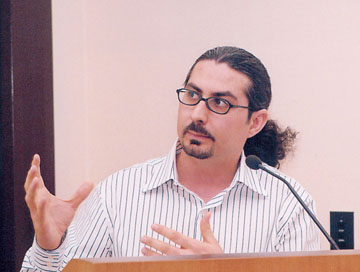
[Webshaykh’s note: Dr. Omar Dewachi, a recent graduate in anthropology from Harvard University, writes about his experiences teaching medical anthropology in Beirut. Here is the first paragraph of his essay, which can be uploaded in full as a pdf at http://www.alterites.ca/dernier.html.]

Teaching at the Margins: Experiences of Anthropology and Medicine in a Middle Eastern Setting

by Omar Dewachi, Altérités 6(2):129-135, 2009

For the last four years I have been teaching the Social Preventive Medicine (SPM) course to first year medical students at the American University of Beirut (AUB) in Lebanon. Around eighty students attend this core course, which is part of the teachin of public health within the medical curriculum. During the course of these years I have attempted to use the SPM as a platform to introduce theories and methods in medical anthropology to medical students. As both a medical doctor trained in Iraq – and an anthropologist – trained in the United States – this task has presented me with many challenges, as well as, offered me insights into tensions between the two fields. These experiences are the subject of this essay, which attempts to explore teaching at the margins of anthropology and medicine in a Middle Eastern setting. While situated at different margins, I reflect on how this course became an interesting site for exploring the complex task of teaching medical anthropology in a non-western context, while, at the same time, raising a set of paradoxes that are particular to teaching medical anthropology in a post-colonial setting. My attempt here is not to generalize my experiences or to reify the dichotomy of East and West; rather it is to situate them within their social-political, economic and historical realities.

To read the entire article in pdf, click here.

Grinding a Greater Axis of Evil


“Yemeni protesters staged a demonstration in the southern part of the country on Thursday after a raid against Qaeda militants”: Photograph from Agence France-Presse for The New York Times

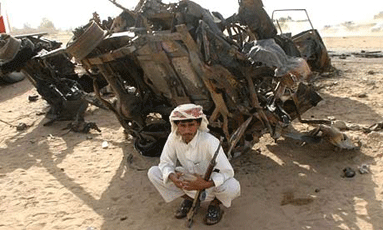
In the midst of two unfinished major wars, the United States has quietly opened a third, largely covert front against Al Qaeda in Yemen. Eric Schmitt and Robert Worth, The New York Times, December 27, 2009

Terrorism takes a toll far beyond the lives lost everyday, even when a plot is thwarted. On Christmas day a 23-year-old Nigerian named Umar Farouk Abdul Mutallab attempted to set himself off as a human bomb on a Northwest Airlines flight from Amsterdam to Detroit. On the surface he hardly fit the profile of a crazed militant fresh out of a training camp in the hills of Pakistan. His father was a recently retired chairman of First Bank of Nigeria and he is an engineering student at University College London. But it now seems that his father was so concerned about his son’s politics that he warned the U.S. embassy about him just a month ago. Initial reports indicate that the explosives were said by Mutallab to be provided by al-Qaeda in Yemen. Based on this claim certain U.S. politicians, most notably Senator Joseph Lieberman of Connecticut, have called for Yemen to be added to the growing terrorist axis of evil. “So I leave you with this thought that somebody in our government said to me in the Sana’a, the capital of Yemen. Iraq was yesterday’s war. Afghanistan is today’s war. If we don’t act preemptively, Yemen will be tomorrow’s war. That’s the danger we face.” Lieberman told Fox News.

Lieberman is actually calling for Yemen to become today’s war, but the key to his thinking is best summed in another line from the same interview: “We’ve got to constantly be thinking like the terrorists here.” Well, Joe, this is the problem. You are thinking like the terrorists when you suggest going into a country you know nothing about and dropping bombs. Unfortunately, it appears we have already started doing that. Continue reading Grinding a Greater Axis of Evil →

Mustafa Pasha Yamolki: From Istanbul to Suleymaniya

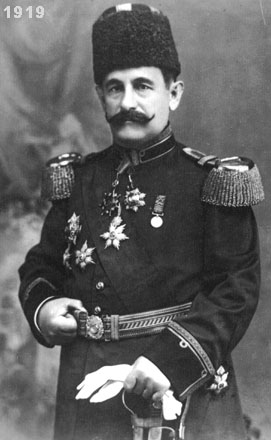
Mustafa Pasha Yamolki: his life and role in the Kurdish nationalist movement

by Dr. Rebwar Fatah, Kurdish Media, 2005

A king is just like a chess king today in the world.

From a poem by Shukri Fazli, Kurdish intellect, journalist and poet

There are countless Kurdish figures that have been denied due credit for contributing to the cause of their people. Mustafa Pasha Yamolki is but one. Attempting to name the others would risk missing some and history already excels at this.

Therefore, this article seeks to reveal some unknown details of Yamolki’s life and to reintroduce him after an absence that is unjustified for a human of such stature. It was a significant, but worthwhile, challenge to discover information about Yamolki. I depended heavily upon his immediate family, whose acquaintance I treasure a great deal.

Prior to his death on May 25, 1936 in the Alwazyrya area of Baghdad, Mustafa Pasha Yamolki asked to have this verse of poetry etched into his grave:

Etirsm ey weten bimrim, nebînim bextiyarî to

Binwsin ba leser qebrim, weten xemgîn u min xemgîn.

Which can be translated to:

My homeland, I am scared that I may die without seeing your happiness

Etch into my grave that my homeland and I are both sad.

Continue reading Mustafa Pasha Yamolki: From Istanbul to Suleymaniya →

Church of the Nativity


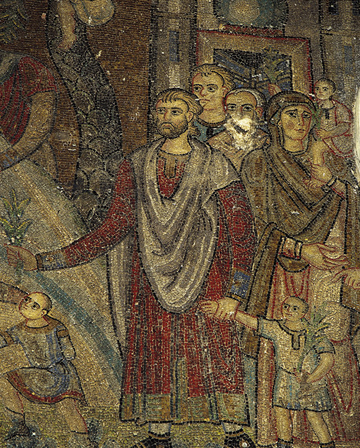
Fresco from the Church of the Nativity in Bethlehem

The Basilica of the Nativity in Bethlehem

In 1099 a detachment of Crusaders commanded by Tancredi took possession of Bethlehem. The night of Christmas 1100 Baldwin, brother of Godefroy de Bouillon, was crowned the first king of Jerusalem in the Basilica of the Nativity, the only early Christian church in Palestine still intact on the arrival of the Crusaders. Subsequently, the Crusaders, after having fortified the sanctuary together with the surrounding monasteries, added a bell tower to the front, restored the double side entry to the Grotto under the presbytery of the basilica and built the Augustinian convent with the cloisters to its north. Between 1165 and 1169 the walls were decorated with mosaics, thanks to the collaboration between King Amalric of Jerusalem and Emperor Manuel Comnenus of Constantinople. The authors of the project were Ephraim a monk, painter and mosaicist assisted by Deacon Basilius. From the descriptions of the pilgrims we are able to determine the entire mosaic decorative cycle. The Nativity decorated the apsidiole of the Grotto, the Tree of Jesse, father of King David and progenitor of Jesus, the inner wall of the facade. On the walls a procession of Angels facing toward the Grotto at the top was followed, at the centre, by texts in Greek and Latin of the Councils in designs of the cities in which they were held, and by busts of the Ancestors of Jesus at the bottom. Scenes of the Gospel decorated the walls of the trilobate transept. Remnants of the Unbelief of St. Thomas, the Ascension, the Entry of Jesus into Jerusalem and a lone figure from the scene of the Transfiguration. Still in the crusade period the shafts of the columns were decorated with encaustic paintings from the Old and New Testaments and with Saints from the east and the west identified by texts in Greek and Latin.

Source: Holy Land of the Crusaders

Arabic Talismania

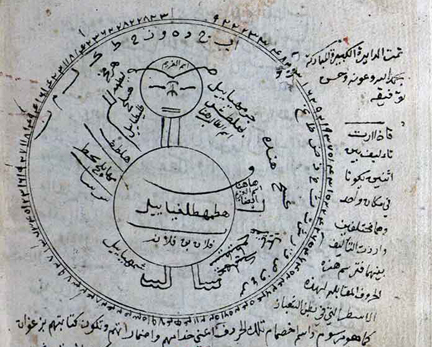
I have had always had a fascination with the variety of astrological, magical and prognosticative manuscripts available in Arabic. Living in the post-Enlightenment modernity era, we scholars tend to think of astrology as a quaint feature of past pre-scientific thinking and now abandoned the New Age enthusiasts. There are, however, thousands of Arabic manuscripts that are magical, in more than the usual sense. These offer a window, however mysterious, into the concerns and fears of the past. I recently came across an extraordinary website, Digital Occult Manuscripts, which has uploaded images of numerous Arabic occult texts. I cannot find information on who puts out the project, but it is an amazing source of documents (although usually just a few pages of each manuscript) and a joy just to browse through. Here is one of the images, a talismanic man from a 12th century text by al-Ghazali.

Illustration from السر الرباني في العالم الجثماني / al-Sirr al-Rabbani fi Al-‘alam al-Juthmani
Author: Abu Hamid al-Ghazali / أبو حامد الغزالي
Year: 505 Hijri / 1111 Gregorian
Language: Arabic
Writing style: Talik
Number of pages: 130 page