All posts by tabsir

Greg Johnsen on al-Qaeda in Yemen

Welcome to Qaedastan
by Gregory D. Johnsen, , Foreign Policy, January/February, 2010

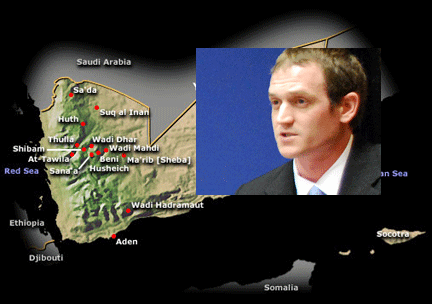
In 2010, Yemen will celebrate the 20th anniversary of national unification. But it won’t be much of a party: This could well be the year Yemen comes apart.

Even the brutal 1994 civil war failed to threaten the structural integrity of this country chronically teetering on the verge of disintegration as much as the current crises, all of which may be coming to a head in 2010.

Yemen has so many dire problems that it’s easy to be overwhelmed. Al Qaeda is growing in prominence, a Shiite rebellion is expanding in the north, and the threat of secession is renewed in the south. There’s a brewing fight over what comes after President Ali Abdullah Saleh, age 67, who has ruled Yemen for 31 years; the country’s elites are locked in a closed-door struggle to take power once he departs. Finally, and perhaps most intractably, Yemen is an environmental and resource catastrophe in the making. The country’s water table is nearly depleted from years of agricultural malpractice, and its oil reserves are rapidly dwindling. This comes just when unemployment is soaring and an explosive birthrate promises only more young, jobless citizens in the coming years. Continue reading Greg Johnsen on al-Qaeda in Yemen

Following Seward’s Folly: #3 Confederates in Cairo


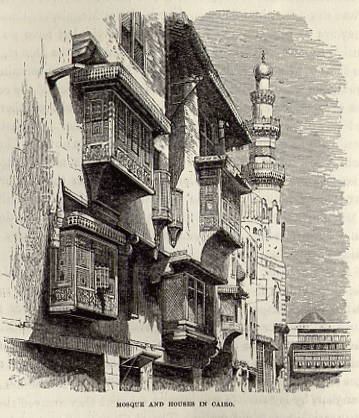
Illustration of Cairo from Seward’s Travels (1873)

William H. Seward, the American Secretary of State who is forever linked with the “folly” of acquiring Alaska from the Russians, spent a year traveling around the world near the end of his life. In two previous posts I posted the comments he and his daughter made about India and Aden, but their trip continued up the Red Sea to Egypt. While in Cairo, Mr. Seward received the esteemed protocol of a traveling diplomat, but in Cairo there came a most civil surprise:

The Americans in Egypt are a mixed though interesting family. The Khédive is reorganizing his army on the Western system of evolution and tactics. Continue reading Following Seward’s Folly: #3 Confederates in Cairo

How I Almost Became a Terrorist


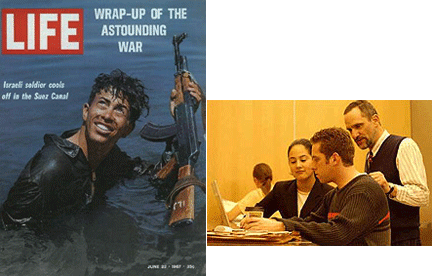
left, 1967 cover of Life Magazine; right, Dr. Alan Singer in the classroom

How I Almost Became a Terrorist
Not Everyone Who Opposes U.S. Policy is a Fanatic

By ALAN J. SINGER, CounterPunch via Maiz Centeotl Chicomecoatl, January 7, 2010

In May 1967 I was a seventeen-year old high school senior and a not particularly religious Jew. I was born in New York City, as were my parents, although my grandparents were immigrants from Eastern Europe. My family strongly identified with the state of Israel and at the time my stepmother was visiting her brother who had emigrated there to fight for independence after serving in the U.S. army during World War II.

The survival of Israel as a Jewish state was important to my identity and the identity of my friends and family members. My friends, siblings, cousins, and I grew up in the shadow of the Holocaust and we had family members who were murdered. Jews had been victims for two thousand years but the survival of Israel meant we would be victims no more.

As the crisis in the Middle East intensified Americans were evacuated. My father and I spent a night at Kennedy Airport waiting for my stepmother to return home. The next morning two friends and I went to the Jewish Agency to sign up to go to Israel as volunteers in the event of war. We hoped to fight but said we would do anything that was needed.

On June 5, 1967 Israel launched a preemptive strike. The Third Arab-Israeli War lasted six days and ended with a resounding Israeli victory. American volunteers were not needed so we never went. But we would have gone and we would have fought for the survival of Israel and of Jews, whether the United States government gave permission, looked the other way, or even if it tried to stop us.

I am no longer a Zionist and I have not supported Israeli policy, especially the occupation of the West Bank and Gaza, since the 1973 Arab-Israeli War. I now see Israel as the aggressor in the region, but that is not the point. Continue reading How I Almost Became a Terrorist

More on the Danish Cartoons

What the Danish Cartoon Controversy Tells Us About Religion, the Secular, and the Limits of the Law
By Winnifred Fallers Sullivan, Religion Dispatches, January 7, 2010

Review of: Is Critique Secular? Blasphemy, Injury, and Free Speech by Talal Asad, Wendy Brown, Judith Butler, and Saba Mahmood (University of California Press, 2009)

This very rich little book seems to me a very good place to begin the new decade. It is smart, informed, thoughtful, urgent—and properly unsettling. It is also very difficult to read quickly or to summarize in short order. It is well worth the effort.

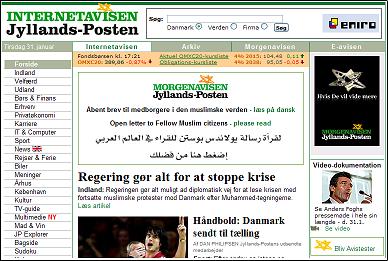
The principal essays, by anthropologists Talal Asad and Saba Mahmood, take the Danish cartoon controversy as a starting point. They review the contexts of the publication of the satirical cartoons of Mohammed in Jyllands-Posten, a Danish newspaper, and the angry responses that ensued; they ask us to take seriously the fundamental incoherence of the assumptions about religion that underlie the dominant narratives of those events (dominant narratives that were repeated again this week in the stories about a recent attack on one of the cartoonists.) The book also includes an introduction by political scientist Wendy Brown and a response to the essays by philosopher Judith Butler. Continue reading More on the Danish Cartoons

Toronto Talks

If you are reading this post today, Wednesday, I may very well be in the air on my way to Toronto, where I will be giving two lectures. Anyone who is interested is invited to attend.

Thursday, January 14th, 2010

Interdisciplinary Perspectives on Science
presents:

Daniel Martin Varisco (Hofstra University)

Star Gazing through Religious Phrasing: The Origins of a Lunar Zodiac in Early Islamic Astronomy

At Ryerson University in ENG LG14, George Vari Engineering and Computing Centre, 245 Church St. from 6:00pm to 8:00pm.

One of the most important astronomical time-keeping calendars from the Arabian Peninsula is the so-called anwâ’, which early Muslim astronomers equated with the tradition of 28 lunar stations (manâzil al-qamar). Through a study of this calendar in pre-Islamic Arabic poetry and Arabic lexical texts and by comparison to ethnographic accounts of existing Arabian star calendars, I argue that the system described in the evolving Islamic science of astronomy is one that did not arise in the Arabian Peninsula but was the result of cleansing the magical elements out of the earlier star lore and modeling this on the lunar zodiac of Sassanid Iran and India.


Refreshments will be served after the discussion.

The second talk will take place at the University of Toronto on Friday, January 15:

Anthropology Colloquium Series

Daniel Martin Varisco (Hofstra University)

The Culture Concept without a Textual Attitude: Reading against Orientalism and between the lines of Culture and Imperialism

Friday, January 15th, 2010. 2-4pm. Room 246.

Department of Anthropology, University of Toronto, AP 246, 19 Russell St.

My paper for the University of Toronto is available online as a pdf.

The Art of Frederick Goodall


Unloading Cotton on the Nile, painting by Frederick Goodall, mid 19th century

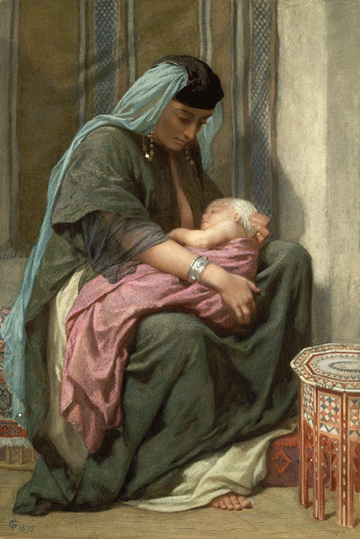
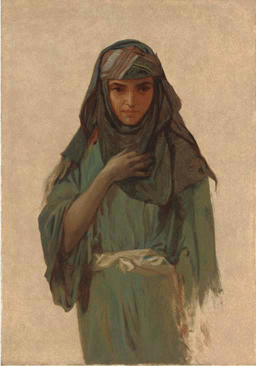
Attention to Orientalist paintings often ignores the lesser artists, some of whom provided valuable descriptive renderings of people and scenes. One of these is the Englishman Frederick Goodall (1822-1904), who moved to the Coptic quarter of Cairo in 1858, sharing space with Carl Haag, a drawing master for Queen Victoria. They spent much time in Bedouin camps, as well as busy suqs, where they were often treated with suspicion. After seven months in Egypt, Goodall had produced 130 oil paintings. He returned to Egypt in 1870 to make more paintings, this time with his two sons. They stayed at the house of the Egyptian archaeologist Mariette-Bey, near Sakkara. To blend in with the context Goodall grew a beard and at times dressed in white with a red fez. His work provides a meticulous “ethnographic” view of Egypt at the time.


Cairo Bazaar, 1891


The Palm Grove, 1894

On our terrorism problem

by Stephen M. Walt, Foreign Policy, January 8, 2010

Declaring that “the buck stops with me,” President Obama announced a set of new directives in response to the foiled bombing of Northwest Flight 253 by the now-infamous “underpants bomber.” The list of presidential orders is mostly unexceptionable, and may even make a repeat performance less likely. Of course, if al Qaeda is even remotely strategic, trying an exact repeat of this attempt would be silly. Instead, they’ll study the new procedures, look for holes in them, and try some new variation. The good news is that air travel will still be incredibly safe, and no sensible person should alter their normal travel plans because they are worried about the “terrorist threat.”

What’s missing from Obama’s list of new initiatives is any sense that U.S. foreign policy might need some rethinking too. There are several dimensions to the terrorism problem, only one of which are the various measures we take to “harden the target” here at home. Why? Because bombing airliners and other acts of terrorism are just tactics; they aren’t al Qaeda’s real raison d’être. Their goal, as veteran foreign affairs correspondent William Pfaff recently reminded us, is trying to topple various Arab governments that al Qaeda regards as corrupt and beholden to us and establish some unified Islamic caliphate. As Pfaff notes, this is a fanciful objective, but still one that can cause us a certain amount of trouble and grief. And if they can get us to act in ways that undermine those governments (even when we think we are trying to help them), then their objectives are advanced and ours are hindered. Continue reading On our terrorism problem