All posts by tabsir

Nutrition in Colonial Aden, #1

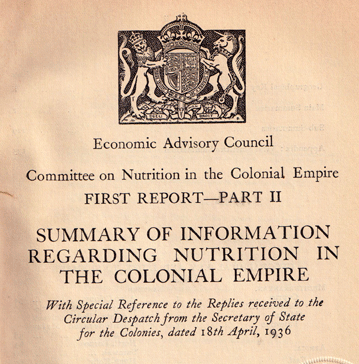
Say what you will about colonial empires, but at least they generate reports. I recently came across a British report to Parliament in 1939 entitled “Summary of Information Regarding Nutrition in the Colonial Empire.” Four pages are devoted to Aden Colony, which is said to have an area of 75 square miles, a population in 1931 of 45,992, a birthrate in 1937 of 32.07 per 1,000, an infant mortality rate in 1937 of 196.61 per 1,000, and a death rate in 1937 of 31.72 per 1,000. I attach excerpts below:

“1. General. – …This survey deals primarily with the 75 square miles of volcanic rock and sand which constitute the Colony of Aden; a detailed review of the nutritional affairs of the Protectorate has been postponed until a later date. The Colony is almost entirely urban and so cosmopolitan in make-up as to complicate the task of reviewing the nutritional conditions as a whole. Arabs, Jews, Somalis and Indians of various races predominate, and a preponderance of males is occasioned by the fact that those who come to Aden for varying periods of time to seek livelihood as coolies or tradesmen leave their womenfolk behind in the interior or in India. The natural division is to classify Arabs, Jews and the poorer classes of Indian Mohammedans as the indigenous population and it is to these, particularly the middle and lower classes, that the present nutritional considerations apply.

2. Composition and Nutritive Value of Dietary. – All the chief articles of diet are, with the exception of fish, imported from overseas or from Arabia. They are: rice, flour, sugar,; fish, mutton, beef, goat’s milk, eggs, ghee; fruits, vegetables, dates, lentils, simsim oil, tea, coffee and spices. Continue reading Nutrition in Colonial Aden, #1

Plant Diversity in Saudi Arabia


Adenium from Saudi Arabia

While preparing a talk for a conference in October on camels, I came across a very useful website maintained by Professor Jacob Thomas of the Herbarium in the Department of Botany & Microbiology at King Saud University in Riyadh. This is Plant Diversity in Saudi Arabia, with sections on topography, vegetation, flora, the history of botanical studies, conservation, and a major bibliography. There is also a checklist of species recorded.

Surfing in Sanaa

Internet cafes offer more to Yemen’s youth
by Teresa Gedi, Yemen Observer, April 3, 2010

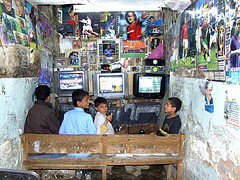
Al-Mortazah internet cafe, located at the foot of the Friendship Bridge near Tahrir square, takes the meaning of internet café to another level. In addition to its 20 computer stations, it has a full service sheesha bar and cafe from which I enjoyed a glass of fresh mango juice courtesy of the soft-spoken poet and journalist Abdul Rahman Ghelan.

Mr. Ghelan, age 30, has frequented the café since his personal computer broke down some months ago. As the place is close to his home and affordable (1 riyal per minute), he takes his time exploring various literary and journalistic websites across the Arab world. Being a poet, Ghelan finds the web to be an effective means of spreading his work and developing it through feedback from the online literary community. Feeling I had stumbled on a budding international artist, I listened intently as he humbly explained his work which focuses largely on politics, women and children. “My poetry has benefited greatly from web exposure in both the Arab world and outside. Literary personalities in Europe for example have contacted me requesting to translate my work into other languages, specifically, French and Italian.” Ghelan is also currently working on a translation of a book into English entitled “Memoirs of the Victim,” the victim being women in Yemen. Another poem “hams al-abir” or “The Whisper of Perfume” has caused quite a stir in the online Arabic poetry community. “I am amazed by the support I receive online,” says Ghelan. “As long as you are appropriate and respectful, it feels like people are right next to you supporting you.” Continue reading Surfing in Sanaa

Ann Dunham and Indonesia

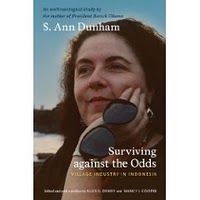
Last fall Duke University Press published the Ph.D. thesis of S. Ann Dunham, President Obama’s mother, who just happened to be an anthropologist. I can certainly sympathize with the editors, as my own dissertation also bordered on the 700 page level (which may be one reason it was never published as a book). Details on the book can be found at Duke University Press. But I attach here a valuable account by Michael Dove for the New York Times last August.

Dreams From His Mother

By Michael R. Dove, The New York Times, August 10, 2009

PRESIDENT OBAMA’s late mother, Ann Dunham Soetoro, was famous for the good cheer and optimism that she preserved in the face of a complex and challenging world. Her personality went hand-in-hand with her career as an anthropologist in Indonesia and Pakistan, where she studied and worked with village craftsmen, slum-dwellers and countless others. I knew Dr. Soetoro as a friend and colleague for many years before her death from cancer in 1995. Though I only met her son once, briefly at her memorial service, I’ve watched him as he’s taken on the hardest job in the world, and often found myself wondering how her worldview might have shaped him. Continue reading Ann Dunham and Indonesia

Mocha Musings #4: Morocco to Afghanistan


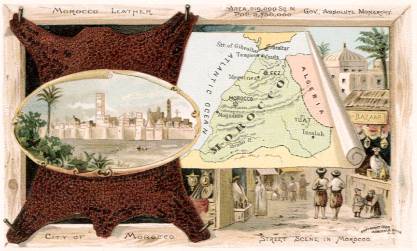
Area: 219,000 sq. mi
Population: 2,750,000
Government: Absolute Monarchy
Scenes: Morocco Leather; City of Morocco; Street Scene in Morocc
o

previous post I began a series on coffee advertising cards with Middle Eastern themes. One of the most colorful collections is that provided by the Arbuckle Coffee Company. In my great, great aunt’s album there were several Middle Eastern and North African nations represented, but she did not have all the cards. Here is a final potpourri from Arbuckle’s 1889 series, starting with Morocco above. Continue reading Mocha Musings #4: Morocco to Afghanistan

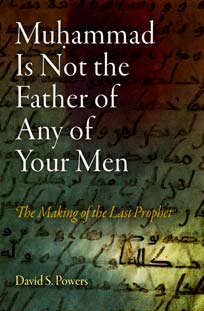
Muhammad Is Not the Father of any of Your Men


David Powers
of Cornell University has recently published what is sure to be a controversial analysis of early redaction of the Qu’ran. This is his
Muhammad is Not the Father of any of Your Men: The Making of the Last Prophet, published by the University of Pennsylvania Press. He provides a discussion of the book on Rorotoko, the first part of which I attach here.

Muhammad Is Not the Father of any of Your Men is about the Islamic assertion that Muhammad was the last in a series of prophets sent by God to mankind in order to facilitate human salvation. This assertion is mentioned once in the Qur’an, in verse 40 of chapter 33 (“The Confederates”). Here, addressing an unidentified audience, the voice that controls the text announces, “Muhammad is not the father of any of your men but the Messenger of God and the Seal of Prophets.”

The meaning of the phrase “Seal of the Prophets” (in Arabic, khatam al-nabiyyin) is equivocal. Some early Muslims understood this phrase as signifying that Muhammad confirmed the revelations sent previously to Moses and Jesus, while others understood it as signifying that Muhammad brought the office of prophecy to an end, that is to say, he was the last prophet. By the end of the first century AH, the latter understanding had come to prevail.

The assertion that prophecy ends with Muhammad is central to the claim that Islam supersedes Judaism and Christianity. It is understandable that this doctrine is taken for granted by Muslim scholars. Less understandable is the general neglect of this doctrine by students of Islam.

In Muhammad Is Not the Father of any of Your Men, I attempt to shed light on the emergence of this key theological doctrine and to show how the Islamic foundation narrative was constructed in order to assure its integrity. Specifically, I focus on the intersection between the theological assertion, on the one hand, and the collective memory of the early Muslim community, key legal institutions, and the text of the Qur’an, on the other.

For the full article, click here.

Human Rights Report on Yemen released

On March 11, 2010 the Bureau of Democracy, Human Rights, and Labor in the U.S. Department of State released its 2009 Country Report on Human Rights Practices for Yemen. The full report can be accessed online here, but I include below the preliminary paragraphs:

Yemen, with a population of approximately 23 million, is a republic whose law provides for presidential election by popular vote from among at least two candidates endorsed by parliament. In 2006 citizens reelected President Ali Abdullah Saleh to another seven-year term in a generally open and competitive election, characterized by multiple problems with the voting process and the use of state resources on behalf of the ruling party. Saleh has led the country since 1978. The president appoints the prime minister, who is the head of government. The prime minister, in consultation with the president, selects the council of ministers. Although there are a number of parties, President Saleh’s General People’s Congress (GPC) party dominated the government. Civilian authorities generally maintained effective control of the security forces, although there were instances in which security forces acted independently of government authority. Continue reading Human Rights Report on Yemen released

Veiled Voices

Veiled Voices

Women across the Arab world are redefining their role as leaders in Islam. Veiled Voices investigates the world of Muslim women religious leaders through the eyes of three women in Lebanon, Syria and Egypt. Filmed over the course of two years, Veiled Voices reveals a world rarely documented, exploring both the public and private worlds of these women. The stories featured in the film give insight into how Muslim women are now increasingly willing to challenge the status quo from within their religion, promoting Islam as a powerful force for positive transformation in the world. Each triumphs over difficult challenges as they carve out a space to lead—both in Islam and in their communities.

For air dates, click here.