All posts by tabsir

Born Free, unless you are female

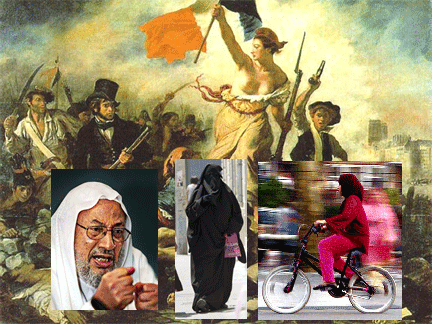
I opened my email this morning and back-to-back there was instant conflict: a posting about a new Indian Deoband fatwa ruling that veiled Muslim women should not ride bicycles and another about a female French lawyer who ripped the face covering off a young Muslim girl in a shopping mall near Nantes, the latter a pre-emptive strike for the pending anti-niqab law in the French parliament. Both rulings strike me as silly, both as overtly political. So now instead of the standard “Death to America” vs. “Muhammad is a child molester” chant wars we have entered the era of dueling over social mores through Fatwa Wars. Although not as erotic as the recent tit-illating fatwa controversy, also involving women’s bodies, the battle lines are still drawn over the same resource: what males do to control women’s bodies and minds.

Let’s start with the Deoband bicycle banning. The commentary by Nigar Ataulla, an Indian Muslim who happens to be female as well as a journalist who enjoys bike riding, called “Cycle Fatwa  Rides into My Re-Cycle Bin” reads:
Continue reading Born Free, unless you are female →
Viagra for Aladdin Lovers


“Sex and the City 2’s” stunning Muslim clichés
It’s hard to overstate the offensiveness of the fabulous four’s exquisitely tone-deaf trip to Abu Dhabi

By Wajahat Ali, Salon, May 26

I’m a heterosexual, Muslim dude who until recently thought pleated khakis and loafers were “hip” and mistook Bergdorf Goodman for an expensive Swiss chocolate. So it is not surprising that 40 minutes into “Sex and the City 2,” a 150-minute cotton candy fantasy accessorized with materialism and fashion porn, I was comatose with boredom.

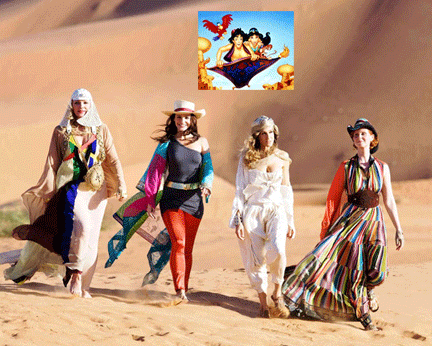
But I was defibrillated by the film’s detour into Abu Dhabi (really Morocco and studio sets) and what can only be described as an Orientalist’s wet dream. After discovering they will visit the Middle East, the ladies whip out hall-of-fame Ali Baba clichés: References to “magic carpet” (a double entendre, naturally), Scheherazade and Jasmine from “Aladdin” come in rapid succession. Upon hearing a stewardess give routine flight instructions in Arabic, Samantha behaves like a wild-eyed child hearing a foreign language for the first time. “I wonder what she’s saying. It sounds so exotic!”

Michael Patrick King’s exquisitely tone-deaf movie is cinematic Viagra for Western cultural imperialists who still ignorantly and inaccurately paint the entire Middle East (and Iran) as a Shangri La in desperate need of liberation from ignorant, backward natives. Continue reading Viagra for Aladdin Lovers →

The Fifth Annual Arab-American Heritage Park Festival

The Fifth Annual Arab-American Heritage Park Festival

Sunday, July 18, From 1-6pm

Prospect Park West, Brooklyn, NY

15th Street Entrance

Presented By: The Arab American Family Support Center & Alwan for the Arts

Bring Your Family & Friends of all ages to Celebrate Arab Heritage

Directions:

F Train to 15th Street/Prospect Park B-68, B-69, or B-75 Buses to Prospect Park West & 9th Street

Enjoy music, cultural performances, savory Arabic food, traditional Arabic shisha, professional henna artists, heritage arts and crafts, face painting, bouncy house, plus enter the raffle to win lots of great prizes!

For more information contact Bret Denning at bret@aafscny.org

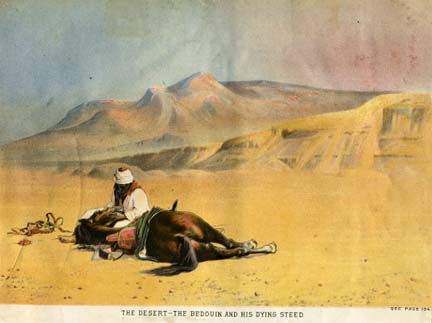
Colorful Lithographic Orientalism #5: Steed

As noted in a previous post, I recently went through a late 19th century scrapbook that belonged to my great, great aunt. She had cut out pictures that interested or amused her. Several of these have Orientalist themes. Sometimes a picture is worth a thousand words; other times the picture says enough for itself. In this series, I leave the image to speak for itself. If you would like to comment on what you see or imagine, please do so in the comments section.

For #4, click here

Divorcing fundamentalism


Nasr Abu Zaid was a brave and honest scholar disgracefully persecuted for his attempts to read the Quran historically

by Brian Whitaker, The Guardian, July 6

The divorce case was what made him famous, though it wasn’t the usual kind of celebrity divorce and Nasr Abu Zayd was still in love with his wife.

Abu Zayd, the liberal Muslim thinker who died yesterday, first came to the attention of Islamists while teaching Arabic literature at Cairo university in the early 1990s. They decided that his research contained “clear affronts to the Islamic faith” and accused him of apostasy.

That in turn inspired a group of Islamist lawyers to file a third-party (“hesba”) case, seeking to divorce him from his wife on the grounds that a Muslim woman cannot be married to an apostate – and after a series of court hearings his marriage was declared null and void.

Such was the controversy after the verdict that Cairo university was “turned into a military fortress” to protect him the next time he made an appearance there. Realising that it was impractical to continue teaching under those conditions, and after one of his guards was heard describing him as “the infidel”, Abu Zayd and his “ex-wife” left Egypt and settled in the Netherlands. Continue reading Divorcing fundamentalism →

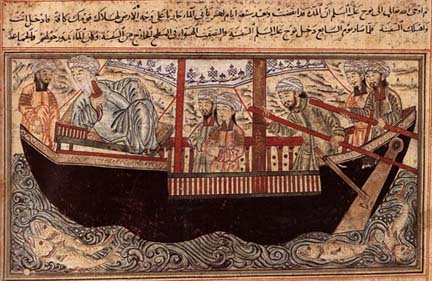
Noah and the ark, seven centuries ago


The story of Noah is shared in the three main monotheisms and still inspires creationists who are convinced that opportunist quasi-Neptunist forces from the great Deluge laid down almost all sedimentary layers on Earth. Above is an illustration from the Jami‘ al-tawarikh, produced in 1314/1315 for the Iranian vizier Rashid al-Din. In this case the ark was not the biblical box but a typical Arab dhow of the time with two masts, two steering oars and a rudder. The manuscript is housed in the Nasser D. Khalili Collection of Islamic Art in London.

Illustration from Art of the First Cities, edited by Joan Aruz (New York: Metropolitan Museum of Art, 2003), p. 491.

Al-Qaeda in the Arabian Peninsula


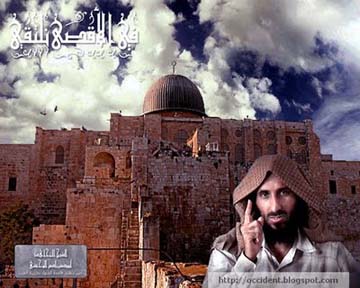
The Amir [leader] of al-Qa’ida in the Arabian Peninsula, Abu Basir Nasir al-Wuhayshi (also transliterated, “Abu Baseer Nasir al-Wahayshi”), in front of a photograph of the al-Aqsa mosque, one of Islam’s holiest shrines, in Jerusalem. The text reads, “At al-Aqsa We Meet.”

Exploiting Grievances: Al-Qaeda in the Arabian Peninsula

Executive Summary
THE PAPER IN A NUTSHELL

• Al-Qaeda in the Arabian Peninsula (AQAP) has been remarkably adept at exploiting the grievances of ordinary Yemenis. The group’s rhetoric, however, only goes so far and has not yet translated into a widespread base of support. In order to prevent AQAP from becoming more deeply entrenched, the Yemeni government must move swiftly to increase governmental visibility and improve the delivery of services at the local level. Failure to do so risks a growing al-Qaeda presence on the Arabian Peninsula with grave consequences for regional and international security.

VITAL STATISTICS
• Al-Qaeda in the Arabian Peninsula (AQAP) is the product of a merger between al-Qaeda’s Saudi and Yemeni branches.
• Estimates of the size of AQAP in Yemen vary from 300 to several thousand. The lower figure likely represents the number of active militants within the organization, while the larger figure includes supporters not actively involved in the group’s day-to-day operations.
• AQAP employs targeted messaging that is consistent with the core tenets of al-Qaeda’s ideology but infused with themes that resonate locally within Yemen.
• According to AQAP, Muslims are suffering at the hands of foreign powers that prop up illegitimate and corrupt local regimes that have failed to provide for their citizens. Continue reading Al-Qaeda in the Arabian Peninsula →

July 4, 1187


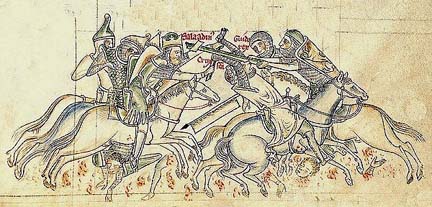
Guy de Lusignan and Saladin in Battle / Mathew Paris, c.1250

[Webshaykh’s Note: July 4 is famous for more than one reason, although firecracker bedlam covers both the annual American celebration as well as a devastating crusader defeat of the Knights Templar almost a millennium ago. The following account is from TemplarHistory.com.]

The Fourth of July, a time for Americans to celebrate their War of Independence from the English in 1776, had an entirely different meaning to medieval Europe. For the Fourth of July, 1187 was to be one of the bloodiest battles of the crusades, the Battle of the Horns of Hattin.

The area is called the Horns of Hattin for the two rocky peaks that rise over the brush covered slopes behind Tiberius on the Sea of Galilee. It was here that Saladin aligned 12,000 of his knights plus an army carrying regular provisions at Tiberius. An army as well mounted and armed as anything that could be assembled by the combined forces of the Templar and Hospitaller orders. On the other side of the battlefield were the crusading forces comprised of 20,000 foot soldiers but only about 1,000 knights. This force, small by comparison, was assembled by depleting the forces of many surrounding cities thus leaving the unarmed cities open to attack.

The Christian army had set out for Tiberius in the early morning hours of July 3rd, leaving in their wake their well-watered camp for the dust and dryness of the desert air. They carried with them that Holy relic so many would die for in coming battles, the True Cross, discovered in 326 CE by the mother of Constantine the Great.

As they made the trek in the hot desert sun they found no water to aid their thirst and in the heavy armor must have been near exhaustion. By evening of July 3rd, the crusading army arrived at a plateau below the Horns of Hattin, which jutted into the air 100 feet above them. Even at this resting spot the Templars and other crusading warriors found no water, as the well was dry and the only stream was blocked. Continue reading July 4, 1187 →