All posts by tabsir

Camels in Vienna


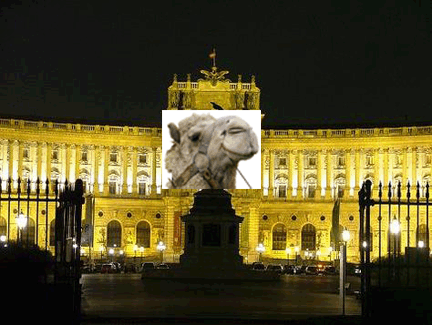
Today I am leaving for Vienna and the forthcoming “Camels in Asia and North Africa
Interdisciplinary workshop” to be held Tuesday & Wednesday 5-6 October, 2010 at the
Austrian Academy of Sciences, AAS, Dr.-Ignaz-Seipel-Platz 2, 1010 Vienna. If you have an interest in any aspect of camels and are near Vienna, Austria, you might want to join in.

Here are the details, also available in pdf from the website.

This workshop aims at a comprehensive discussion on Old World camels (Dromedary and Bactrian camel) including the following topics:
• Origin and domestication
• Conservation of the wild Bactrian camel
• Veterinary folk medicine
• Socio-economic significance: Breeding, caring, trading
• Art: Petroglyphs, poetry and music
• History and Symbolism of camels in Asia and Austria

These issues will be addressed by scholars from the natural sciences as well as from the social sciences and humanities Continue reading Camels in Vienna

Leaves from an old Bible Atlas #5


Hurlbutt’s Atlas, p. 118


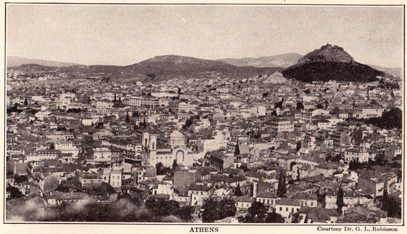
Athens, Hurlbutt’s Atlas, p. 119

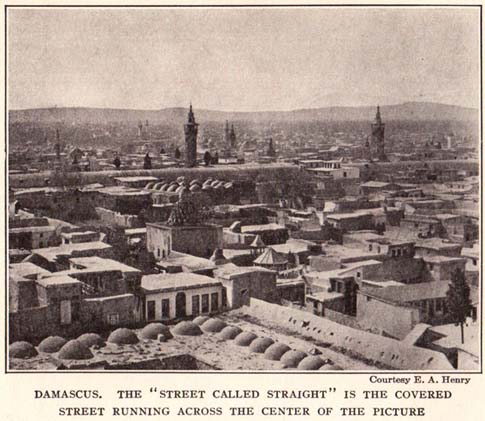
The Christian fascination with the Holy Land as a window into interpretation of the Bible has a long and indeed fascinating history of its own. Here I continue the thread on Jesse Lyman Hurlbutt’s A Bible Atlas (New York: Rand McNally & Company, 1947, first published in 1882). One of the interesting aspects of the accompanying illustrations is the sense that what you see in the photograph is essentially unchanged from the days of Paul’s missionary journeys. Both these images appear to have been taken before the turn of the 20th century.

To be continued …

UN Fact-Finding Mission Says Israelis “Executed” US Citizen Furkan Dogan


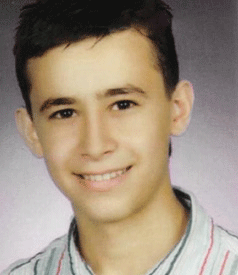
Furkan Dogan, a 19-year-old US citizen of Turkish descent, was aboard the Mavi Marmara when he was killed by Israeli commandos. (Photo: freegazaorg; Edited: Jared Rodriguez / t r u t h o u t)

by Gareth Porter, t r u t h o u t Monday 27 September 2010

The report of the fact-finding mission of the Office of the United Nations High Commissioner for Human Rights (OHCHR) on the Israeli attack on the Gaza flotilla released last week shows conclusively, for the first time, that US citizen Furkan Dogan and five Turkish citizens were murdered execution-style by Israeli commandos.

The report reveals that Dogan, the 19-year-old US citizen of Turkish descent, was filming with a small video camera on the top deck of the Mavi Marmara when he was shot twice in the head, once in the back and in the left leg and foot and that he was shot in the face at point blank range while lying on the ground.

The report says Dogan had apparently been “lying on the deck in a conscious or semi-conscious, state for some time” before being shot in his face. Continue reading UN Fact-Finding Mission Says Israelis “Executed” US Citizen Furkan Dogan

Art Territories

Check out this new website, initiated by Ursula Biemann and Shuruq Harb, this month: ArtTerritories is conceived as an independent platform for artists, thinkers, researchers and curators to reflect on their art practice and engage in critical exchange on matters of art and visual culture in the Middle East and the Arab World. Dedicated to the interview format, the initiative encourages discussion of artistic process with an emphasis on discursive art and media practices, collaborative initiatives, and cultural and institutional politics. ArtTerritories aims to define, connect and expand already existing art communities in the region as well as an ever-growing invested international arts community.”


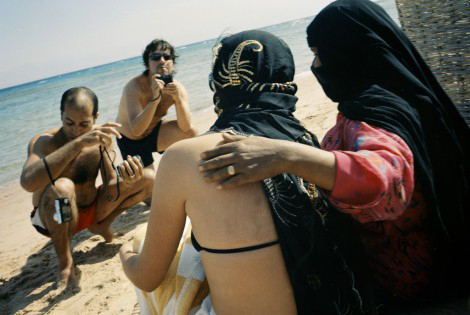
Photograph by Ahmad Hosni, from his Go Down, Moses project

The following is a sample of an interview with photographer Ahmad Hosni.

Ursula: The book is the result of intense but somewhat undirected exposure to desert experience with its chance encounters, local stories and tourist ethnographies, tinted by a literary reading of an eclectic range of writers, some of whom are discussed in the book. Continue reading Art Territories

The Meaning of Islam

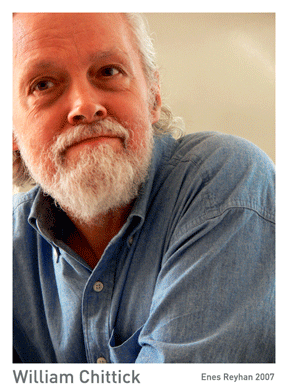
by William Chittick, Huffington Post, September 22, 2010

A few years back, long before 9/11, one of our Religious Studies majors told me that she had taken my course to learn why she should hate Islam. As a normal young American growing up on Long Island, she had no doubt that she should hate Islam, but she still wanted to know what was so bad about it.

There are many historical, political, and cultural reasons for the negative stereotypes of Islam that permeate American society. One of the more obvious is that people confuse religion and ideology.

Scholars often distinguish between “Islam,” meaning the religion as taught and practiced over the centuries, and “Islamism,” meaning the various ideologies that have appeared over the past century claiming to speak on its behalf. As one of these scholars put it, “An ideology is a clear blueprint that requires only mechanical implementation. … It offers easy answers to the most difficult and fundamental questions. … [It] renders redundant the human processes of constantly thinking, evaluating, facing hard choices, and balancing” (Farhang Rajaee, Islamism and Modernism, p. 4). Continue reading The Meaning of Islam

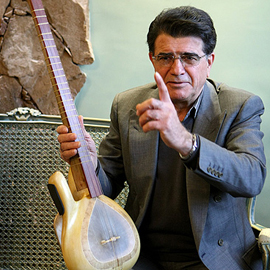
Mohammed Reza Shajarian: Protest Through Poetry


by Steve Inskeep, NPR Morning Edition, September 27, 2010

[NPR this morning has a 7 minute segment on this famous Iranian singer; click on the website for samples of his music.]

Mohammed Reza Shajarian may be the most famous singer in all of Iran.

He’s also Iran’s most famous protest singer — even though, strictly speaking, his music doesn’t directly protest the government at all.

Just before they end their fast each day during the Muslim holy month of Ramadan, many Iranians or people of Iranian descent around the world listen to a prayer sung by Shajarian.

“It has such power, and the power of it has virtually nothing to do with the words,” says Iranian-American scholar Abbas Milani. When Milani hears Shajarian’s recording of the prayer, it transports him back to his youth in Iran.

“When I still hear it, I get a chill to my bone and think that this is not the voice of a mere mortal — this is the gods speaking to us.”

Iranians heard Shajarian’s voice on the radio for decades — and then, suddenly, the music stopped. Shajarian, protesting a crackdown on voters after last year’s disputed election, asked that the government cease broadcasting his songs. Continue reading Mohammed Reza Shajarian: Protest Through Poetry

and where is the city of the future?


Take a look at the picture above. This is the recently operationalized city of Masdar, one that seems to come right off the drawing boards of 2001: A Space Odyssey or at least Star Wars. Imagine a city with zero carbon emissions. Imagine a perfectly planned city from top to bottom, fueled by solar power and clean as the pure desert sand. This one happens to have been built on the desert sand, only a short commute by a carbon-emitting vehicle from the city of Abu Dhabi. Forget the Seven Wonders of the Ancient World; here is Futurama out of the Arabian Nights.

Today’s New York Times has a lengthy article about the architectural feat, designed by Foster & Partners. All it takes is money (lots of money) and visionary architects. In this Disney on Sand there are even battery-powered pod vehicles, which operate underground out of sight and take people from place to place without drivers. The author of the article, Nicolai Ouroussouf, mixes praise with a dose of populist realism and rightly so: Continue reading and where is the city of the future?

On Professor Mohammed Arkoun


Professor Mohammed Arkoun: A Courageous Intellectual Who Advocated A Tolerant, Liberal and Modern Islam

Simerg, September 18, 2010

Algerian born scholar Mohammed Arkoun (February 1, 1928 – September 14, 2010) was a Senior Research Fellow at the Institute of Ismaili Studies and also a member of its Board of Governors, which is chaired by His Highness the Aga Khan

In a tribute to the Algerian Islamic scholar Mohammed Arkoun, who died at the age of 82 in Paris, France, on Tuesday, September 14, 2010, Algeria’s Minister of Culture, Khalida Toumi, said that Professor Arkoun “believed in dialogue between cultures and civilizations of which he was an ardent activist” and “his sincerity and dedication to bringing people and religions together have made him a true messenger of peace and harmony between different societies.” In her condolence message she also stated that he was “the author of books in the field of critical thinking who taught in the most prestigious universities of the East and the West.”

Amongst his peers around the world, Professor Arkoun was regarded as one of the most influential scholars in Islamic studies contributing to contemporary Islamic reform. Continue reading On Professor Mohammed Arkoun