All posts by tabsir

Leaves from an old Bible Atlas #6


Hurlbutt’s Atlas, p. 118

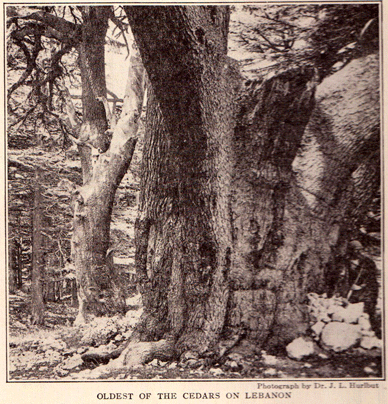
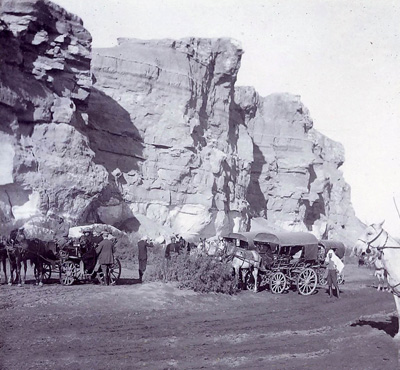
The Christian fascination with the Holy Land as a window into interpretation of the Bible has a long and indeed fascinating history of its own. Here I continue the thread on Jesse Lyman Hurlbutt’s A Bible Atlas (New York: Rand McNally & Company, 1947, first published in 1882). Ah, those cedars of Lebanon, hewn for Solomon’s temple but a few being left for the intrepid explorer, in this case Rev. Hurlbutt himself. Here is his sketch of that temple. Continue reading Leaves from an old Bible Atlas #6

The Surprising Effect of Religious Devotion on Suicide Attacks


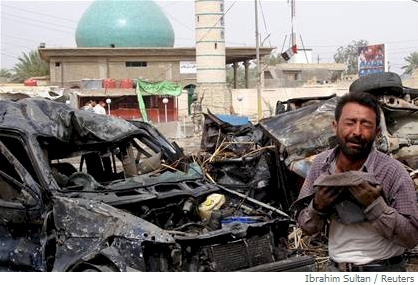
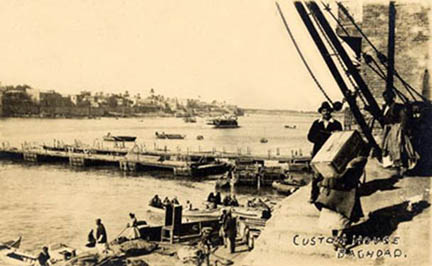
2007 suicide blast at Baghdad hotel

by Matt J. Rossano, The Huffington Post, September 27, 2010

We all have our personal “theories” about what motivates religious terrorists. To go from personal theories to real ones, we need to study the issue scientifically. One recent study draws the provocative conclusion that ritual participation more than religious belief may be behind suicide attacks.

From a scientific standpoint a suicide attack represents an extreme form of parochial altruism — a self-sacrificial act made on behalf of one’s in-group, involving aggression against an out-group. Religious belief, some have argued, is the prime motivator for such an attack. The attacker believes that his or her sacrifice will lead to a glorious reward in the afterlife (e.g., Islam’s famous 70-some-odd virgins-awaiting). This explanation can be called the “belief hypothesis,” and it would predict that those who demonstrate increased devotion to religious beliefs or deities would be more supportive of suicide attacks. In the context of a recent study (Ginges et al., Psychological Science, 20, p. 224), devotion was measured by prayer frequency. Thus, those who prayed more were assumed to be more devoted, and some preliminary analyses confirmed that this was indeed the case. Continue reading The Surprising Effect of Religious Devotion on Suicide Attacks

In Memoriam: Selma Al-Radi


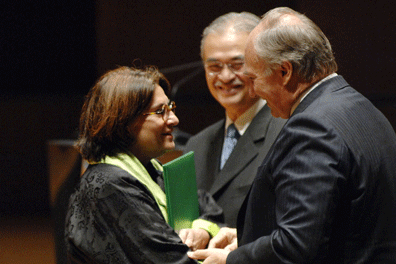
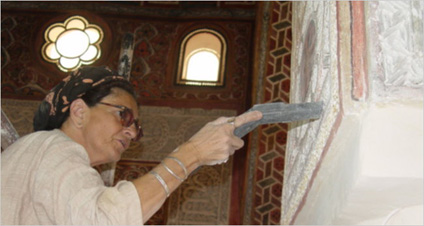
Dr. Selma Al-Radi, the Iraqi project director who restored the Amiriya complex in Rada, Yemen, over a 26 year period, receiving her 2007 Aga Khan Award for Architecture. The winners are being congratulated by Malaysian Prime Minister Badawi and His Highness the Aga Khan. Photo credit: AKDN/Gary Otte

Selma Al-Radi died peacefully at her home in New York City on October 7, 2010. She was 71 and was surrounded by family and friends. Often described as “a force of nature” by many, she was slowly robbed of that energy by her Alzheimer’s affliction, leaving a ruin that was rapidly demolished by ovarian cancer in a little over a year after symptoms were first detected.

Selma was born on 23 July 1939 in Baghdad and grew up in many countries but largely in Iran and India where her father served as the Iraqi Ambassador for a number of years. She graduated from Cambridge University in Archaeology and Ancient Semitic Languages, and earned her Master’s degree at Columbia where she came under the influence of her lifelong mentor, the late Dr. Edith Porada. She obtained her PhD at the University of Amsterdam but remained under the mentorship of Dr. Porada along with Dr. Maurits van Loon. Her thesis work focused on a Neolithic site in Cyprus (Phlamoudhi Vounari).

A consummate “dirt” archaeologist, working mainly on excavations in the field, Selma excavated on sites in most of the Middle East including Iraq, Syria, Turkey, Lebanon, Kuwait, Egypt, and Yemen. But Yemen was where she would spend much of her career. Continue reading In Memoriam: Selma Al-Radi

Nawal El Saadawi on Osama Bin Laden


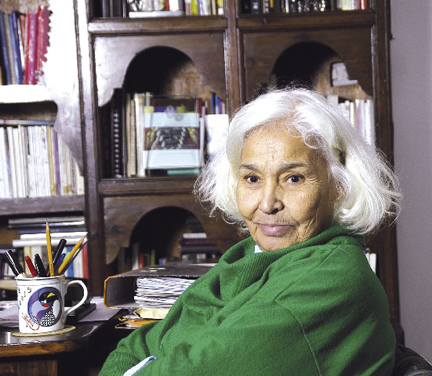
Nawal El Saadawi


Nawal El Saadawi: Leftist support of Taliban is short-sighted

by Sahar Saba, Viewpoint, Pakistan, September 10, 2010

Award-winning Egyptian writer and feminist Nawal El Saadawi hardly deserves an introduction. Author of over forty books—-translated to over 30 languages—-she has inspired women all over the world but particularly in Muslim world with her writings as well as courageous struggle against obscurantism. She has faced threats to her life, was fired from job by Egyptian authorities and imprisoned, has seen her books banned, even went in exile but has been steadfast and vocal when it comes to women rights and socialism.

Sahar Saba:
Osama bin Laden’s act nine years ago became instantly popular all over the Muslim world. Now after nine years, in your assessment, how has the Muslim/Arab world benefitted or suffered as a result of September 11?

Nawal El Saadawi:
After nine years of September 11, nobody has benefitted from Sept 11 except global and local powers who started the colonial oil war and triggered religious conflicts in the Arab region. Continue reading Nawal El Saadawi on Osama Bin Laden

Blogging Islamophobia


Blogger Pamela Geller and Imam Feisal Abdul Rauf

How the “ground zero mosque” fear mongering began

BY JUSTIN ELLIOTT, Salon.com

A group of progressive Muslim-Americans plans to build an Islamic community center two and a half blocks from ground zero in lower Manhattan. They have had a mosque in the same neighborhood for many years. There’s another mosque two blocks away from the site. City officials support the project. Muslims have been praying at the Pentagon, the other building hit on Sept. 11, for many years.

In short, there is no good reason that the Cordoba House project should have been a major national news story, let alone controversy. And yet it has become just that, dominating the political conversation for weeks and prompting such a backlash that, according to a new poll, nearly 7 in 10 Americans now say they oppose the project. How did the Cordoba House become so? Continue reading Blogging Islamophobia

A Comic Approach to Tragedy


A novel, even comic, approach to combating terrorist acts by extremist Muslims in South Asia is currently underway in Indonesia. This is a comic book about Ali Imran, who engineered the 2002 bombing of a hotel in Bali. Through the life story of the bomber, the story urges young Muslims not to be duped by anyone praising suicide bombing as an Islamic duty. For a video account of the book on Al Jazeera, click here.

Spiritual Malaria?


by Nadeem F. Paracha, blog.dawn.com, July 1
 
A recent fatwa from a ‘Saudi Council of Muftis’ has this advice for fellow
Muslims: Do not say [or write] ‘mosque.’ Always say ‘masjid’ because mosque
may mean mosquito. Another myopic case of Saudi malaria perhaps?

Certainly. But that’s not all. The grand fatwa goes on to suggest that
Muslims should not write ‘Mecca’ but Makkah, because Mecca may mean ‘house
of wines.’ I am serious. But then so are the Muftis. They certainly need to
get a life.

But I’m not all that surprised by such fatwas that usually emanate from
Saudi Arabia. While vicious reactionary literature originating in
totalitarian puritanical Muslim states impact and mutate the political
bearings of various religious parties and groups in Pakistan, ‘social
fatwas’ like the one mentioned above also began appearing in the early 1980s
to influence the more apolitical sections of Muslim societies.

Reactionary literature generated by the Saudi propaganda machine started
being distributed in Pakistan from 1979 onwards, mostly in the shape of
pamphlets and books.

Duly translated into Urdu, they glorify and propagate violent action (jihad)
not only against non-Muslims (or infidels) but also against those Muslims
who fail to follow the thorny dictates of a certain puritanical strain of
the faith. Continue reading Spiritual Malaria?