All posts by tabsir

Inventing Muslims: 1001 Inventions Exhibit now in New York

New York launch for 1001 Inventions

1001 Inventions at the New York Hall of Science Uncovers a Thousand Years of Science and Technology Developed Throughout Muslim Civilization.

Five-Year Global Tour Makes U.S. Debut Following Record Breaking Runs in London and Istanbul

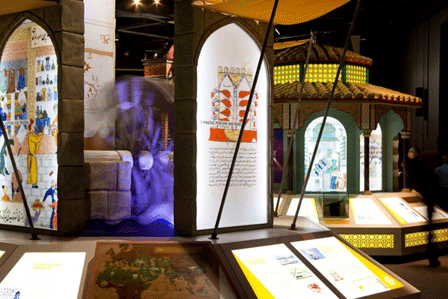
17 November 2010, New York — After blockbuster runs in London and Istanbul, 1001 Inventions, an exhibition highlighting the scientific legacy of Muslim civilization in our modern age, will make its United States premiere at the New York Hall of Science (NYSCI) on December 4, 2010.

The exhibition reveals the forgotten history of men and women from a variety of faiths and backgrounds whose contributions to the advancement of scholarship and technology during the Middle Ages helped pave the way for the European Renaissance. This period of history from the 7th through 17th centuries is commonly–though, often erroneously—referred to as the “Dark Ages.”

The centerpiece of the exhibition is a 20-foot replica of Al-Jazari’s “elephant clock,” which dates to the 13th century. Other signature elements include a model of a ninth century flying machine and a scale model of a Chinese junk ship built in the 15th century. Divided into seven zones, 1001 Inventions includes more than 60 interactive exhibits that delve into discoveries that shaped the home, school, market, hospital, town, world and universe. Visitors will learn when scientists first discovered how we see, how ancient approaches to health influence modern medicine, why East and West share so much architectural heritage, and the origins of everyday items like coffee, toothbrushes, soap, and much more. Continue reading Inventing Muslims: 1001 Inventions Exhibit now in New York

Translating Arabic Literature


Cambridge Arabic expert made executive editor of five-year project, University of Cambridge, November 29, 2010

James Montgomery, Professor of Classical Arabic at Cambridge University, has been appointed as Executive Editor of a five-year project at the Library of Arabic Literature (LAL).

He will work in conjunction with Professor Philip Kennedy (General Editor and Faculty Director, NYUAD Institute) and Shawkat M. Toorawa, (Executive Editor and Associate Professor of Arabic and Islamic Studies at Cornell University).

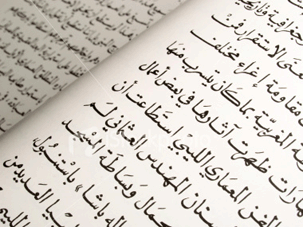
The project, funded by a grant from NYUAD’s research centre, the NYU Abu Dhabi Institute, will initially publish 35 English translations of the great works of classical Arabic literature. The translations, rendered in parallel-text format with Arabic and English on facing pages, will be undertaken by renowned scholars of Arabic literature and Islamic studies. The translations will include a full range of works, including poetry, poetics, fiction, religion, philosophy, law, science, history and historiography. Continue reading Translating Arabic Literature

Rebuff the Radicals


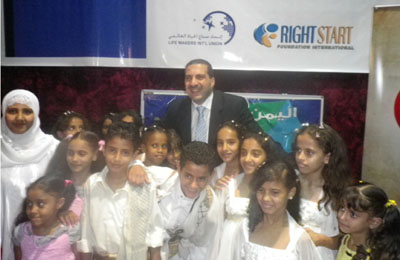
The Egyptian televangelist Amr Khaled with a group of young Yemeni performers at the opening ceremony of a new campaign to combat religious extremism in Yemen. Yemen Times photo

by Tom Finn. Yemen Times, November 25, 2010

ADEN, Nov. 23 — A campaign has been launched by the Yemeni government to win over Yemeni hearts and minds, in a battle to confront extremist ideology and favour Islam’s moderation.

The project was launched on Wednesday at an opening ceremony in Aden attended by the Deputy Prime Minister and representatives from the Ministries of Tourism, Culture and Justice.

As well as an array of performances by Yemeni children, the ceremony included a speech by Amr Khaled, the world renowned Egyptian televangelist, whose organization, the Right Start Foundation, will be leading the two week project to confront religious extremism in Yemen. Continue reading Rebuff the Radicals

Afghan Trucks 1

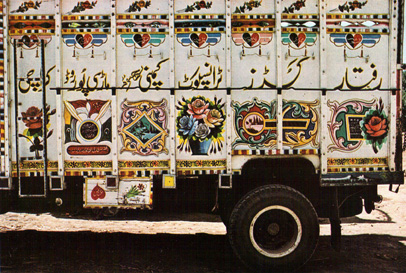
Way back in 1976 I picked up a delightful photographic book called Afghan Trucks, published by the Stonehill Publishing Company in New York. The photographer was Jean-Charles Blanc, who obviously had a far easier time trucking around Afghanistan than a photographer would today. The brief introduction says nothing about the photographer. It does say a lot about Afghan drivers:

“The driver and his mates are conditioned to a hard, lonely, even painful life, but its austerity is brightened by the dazzling exterior decor of the truck. Flowers transform it into a moving oasis: with rows of tulips and bouquets of roses clinging to its sides, the Afghan truck is like a traveling art gallery wending its way through arid mountains and deserts. Continue reading Afghan Trucks 1

Worse than Vietnam


by Robert Wright, The New York Times, Opinionator, November 23, 2010

“We did the Cole and we wanted the United States to react. And if they reacted, they are going to invade Afghanistan and that’s what we want … . Then we will start holy war against the Americans, exactly like the Soviets.”
— Mohammed Atef, military commander of Al Qaeda, in November of 2000

You have to give the people at Al Qaeda this much: They plan ahead. And they stick with their goals. If bombing the U.S.S. Cole failed to get American troops mired in Afghanistan, maybe 9/11 would do the trick?

You might say. Last week at the NATO summit President Obama pushed the light at the end of the tunnel further down the tracks. By the end of 2014, he now tells us, American combat operations in Afghanistan will cease.

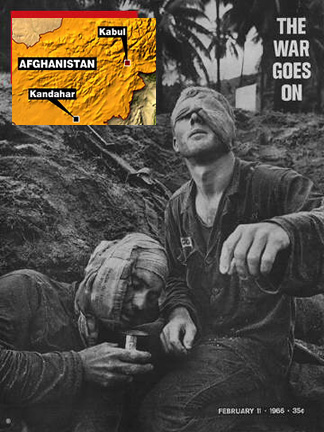
It’s not as if we need those four years to set any records. At just over nine years of age, this war is already the longest in American history. And this Saturday we’ll eclipse the Soviet Union’s misadventure in Afghanistan; the Soviets brought their own personal Vietnam to an end after nine years and seven weeks.

Is Afghanistan, as some people say, America’s second Vietnam? Actually, a point-by-point comparison of the two wars suggests that it’s worse than that. Continue reading Worse than Vietnam

Raising Dust in Palestine


Sword dance at a Bedouin wedding in Palestine, early 1900s; Rowe 2010, opposite p. 116

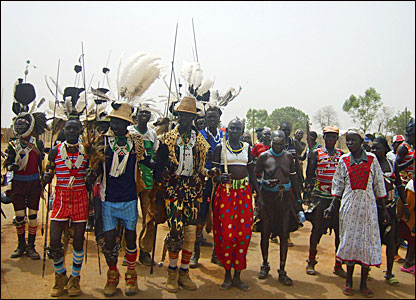
We hear so much about the political turmoil between Palestinians and Israelis that the traditional culture and its transformation are all but forgotten. Bombs continue to go off or be dropped, settler slabs destabilize the opportunity for a variety of people to live together, hawks and doves flitter away in a rhetorical fog. Yet there is movement, especially in dance. Nicholas Rowe, a choreographer and dancer from Australia has recently published a moving portrait of the changing dance tradition among Palestinians, with a focus on how dance reflects political stalemate and obstacles. This is his Raising Dust: A Cultural History of Dance in Palestine (London: I. B. Tauris, 2010).

A brief description of the book is provided by the publisher: Continue reading Raising Dust in Palestine