All posts by tabsir

Belly Dance a century ago


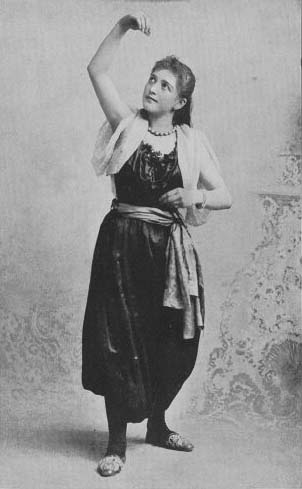
Little Egypt

There are several fascinating videos uploaded on Youtube of belly dance more than a century ago. One is a very short clip of 14 seconds from 1895 of a dancer named “Princess Ali.” Another is an early Edison film of Ella Lola, made in 1898, combined on Youtube with a 1900 track of Turkish music. The video lasts over three minutes. Ella was in costume, but another early video from 1904 shows “Princess Rajah” in the dress of the day dancing away her hoochie koochie as a circus act complete with chair. The queen of the art, at least in hindsight, was “Little Egypt,” who is also to be found in a clip from a movie about striptease. Although not an original film video, there is an interesting Youtube video with vintage “Orientalist” commentary about Egyptian and other North African belly dance at the 1889 L’Exposition Universelle, especially along “La Rue du Caire.”

For an overview of belly dance, see the excellent article by Najwa Adra.

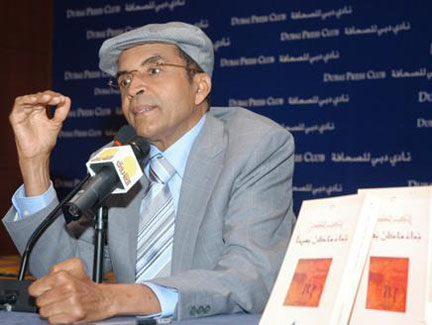
Libya’s novelist Ibrahim al-Koni wins Arab Novel Award


Al-Arabiya, December 16, 2010

CAIRO (Arab Media House)

Libyan novelist Ibrahim al-Koni received in Cairo the Arab Novel Award and dedicated the value of the prize to the children of the Tuareg tribes from which he originally hails.

At the closing ceremony of the fifth round of the Cairo Novel Conference, prominent Libyan author Ibrahim al-Koni was chosen from 23 competitors to receive the Arab Novel Award, whose value is 100,000 Egyptian pounds ($18,000).

“Koni was chosen for his ability to breathe life into the desert on the human, natural, spiritual, and mythological levels,” said Syrian critic Sobhi Hadeedi, who headed the jury.

The committee in charge of choosing the winner praised Koni’s ability to utilize folklore, oral tradition, death rituals, and aspects of everyday life in order to create a literary work.

“He creates his own individual anthropology,” added the committee statement. Continue reading Libya’s novelist Ibrahim al-Koni wins Arab Novel Award

Sailing Forbidden Coasts


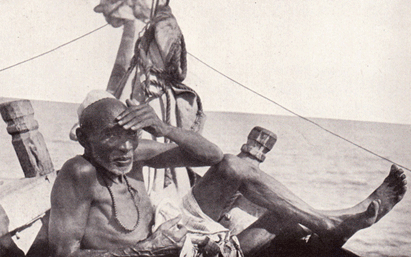
Sheik Issa Embarks on the ‘Altair’ for Arabia. He is honored and respected among the Danakil as a leader and saint. Not only was he a gracious host, but he offered to accompany the Altair’s party from the Somali coast over to Arabia, in order to afford them protection from pirates.


[Webshaykh’s Note: Much attention has been given to the Somali pirates loose in the Gulf of Aden. Piracy is no stranger to this corner of the Horn of Africa, nor to seafaring anywhere in history. Here is an excerpt by an American woman visiting the French Somaliland coast in 1930. Ms. Treat indeed provides a colorful narrative treat of her journey aboard a dhow captained by a French convert to Islam. The whole article is well worth reading, as the following excerpt suggests.]

by Ida Treat, The National Geographic Magazine, 1931

Wading through the warm lagoon, breast deep, we crossed the damp sand among the mangroves, treading down the rubbery shoots among which lay quantities of black sea snails, for it was low tide. Beyond the mangroves, the beach stretched bare and white to the four huts, bleached as driftwood, and of so light a construction it seemed that a puff of wind would scatter them across the sand.

Two downy baby camels, in a narrow inclosure of mimosa thorns, darted snakelike necks through the ranches as we passed. From the largest of the huts a man came toward us. I recognized Sheik Issa, whom I had sen at Obock, his lean torso bare, the wooden prayer beads about his neck, swinging across the sand with a vigorous, youthful stride, for all his sixty-odd years.

The day before he had sent the Altair from the heights of Djebel Ghin and had walked all night to be at Angar to welcome us. Continue reading Sailing Forbidden Coasts

Islam, Science and Creationism


Islam, Science and Concerns About Creationism in the Classroom

by Jalees Rehman, Assistant Professor of Medicine, University of Chicago, The Huffington Post, January 3, 2011

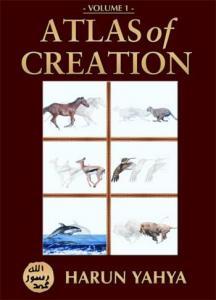
I have often been asked why we scientists are so resistant to introducing ideas such as “creation science” in the biology classroom. My first reaction is to say that these ideas are not really scientific and therefore do not belong in a biology class, and I would be similarly opposed to teaching lacrosse rules or musical “song and dance” routines in a biology class. I have also realized that one of my key concerns is the harm that teaching creationist ideas in a biology classroom can do to the development of scientific thought in schoolchildren. I will first briefly illustrate some aspects of scientific work in biology, and then I will use a specific example from recent Muslim creationist literature to show how it can be potentially detrimental for students who want to develop rigorous scientific thought. For the purpose of brevity, I will use the all-encompassing term “creationism” to describe beliefs based on religious scriptures about the development of life on earth. An in-depth discussion of the different types of creationism can be found in the excellent overview by Ronald Numbers entitled “The Creationists: From Scientific Creationism to Intelligent Design”. Continue reading Islam, Science and Creationism

THE STORY OF PYRAMID THOTHMES


Sphinx and Pyramid at Giza

THE STORY OF PYRAMID THOTHMES

THOTHMES, who loved a pyramid,
And dreamed of wonders that it hid,
Took up again one afternoon,
His longest staff, his sandal shoon,
His evening meal, his pilgrim flask,
And set himself at length the task,
Scorning the smaller and the small,
To climb the highest one of all.

The sun was very hot indeed,
Yet Thothmes never slacked his
Until upon the topmost stone
He lightly sat him down alone
To make himself some pleasant cheer
And turned to take his flask of beer,
For he was weary and athirst. Continue reading THE STORY OF PYRAMID THOTHMES