All posts by tabsir

What the Arab papers say

The Economist has a roundup of views from the Arab press on the unfolding events in Egypt (in English translation):

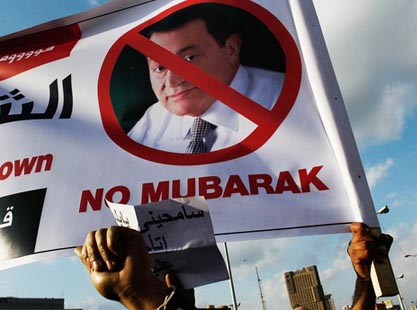
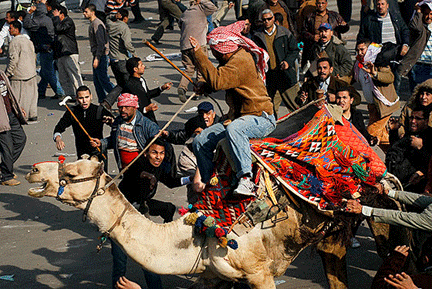
THE Arab press has been following the unrest in Egypt closely since the country’s first “day of rage”, over a week ago.

In Al Shorouk, an independent Egyptian daily newspaper, Emad El Din Hussein describes the sudden disappearance of religious and political barriers that have divided Egyptians in the past decades:

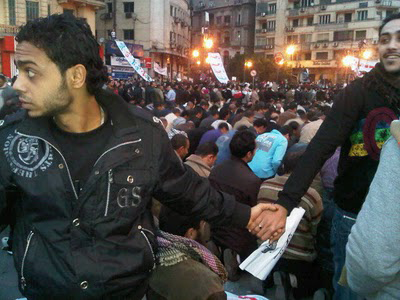
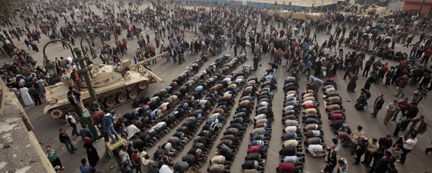
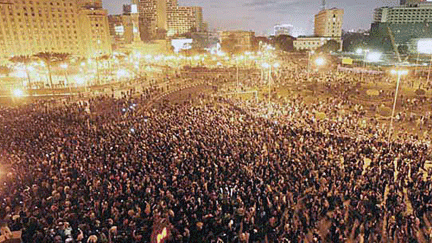
I swear by Almighty God that I cried with joy to see Egypt reborn in Tahrir Square on Tuesday night…Members of Muslim Brotherhood, Nasserists and Marxists were all present; you could recognize them from their physical appearance and the way they spoke or dressed. But they were few and far between…The majority of those present were ordinary citizens…thousands of people mingled together shouting different slogans and singing together…other demonstrators sat talking about poverty, unemployment and violation of human dignity.

Continue reading What the Arab papers say

Dawn

by Sherifa Zuhur, Sociology of Islam and Muslim Societies, February 1, 2011

I find it very difficult to assemble emotions, memories and impressions to respond to the events in Tunisia and Egypt. I have been responding sharply to others who seized the moment to offer their analysis. Certain characterizations of Egyptians did not sit well with me. I also fear that specific arguments are easily manipulated — that the centers of power who have so deftly dominated the media, huge sums of money and many segments of national elites will thwart the resurgence of popular resistance and demonstration of public will. But since those consulted by Barry and Joe and their “teams” are hard at work, spreading fear of a future Egypt non-compliant with the terms of Camp David, conjuring up the Islamist bogeyman, and (one fears) holding Hosni’s hand, we too should speak.

A group of Tunisian friends joined my Facebook page and share their jubilation and updates with me. Their example has inspired Egypt, however, to attribute events in Egypt to Tunisia, or social media and the impact of al-Jazeera would be wrong. Underlying events are Egyptians’ own lengthy struggles and perceptions that transformation is possible. To some degree, fear of counter-revolution is what froze civil expression in Egypt when the communists, the workers and the Muslim Brotherhood were each treated as intolerable threats to the Nasser government. Student activism became possible again in Sadat’s era, but firm rules were established about the “forbidden topics” (the infitah, peace with Israel, corruption, Saudi Arabia etc.) People complied, or they suffered professional defeat, exile, or worse. Then, for many years, violent attacks – against government officials, against judges, policemen, continued up to the crescendo of the firebombing of buses in Tahrir square and the massacre of tourists at Luxor. When the truce with the Gama’at Islamiyya and then Gihad Islami (Islamic Jihad) were achieved, the detentions, torture, and suspension of civilian liberties could have been lifted, but they were not. This year, I spent some time studying instances of extrajudicial actions versus what is acknowledged as state terror. Perhaps they differ in volume, but not in effect. We are speaking of drowning in cold water, the use of dogs, hanging, beatings, electrocution, and threats to family members. These were the weapons of government and are responsible, at least to some degree for the emergence of figures like Ayman al-Zawahiri. In the 2000’s as new “terror” threats emerged, the Minister of the Interior and his employees arrested thousands in the Sinai and elsewhere, and these tactics continued as well as public beatings and confrontations with demonstrators. The emergency laws were extended again, and again. Continue reading Dawn

Other despots should quail


We’ve Waited For This Revolution For Years. Other Despots Should Quail
By Mona Eltahawy, The Observer, January 29, 2011,

My birth at the end of July 1967 makes me a child of the naksa, or setback, as the Arab defeat during the June 1967 war with Israel is euphemistically known in Arabic. My parents’ generation grew up high on the Arab nationalism that Egyptian president Gamal Abdel Nasser brandished in the 1950s. But we “Children of the Naksa”, hemmed in by humiliation, have spent so much of our lives uncomfortably stepping into pride’s large, empty shoes.

But here now finally are our children – Generation Facebook – kicking aside the burden of history, determined to show us just how easy it is to tell the dictator it’s time to go.

To understand the importance of what’s going in Egypt, take the barricades of 1968 (for a good youthful zing), throw them into a mixer with 1989 and blend to produce the potent brew that the popular uprising in Egypt is preparing to offer the entire region. It’s the most exciting time of my life. Continue reading Other despots should quail

Good Sufi, Bad Muslims


by Omid Safi, Sightings, January 27, 2011

One of the lower points in the Park51 Center controversy was the comment by New York Governor David Paterson: “This group who has put this mosque together, they are known as the Sufi Muslims. This is not like the Shiites…They’re almost like a hybrid, almost westernized. They are not really what I would classify in the sort of mainland Muslim practice.”

In a few short sentences, the governor managed to offend Sufis, Shi’i Muslims, as well as westernized Muslims, non-westernized Muslims, and “mainland Muslims” (whoever they are). Paterson overlooked the fact that some Shi’i Muslims are mystically inclined, and that six million American citizens are Muslims, thus there is no question of “westernizing” or “almost westernizing” for them. There is a more disturbing implication hiding in his assertion: the ongoing way in which the general demonization of Muslims, of the kind now routine on Fox News, is accompanied by an equally pernicious game of Good Muslim, Bad Muslims.

There are many versions of this game, but the basic contour stays the same: The assertion that the general masses of Muslims are evil, terrorist-supporters, anti-western, patriarchal, misogynist, undemocratic, and anti-Semitic; and that these masses are set off and defined against either the solitary, lone Muslim good woman or man. The “Good Muslim” is often an individual, or a small circle, because to admit that the larger group of Muslims could be on the right side of the human-rights divide is to have the house of cards of the Muslim demonization game collapse on itself. Continue reading Good Sufi, Bad Muslims

Youtubing the current wave of Egyptian protests


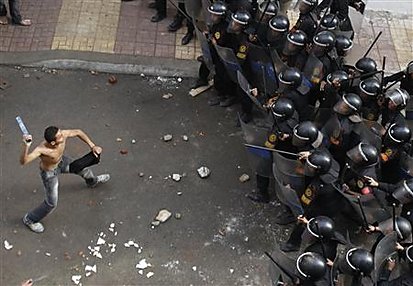
An Egyptian Christian clashes with Egyptian riot police in front of the the Coptic Orthodox church in Alexandria, 230 km (140 miles) north of Cairo January 1, 2011; Photo, Reuters

Tunisia lost a dictator and this has heartened critics of other regimes, especially with seemingly for-life leaders, to take to the streets and, nowadays, to youtube. New videos are posted around the clock. Here is one from a day ago, but you can easily follow a thread. The mainstream media always sanitize the news and views, but the amateur Youtube videos are almost always out of context and prone to exaggerate what is really going on. But there is indeed unrest in the streets and it is not yet played out. There is an account of what is going on in today’s New York Times.

Sunni-Shi’a Relations in Mamluk and Ottoman Contexts


by Stefan Winter

There is a wealth of literature on Sunni-Shi’a relations relating to many periods and places of Islamic history. I attach a brief list of titles on the Mamluk and Ottoman cases with which I am familiar below.

Beyond that, however, there is probably a good reason why “this confrontation” and “its new relevance in today’s politics” is dealt more with in journalistic analyses than scholarly works. To link all instances of conflict or contact between given Sunni and Shi’a actors throughout Islamic time and space, from Pakistan to Lebanon, from Siffin to Doha, to a single ongoing confrontation, as modern observers often do, is reductionist at best.

Of course there is a fundamental theological dispute between Sunnism and Shiism and there has been no shortage of wars and communal disturbancesthat expressed themselves along sectarian lines. But such events invariably also had political and economic causes that must be investigated in their own specific context, and they should not mask the far more numerous instances when the supposed Sunni-Shii dichotomy explains absolutely nothing of, or is downright contradicted by, political events, from the Ayyubids’ tactical alliances with the Ismailis, to the Ottomans’ commercial relations with the Safavids and recourse to Shii tax farmers, to Iran’s intermittent support of Gülbuddin Hekmatiyar to the posters of Hasan Nasrallah you see all over the (conservative Sunni) suq in Aleppo today. Continue reading Sunni-Shi’a Relations in Mamluk and Ottoman Contexts