All posts by tabsir

Vote for Sanaa Water


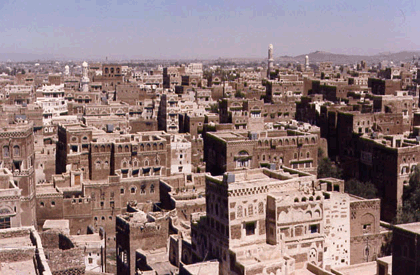
There is currently a contest for interesting sustainable living concepts in the Philips Livable Cities Award. One of these is about collecting rainwater in the Yemeni capital from rooftops. There is a short video on this that can be accessed here. You need to scroll down to the option called “Rainwater Aggregation.” Voting continues until March 24, 2011. If you vote, you might win a trip to the handing out of the award in The Netherlands.

On Egypt and Islam

Uprising in Egypt: Islam and the compulsion of the political
by Jeremy F. Walton, The Immanent Frame (SSRC), February 23, 2011

Invariably, contemporary discussions of Islam seem to begin and end with the relationship between Islam and politics—both anti-Islamic pundits and critics of Islamophobia vigorously assert that the mechanics and kinetics of this relationship are central to the evaluation of Islam today. A nexus of paranoia, fear, ignorance, and old-fashioned bigotry typically animates arguments on one side, while those on the other tend toward the polemics and apologetics of subaltern critique. Both camps, however, assume that discussions of Islam necessarily traverse and trouble the domain of the political. This exclusive emphasis on the political marks the difference between Islamphobia à la mode and the older Orientalist discourses of Edward Said’s interrogation: unlike today’s Islamophobia, classical Orientalism constituted a total romance of the East that subsumed political, aesthetic, religious, and cultural forms. In contrast, contemporary Euro-American public debate about Islam evinces what I call the compulsion of the political. While this compulsion achieved hegemony rapidly in the wake of September 11, 2001, it stretches back at least to the seventies and eighties, with high water marks during the Iranian Revolution and the Rushdie Affair.

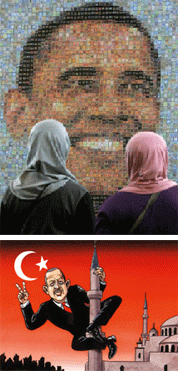
Much commentary on the recent events in Tahrir Square, throughout Egypt, and across the Middle East has inevitably recapitulated the compulsion of the political in relation to Islam. Despite the deeply ambiguous relationship between the Egyptian pro-democracy demonstrations and politically-oriented Islamic organizations such as the Muslim Brotherhood, pundits from across the political spectrum have seized on the relationship between Islam and politics as the crux of the matter. Arguments have crystallized around two poles, dystopian and utopian, respectively: either the dismantling of Hosni Mubarak’s autocracy will yield the nightmare of a theocracy led by the Muslim Brotherhood (as Ayaan Hirsi Ali fulminated in the New York Times on February 3), or the post-Mubarak era will witness the triumph of pluralist, liberal democracy, with the Muslim Brotherhood as one prominent voice among a multitude (as Tariq Ramadan asserted in a recent interview on al-Jazeera). Continue reading On Egypt and Islam

A Geography Lesson from 1879: #3: Racial as Facial


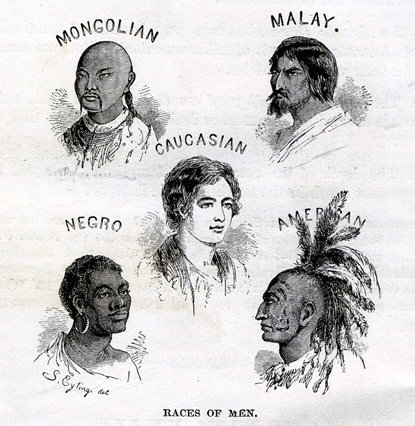
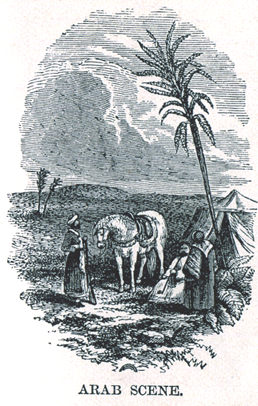
In a previous post I provided an account of the five different states of civilization from an 1879 geography text once owned by my great, great aunt. Apparently the author was enamored with the number “five,” since he also divided the human race into five distinct races. Let’s face it, race at the time was a visual matter of face (and hair) and notice in the image above who was in the middle. Here is the breakdown:

“1. The people inhabiting the different regions of the globe have been divided into five varieties, or races; namely, the Caucasian, or European; the Mongolian, or Asiatic; the Ethiopian, or African; the Malay; and the American or Indian.
2. The Caucasians are distinguished for their light complexion and straight hair. They inhabit nearly the whole of Europe, southwestern Asia, and a large part of America. The comprise the most enlightened and civilized nations of the world. Continue reading A Geography Lesson from 1879: #3: Racial as Facial

Tribal Mediation in Yemen


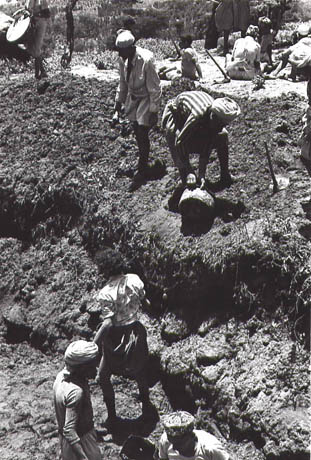
Community cleaning of cistern in al-Ahjur, 1979; photograph by Daniel Varisco

TRIBAL MEDIATION IN YEMEN AND ITS IMPLICATIONS TO DEVELOPMENT

by NAJWA ADRA, AAS WORKING PAPERS IN SOCIAL ANTHROPOLOGY
2010, Volume 19: 1–17.

Introduction

An international phenomenon that has captured the interest of scholars and international development organizations is a continued tendency to resolve conflict through indigenous methods rather than in state courts (Chirayath et al.; Corrin Care 2000; Syria-News.com; UNDP). In Yemen, as in countries as diverse as Kenya and the Solomon Islands, traditional justice is often perceived as familiar, transparent, and participatory. Its focus is reconciliation rather than punishment (Dempsey and Coburn 2010; Dimitrijevic 2006). Specifically in Yemen there is considerable flexibility and adaptability in indigenous tribal procedures and decisions, more so than one usually finds in state justice systems, and decisions are restitutive rather than coercive. Furthermore, indigenous dispute mediation, where fi nes are shared by the entire community, is less costly than the formal legal system. On the other hand, there are concerns that traditional justice may perpetuate social hierarchies by favoring the powerful or discriminating against women (Corrin Care 2000; Kameri-Mbote 2005; Kollapen 2005; Tripp n.d.). In Yemen, as elsewhere, “local strongmen” may co-opt traditional mechanisms by using force in ways that would not have been permitted historically (Dempsey and Coburn 2010). Political scientists worry that resort to traditional justice may undermine state sovereignty.

In this article, I explore these issues as they apply to self-identified tribal communities in Yemen’s Central Highlands through case studies of mediation that I collected during extensive fieldwork between 1978 and 2005 in al-Ahjur. Continue reading Tribal Mediation in Yemen

Winners and Losers in a Post-Mubarak Arab World

By Yousef Munayyer, Palestine Center, The Jerusalem Fund, February 14, 2011

Thirty years ago the Soviet Union was at the beginning of a long campaign in Afghanistan, the average person was lucky to have an advanced recording technology called a “VHS tape,” and Mohammad Hosni Mubarak took control of Egypt, the most populous nation in the Arab Middle East. This week, the last of these beginnings came to an end when millions of Egyptian protestors succeeded in toppling one of the longest standing rulers in the 5,000-year history of Egypt.

But as with all eras, Hosni Mubarak’s established norms, some national and others regional, which have now irreversibly changed. What type of government may take form in Egypt in the coming weeks and months is yet to be seen, however, it is highly unlikely that any new government can afford to repeat the mistakes of the previous regime which eliminated pluralistic political participation in the formulation of both domestic and foreign policy.

Many different global players had an investment in the outcome of the drama that finally concluded in Egypt with Mubarak’s departure. So after this transformational moment, who are the winners and who are the losers?

The Winners

1. The People of Egypt – After only 18 days, the people of Egypt succeeded in removing a ruler who had governed Egypt for three decades. But the victory for the people of Egypt is far greater than the removal of one person like Mubarak or his family. Continue reading Winners and Losers in a Post-Mubarak Arab World