All posts by tabsir

Northrop Frye and the Qur’an


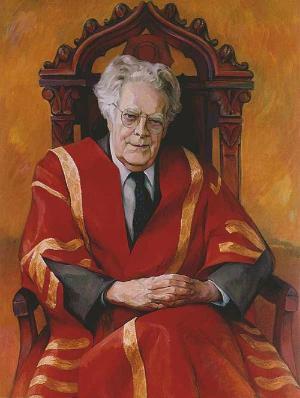
Northrop Frye

by Todd Lawson, University of Toronto, Dept. of Near and Middle Eastern Civilizations

In the course of my ongoing research project, studying the Qur’an as a special instance of apocalyptic discourse, I have found that the writings of Northrop Frye hold important clues and suggestions for both the apocalyptic élan of the Qur’an and the related problem of the Qur’an’s status as a specific form of epic. The two seem to go together and I am exploring these cross-pollinating and mutually energizing literary dynamics in the book that will result. In the meantime, I have found that Frye deserves to be mined more deeply for what is obviously his irresistible interest in the Qur’an.

Over the last two years, I have conducted a grad seminar at the University of Toronto entitled “The Quran and the Apocalyptic Imagination.” A large part of the discussion in this course has focussed on Frye and what he might have to say about the Quran. I have also conducted an undergraduate seminar “How Does the Qur’an Mean” in which two texts have been assigned: the Qur’an and Frye’s Double Vision. It has been a revelation. In part, this has been an attempt to have a conversation that I never had the nerve to initiate while the great man was alive and working away happily, virtually across the street. In any case, the results have been extremely encouraging. I am now delving deep into the Frye archive and studying his marginalia and other related documents.

Frye’s explicit references to Islam and the Qur’an, though few, have long been in print. I am calling for a workshop to see if we can manage a coherent discussion around this general theme. Continue reading Northrop Frye and the Qur’an

Aesop’s Fabulous Camels (and an Ass) #2


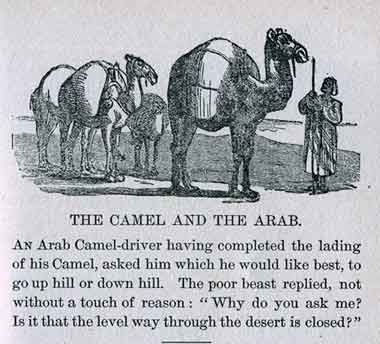
Aesop’s Fables, 1888, p. 132

One of the joys of returning home to where I was born is going through the books that my grandmother once owned. In a previous post I mentioned an 1888 edition of Aesop’s Fables, translated by George Fyler Townsend. In leafing through the fables I found several that talk about camels and one that refers to an “Arab.”

In this post I provide three of the fables, Continue reading Aesop’s Fabulous Camels (and an Ass) #2

Yemen’s Unfinished Revolution


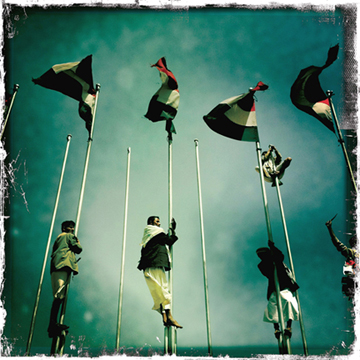
Photo by Karim Ben Khelifa

By TAWAKKOL KARMAN, The New York Times, June 18, 2011

Sana, Yemen

AFTER more than five months of continuous protests, I stand today in Change Square with thousands of young people united by a lofty dream. I have spent days and nights camped out in tents with fellow protesters; I have led demonstrations in the streets facing the threat of mortars, missiles and gunfire; I have struggled to build a movement for democratic change — all while caring for my three young children.

We have reached this historic moment because we chose to march in the streets demanding the resignation of President Ali Abdullah Saleh, an end to his corrupt and failed regime and the establishment of a modern democratic state. On June 4, our wish for Mr. Saleh’s departure was granted, but our demand for democracy remains unfulfilled.

Following months of peaceful protests that reached every village, neighborhood and street, Yemen is now facing a complete vacuum of authority; we are without a president or parliament. Mr. Saleh may be gone, but authority has not yet been transferred to a transitional presidential council endorsed by the people.

This is because the United States and Saudi Arabia, which have the power to ensure a peaceful transition to democracy in Yemen, have instead used their influence to ensure that members of the old regime remain in power and the status quo is maintained. American counterterrorism agencies and the Saudi government have a firm grip on Yemen at the moment. It is they, not the Yemeni people and their constitutional institutions, that control the country. Continue reading Yemen’s Unfinished Revolution

N is for nabidh…


In a previous post I introduced a delightful read and a handy recipe book entitled Ziryab: Authentic Arab Cuisine by Farouk Mardam-Bey and illustrations by Odile Alliet. The “Logbook” at the end of the text is an entertaining alphabet of stories about Arabic good and drink. Here is the selection on a type of wine that the Prophet Muhammad drunk:

N for Nabidh

In most Arab countries today, the word “nabidh” means “wine.” It used to be quite a different beverage, which was made by macerating grapes, dates, or other fruits for some time in water. The Prophet himself loved it. According to the most authentic hadith, he never let the fruit macerate longer than three days. But such a beverage tends to ferment quickly in the heat, and a furious controversy developed among Muslim lawmakers, about whether or not it was licit to drink it. For most of them, the Malikitesm the Shafi‘ites, and the Hanbalites, as well as the Shi‘a Muslims, it was not permitted, and those who drank nabidh were to be punished with forty or eighty lashes, just like those who drank wine. On the other hand, the Hanafites were nice enough to authorize this drink under certain conditions. And the Mu‘tasilites – Jubba’i among them believed that the faithful could drink it as much as they liked in order to get familiarized on earth with the pleasures awaiting them in the Hereafter. Continue reading N is for nabidh…

Orientalist Images #2


Half of the painting for the inside cover of Richards Cyclopedia, by Edwin Winfield Hall


[With this post I continue a series dedicated to photographs in an “Orientalist” mode. In addition to
Reading Orientalism, the title of my last book, the creation of an imagined Orient is very much a pictorial voyeuristic voyage. In this series I focus on Western images of the Middle East and North Africa, both those that perpetuate stereotypes and those that chip away at the bias. Readers of the blog are welcome to send in images they have found and want to share.]

I continue with an image from a 1933 edition of Richards Cyclopedia, with 24 volumes published in New York by J. A. Richards, Inc and edited by Ernest Hunter Wright and Mary Heritage Wright. This is an unusual encyclopedia, arranged by topics in a more or less arbitrary order but replete with images. The inside cover, half of which is shown above, is a collage of cultural references. Across the top one finds the beginnings of civilization (at least in the thinking of the time) in the ancient Egyptian pyramid and sphinx, with a towering medieval castle above and both a modern airplane and image of Saturn looking down on ancient Greece, where a beautiful half-naked Grecian standing odalisque butts up against a knight in shining armor. There are ships and covered wagons in this pictorial representation of manifest destiny. The part not shown is distinctively American progress, though with a Maharajah inexplicably riding an elephant in front of a giant oceanliner. Continue reading Orientalist Images #2

Cruising above the Empty Quarter


There is a spectacular photographic website devoted to a book by George Steinmetz, who took photographs across the fabled Empty Quarter of Arabia.

I became captivated by Arabia’s Empty Quarter as a young man when I read Wilfred Thesiger’s Arabian Sands. The Empty Quarter is larger than France without a single permanent point of water or human habitation. It’s both the world’s largest sand sea and one of the hottest places on earth, and has only been traversed a handful of times. I didn’t want to repeat Thesiger’s epic journeys many decades later, but when I discovered motorized paragliding I found a way to visualize this remote landscape in a new way. I made three paragliding trips into the sands, first for GEO in Saudi Arabia, and then returned two years later to go from Riyadh to Oman and Yemen for National Geographic, and finally made a personal trip to the southern most reaches of the U.A.E. to complete my field work. What I found was one of the most beautiful and unseen wilderness on earth. On its fringes I encountered elements the oil wealth that has forever changed Arabia, but I also found Bedouins still clinging to traditions, and offering up a level of hospitality that was truly humbling. This body of work would simply not have been possible without their kindness.

Empty Quarter is George’s second book, published by Harry N. Abrams. This is the most extensive compilation of photographs ever taken in the Arabian Desert. Measuring 9.5 x 13 inches, the book has 208 pages with 150 color photos and captions.