All posts by tabsir

Tabsir Redux: Gibran Kahlil Gibran: A Timeless and Universal Vision

By George Nicolas El-Hage

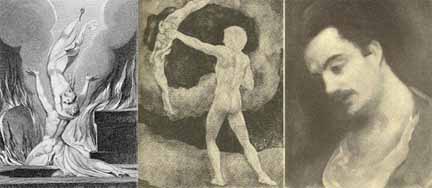
Poetry and art are twins. Both are the offspring of suffering and joy. Gibran translated Blake’s “Innocence and Experience” into a “Tear and a Smile.” Nevertheless, the unending drama of human existence unfolds itself in the pages of both men. Only the elected and gifted soul is capable of creativity, of reading the world differently, and of rebelling against evil clothed in a lamb’s garment. Art knows no boundaries. It transcends all national limits and is only satisfied with the universal. There, time and place lose their ability to imprison the artist in a closed cell. The inspired poet becomes a winged soul floating over life, embracing the infinite. It is in the midst of this vast expanse where the responsibility of the artist becomes eternal and his mission turns holy that we can speak of Kahlil Gibran and William Blake together. Continue reading Tabsir Redux: Gibran Kahlil Gibran: A Timeless and Universal Vision →

Sailing to Yemen with human traffickers


Journalist who took the human smuggling voyage from Djibouti to Yemen gives a first-hand account of migrant beatings.

by Glen Johnson, Al Jazeera, July 18, 2011

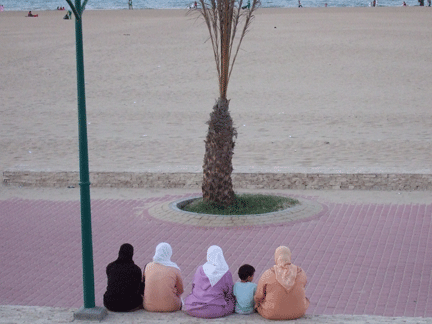
There were more than 30 people crammed on the back of the truck as the vehicle bumped through the desert in eastern Djibouti.

The passengers were men, women and children from Ethiopia and Somalia and myself. And all would be smuggled in boats from Djibouti to Yemen, as part of wider trafficking operations involving six countries – Saudi Arabia, Yemen, Djibouti, Somalia, Ethiopia and Eritrea – that apparently trafficks tens of thousands of people from the Horn of Africa to Arabian nations each year.

I had arrived in Djibouti on June 7 to research human trafficking. Having lived in Yemen for part of 2010, I was aware that the Africa-Arabia smuggling trade was one of the myriad challenges facing Yemen, yet one of the troubled nation’s least discussed. In Djibouti, I quickly established links with smugglers, some of whom agreed to let me accompany migrants from Ethiopia and refugees from Somalia by boat to Yemen.

The truck drove slowly through the desert. No one talked. A distant beam from a lighthouse swept across the night sky. The silhouettes of coarse thorn scrubs, bent back from the wind, stood under a yellow moon that was ill-defined from the dust and sand that swept up into the night.

Occasionally the truck would grind to a halt and men would get out swinging sticks wildly, telling the passengers to keep still. A woman spoke to a child – his hair a mass of coarse, black curls; his spindly legs sticking out the bottom of his trousers. Continue reading Sailing to Yemen with human traffickers →

Ali Abdullah Salih: First Take


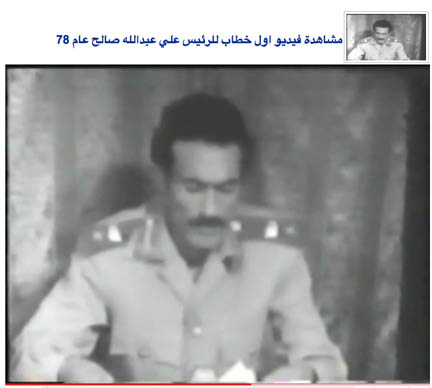
Yesterday, July 17, is a day that will live in history. Not because it was the day of my 35th anniversary, but because 33 years ago Sunday Ali Abdullah Salih came to power in Yemen. Yemen Press has posted a video of his first speech. Yemen remains in stalemate as President Salih remains in Saudi Arabia, despite all the rumors of his return to Sanaa. But stalemate is a downward slope as the government has ceased to function and even basic commodities are hard to get. We are watching a country self-destruct. The fact that videos get posted and Twitter whirls away over the continuing protests overshadows the obvious: Yemen has been a military dictatorship far too long to transition overnight into a practical democracy. Hopefully in another 33 years we will not see yet another first take of a military leader rebroadcast on the Internet…

Tabsir Redux: Astrolabes and Angels, Epigrams and Enigmas

AN INTRODUCTION TO THE DE REGIO MONTE CODE, CARDINAL BESSARION’S AGENDA, AND PIERO DELLA FRANCESCA’S ENIGMA

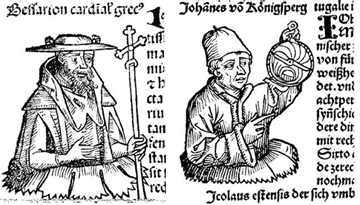
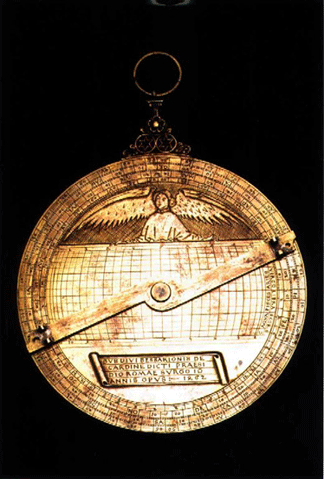
[The noted historian of Islamic science, David A. King, recently retired from his position as Professor of the History of Science at Frankfurt University, has published a new book on two of the most remarkable objects surviving from the Renaissance, one an astrolabe and the other a painting. The connection between the two is described in detail in his new book Astrolabes and Angels, Epigrams and Enigmas – From Regiomontanus’ Acrostic for Cardinal Bessarion to Piero della Francesca’s Flagellation of Christ, Stuttgart: Franz Steiner, 2007. An associated website is http://web.uni-frankfurt.de/fb13/ign/Code.htm.]

Only recently have we achieved a better understanding of two monuments to the intellectual genius of the Renaissance, both of which have caused scholars a lot of trouble over several decades. As it happens, the two are intimately related.


The back of the astrolabe made by Regiomontanus for Cardinal Bessarion, with an inscription or epigram and the image of an angel.

One is an astrolabe, presented to the ageing Greek Cardinal Bessarion in Rome, 1462, by his new protégé, the young German astronomer Regiomontanus. Continue reading Tabsir Redux: Astrolabes and Angels, Epigrams and Enigmas →

Yusuf al-Qaradawi: Fatwa on Islam and Democracy

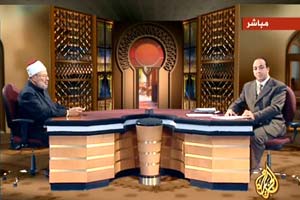
by Yusuf al-Qaradawi, Islamopedia, June 27, 2011

The Islamic state is a civil one, like other governments in the modern world and the only difference is that it makes Islamic Shari’a its reference. We would like to highlight, in this chapter, that the Islamic state is based on the Shura Council, allegiance, free choice of the nation to its ruler, advice to him, accountability of him, obedience to him, break of his allegiance if he commands sin, and the nation’s right to dismiss him if he insists on straying and deviation. This approach makes the essence of the Islamic state close to the democratic one.

By democracy we mean political democracy. As economic democracy is concerned, it means capitalism and it has its advantages and disadvantages, so we have been conservative about it while the social democracy means liberalism holding the absolute freedom, and we have been conservative about it too. Capitalism (of Qaron, a king of the past) is unacceptable to us since it is based on an idea of wealth refused by the Holy Quran. As Qaron said about his wealth, “I have been given it according to my knowledge”(stories: 78). Or as people said to Prophet Shoaib, “Does your prayer command us to leave what our fathers worshiped or that we do in our money what we want (Hud: 87).

According to Islamic thought, human being are heirs to the wealth of God. The Quran said: spend of that He made you heirs in it (Iron: 7). The true owner of the wealth is Allah while the rich man is trustee of this wealth and agent of the real owner. So ownership is bound with some duties and obligations as it is constrained in consumption, investment, distribution and circulation. Also, the giving of alms (Zakat) is imposed on the wealthy as one of the pillars of Islam. And usury, monopoly, fraud, injustice, extravagance, luxury, treasuring and other transactions are prohibited to the owners. With these admonitions and law, we could dull the dangerous nail of the capitalism, so as to achieve social justice, care for vulnerable groups in society such as orphans, the needy and the wayfarers, and work on a better distribution of the wealth “in order not to be the circulated among the rich of you” (al-Hashr: 7). Continue reading Yusuf al-Qaradawi: Fatwa on Islam and Democracy →

Tabsir Redux: The Land and the Book #1: Looking for an Omnibus?


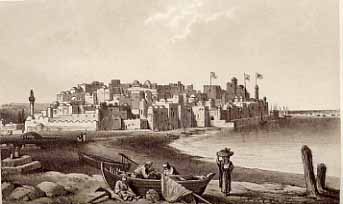
Jaffa from Thomson’s “The Land and the Book”

Almost 150 years ago one of the most popular travel accounts of the Holy Land was penned by an American missionary named William M. Thomson. Born in Ohio, my own home state, the 28-year old Thomson and his young bride arrived in Lebanon in 1834 as Protestant missionaries. This was a mere 15 or so years after the first American missionaries had made the Holy Land a mission field. At once an entertaining travel account and Sunday School commentary on the places and people of the Bible, this may have been one the most widely read books ever written by a Protestant missionary.

Reading Thomson is like reading one of the early English novels. The language is less familiar, although still thoroughly Yankee and the devotional tone has long since disappeared for a readership buying out The Da Vinci Code as soon as it hit the bookstores. The biblical exegesis, literalist yet frankly pragmatic at times, is intertwined with astute and at times humorous accounts of the people Thomson met along the way. But the style is not at all dry or discouragingly didactic. From the start Thomson engages in a dialogue with the reader, making the text (which stretches over 700 pages in the 1901 version) a rhetorical trip in itself.

Here is one of the forgotten books of a couple generations back. Easily dismissed as an Orientalist book, in the sense propounded and confounded by Edward Said, it is nevertheless a very good read. With this post I begin a series to sample the anecdotes and local color presented by Rev. Thomson. The times have indeed changed, but such textual forays into the night reading of a previous generation of Americans are well worth the effort. Let’s begin with the author’s own invitation. Continue reading Tabsir Redux: The Land and the Book #1: Looking for an Omnibus? →

Tabsir Redux: The Cynical Dairy Farmer’s Guide to the New Middle East


BY Karim Sadjapour, Foreign Policy, June 15, 2011

How a couple of cows explain a changing region: equal opportunity offender edition.

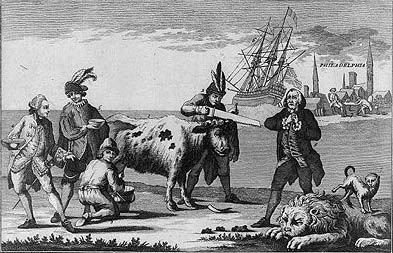
In the early years of the Cold War, in an effort to simplify — and parody — various political ideologies and philosophies, irreverent wits, in the spirit of George Orwell, went back to the farm. No one really knows how the two-cow joke known as “Parable of the Isms” came about, but most students of Political Science 101 have likely come across some variation of the following definitions:

Socialism: You have two cows. The government takes one of them and gives it to your neighbor.

Communism: You have two cows. The government takes them both and provides you with milk.

Nazism: You have two cows. The government shoots you and takes the cows.

Capitalism: You have two cows. You sell one and buy a bull.

Over the years, the parables gradually expanded, using the two-cow joke to explain everything from French unions (You have two cows. You go on strike because you want three cows.) to the Republican Party (You have two cows. Your neighbor has none. So what?). While in its original iteration the cows were a metaphor for currency, capital, and property, they later began to take on different meanings.

Today, the Middle East has replaced the Cold War as America’s primary foreign-policy preoccupation. As opposed to the seemingly ideologically homogenous communist bloc, however, the 22 diverse countries that compose the modern Middle East are still confusing to most Americans. Why can’t the Israeli and Palestinians stop fighting already? What’s the difference between Libya and Lebanon again?

Herewith then is a satirical effort to simplify the essence of Middle Eastern governments so that, in the immortal words of George W. Bush, “the boys in Lubbock” can read it. And, rather than symbolizing property, the cows here symbolize people, which — funny enough — is how most Middle Eastern regimes have traditionally viewed their populations.

Saudi Arabia
You have two cows with endless reserves of milk. Gorge them with grass, prevent them from interacting with bulls, and import South Asians to milk them.

Iran
You have two cows. You interrogate them until they concede they are Zionist agents. You send their milk to southern Lebanon and Gaza, or render it into highly enriched cream. International sanctions prevent your milk from being bought on the open market.

Syria
You have five cows, one of whom is an Alawite. Feed the Alawite cow well; beat the non-Alawite cows. Use the milk to finance your wife’s shopping sprees in London.

Lebanon
You have two cows. Syria claims ownership over them. You take them abroad and start successful cattle farms in Africa, Australia, and Latin America. You send the proceeds back home so your relatives can afford cosmetic surgery and Mercedes-Benzes.

Hezbollah
You have no cows. During breaks from milking on the teat of the Iranian cow you call for Israel’s annihilation. Continue reading Tabsir Redux: The Cynical Dairy Farmer’s Guide to the New Middle East →