All posts by tabsir

Montesquieu, St. Augustine and Libya


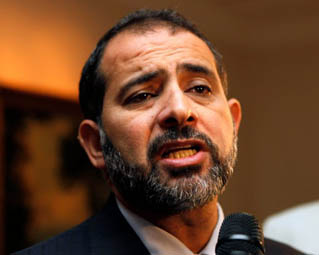
Photograph by Murad Sezer/Reuters

A Man of God and Technology, Trying to Steady Libya
By ANNE BARNARD, The New York Times, September 16, 2011

Tripoli, Libya

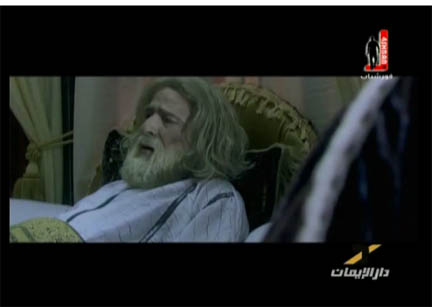
AREF NAYED was sipping cappuccino in the soaring marble lobby of the Corinthia Hotel near Tripoli’s seafront, quoting Montesquieu on law and Augustine on forgiveness in a conversation that had begun with earthier subjects, like the challenges of restoring Libya’s water supply and counting its dead.

He held forth on how Bedouin poetry shaped a moderate Islam in Libya, and he was just starting to explain the relevance to Libyan politics of the mathematical theory of complexity — it had to do with something called “flocking phenomena” — when his cellphone rang.

“I have to take this,” he said, glancing at the number. “Somebody wants to surrender.”

An associate of Col. Muammar el-Qaddafi, the deposed Libyan leader, wanted safety guarantees before turning himself in. Mr. Nayed wanted to make it happen, and not just because fostering reconciliation is one of his many jobs for Libya’s de facto government.

He is also a Muslim theologian who, in addition to running a technology business, spent his time before the Libyan rebellion writing erudite papers arguing that compassion is the paramount value in Islam, that pious Muslims can thrive within a liberal secular state and that even the most righteous ones should adopt a “humble recognition” of their own fallibility.

Now, as the Transitional National Council’s coordinator of a Libyan stabilization team being asked to solve problems like fuel shortages and human rights abuses, he suddenly finds himself in an ideal laboratory to test his signature theological propositions — and to try to make them government policy.

“I don’t think there should be a witch hunt, purges or cleansings,” he said Monday at the hotel cafe, adding that those who committed crimes under Colonel Qaddafi should be tried. “Any time you deal with human beings with that kind of terminology, you end up with unfairness and persecution.” Continue reading Montesquieu, St. Augustine and Libya →
Tabsir Redux: Déjà Voodoo

Consider the opening line of the lead story in yesterday’s New York Times:

BAGHDAD — Saudi Arabia and Libya, both considered allies by the United States in its fight against terrorism, were the source of about 60 percent of the foreign fighters who came to Iraq in the past year to serve as suicide bombers or to facilitate other attacks, according to senior American military officials.

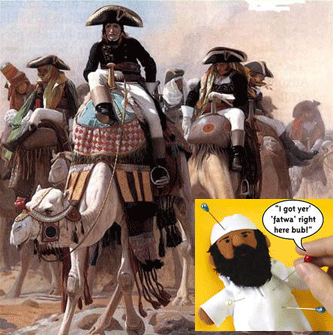
In the long durée, as Napoleon might say if he were alive today, politics makes strange embedded fellows of nation states. There are three nations at play here in the field of lording over by the world’s reigning super power. Iraq and Libya had European imposed (and later revolution-deposed) monarchs at mid-stream in the 20th century. At the same time Saudi Arabia’s royal line evolved an iconclastic religiously mandated kingship that has withstood toppling and seems likely to do so far into the security based future. All three states are where they are today largely because of the world’s thirst for crude oil. The same three states, should Iraq survive de facto federation, face a future defined by a mega-politicized war on terrorism, a war with no state-like enemies being fought by a coalition of nation states willing to arm themselves to the teeth with conventional weapons and make airline passengers take their shoes off each and every time they fly. Two centuries from now a future Napoleon, whatever his or her nationality, may look back on the current political climate and have a hindsight sense of déjà vu, or will it be more of the voodoo politics mass mediated today? Continue reading Tabsir Redux: Déjà Voodoo →

Arabic in Kufic Script


Kufic Quran, second/eighth century

by John F. Healey and G. Rex Smith

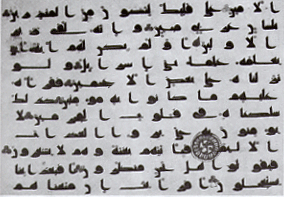
The Kufic Quran has reached its fully developed form by the end of the second/eighth century. It was invariably written on parchment, the letters in a black ink with dots, often red and green (the latter used with initial hamza) though sometimes in gold only, representing short vowels, and black strokes, single and double, distinguishing letters. The text thus written is made difficult by the spacing which would seem to be more to do the calligrapher’s artistic inclinations and his desire to justify his text precisely than with Arabic orthography. “Justification” here refers to what became the standard practice in printed books of making the lines even in length both at the beginning and at the end of the lines. Verse endings and other pauses call for gold: usually a cluster of three balls, one sitting on two others and quite elaborate roundels. Continue reading Arabic in Kufic Script →

9/11 Raised Unrealized Hopes in US-Iran Relations


by William O. Beeman, New American Media, Sep 11, 2011

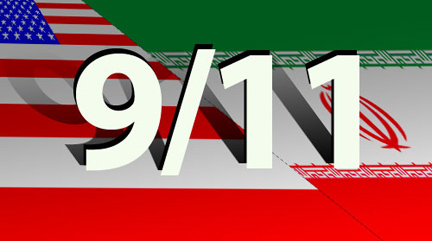
As the United States remembers the events of September 11, 2001 on their tenth anniversary, it is important to remember that the tragedy was commemorated around the world, not just in America. And one of the nations that expressed the most profound and sincere grief over the loss of life was Iran.

Candlelight vigils were held throughout Iran and professions of sorrow and sympathy for the United States citizens who lost family and friends were ubiquitous. This was even more impressive when one notes that these were not government organized events, but were the spontaneous outpouring of Iranian citizens. On an official level, many Iranian religious leaders condemned the attacks, despite their differences with the United States administration. It was also noteworthy that no Iranian was involved in any way with the 9/11 attacks.

The 9/11 tragedy also resulted in a brief thaw in U.S.-Iran relations as Iran offered its air space and landing fields to the United States in its attacks on al-Qaeda and the Taliban in Afghanistan. It created increased positive feeling on the part of ordinary Iranian citizens for the United States and its people.

It is a secondary tragedy that this brief halcyon period in U.S.-Iran relations did not last. Continue reading 9/11 Raised Unrealized Hopes in US-Iran Relations →

The Latino Ummah


Latino Muslims Define Their Identity 10 Years After 9/11

by Jorge Luis Macias, The Huffington Post, September 9, 2011

It has been 10 years since the Sept. 11 terror attacks, but many Latino Muslims say there is still a lack of understanding about their religion and its practices.

A 2007 study conducted by the Pew Research Center showed that Latino Muslims accounted for an estimated 4 percent out of a total of about 2.5 million Muslims living in the U.S. But a look at the individuals behind those numbers reveals a group of people who say they have become ambassadors for Islam despite the common stereotypes they say are still leveled by many in the U.S.

According to the Pew findings recounted in a 2011 report, while 40 percent of the U.S. population believed Muslims in the U.S. support extremism, only 21 percent of U.S. Muslims said there is support for extremism among them in the U.S.

“The first misconception is to associate violence with Islam,” said Wilfredo Amr Ruiz, a Muslim chaplain and attorney born in Puerto Rico. “Another misconception is that somehow Islam aspires to some sort of world domination, and that his followers want to impose Islamic Law in the countries in which they live, which couldn’t be further from the truth.” Continue reading The Latino Ummah →

Wellcome Library Arabic Manuscripts Online

Historic Arabic medical manuscripts go online

Researchers may now search and browse the Wellcome Library’s Arabic manuscripts using groundbreaking functionalities in a new online resource that brings together rich descriptive information and exceptionally detailed images.

Arabic medicine was once the most advanced in the world, and now digital facsimiles of some of its most important texts have been made freely available online. The unique online resource, based on the Wellcome Library’s Arabic manuscript collection, includes well-known medical texts by famous practitioners (such as Avicenna, Ibn al-Quff, and Ibn an-Nafis), lesser-known works by anonymous physicians and rare or unique copies, such as Averroes’ commentaries on Avicenna’s medical poetry.

The Wellcome Arabic Manuscript Cataloguing Partnership (WAMCP) combines the efforts of the Wellcome Library, the Bibliotheca Alexandrina and King’s College London Digital Humanities Department and is funded by JISC and the Wellcome Trust. It offers a rich digital manuscript library available online for free, which represents a significant resource for a wide range of researchers – including Arabic studies scholars, medical historians and manuscript conservators – to aid and enhance their work.

The resource is now available online. Continue reading Wellcome Library Arabic Manuscripts Online →