All posts by tabsir

Tabsir Redux: Flipping through Yemen a Millennium Ago


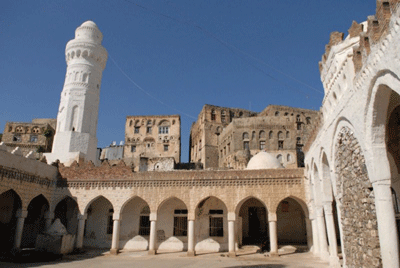
Mosque in Jiblah, Yemen

There was a time when books were hard to come by. Either they cost too much or were inaccessible in a private or exclusive university library. Whatever else the world wide web has done (and that is a mouthful), it now functions as an archive. More and more, the rare and out-of-print books I used to be forced to read in a library reading room are becoming available online. Mr. Gutenberg might roll over in his Grab at the very thought of a pdf file, but print has taken a new and universal turn. I especially enjoy the “flipbook”, which simulates turning the pages of images of the original. For an enjoyable read on the early history of Yemen, there is the flipbook version of Henry Cassels Kay’s translation called YAMAN, ITS EARLY MEDIAEVAL HISTORY, published in London in 1892. This has excerpts (not always trustworthy in their translation) from Umarah ibn Ali al-Hakami (1120/21-1174), Ibn Khaldun (1332-1406); Muhammad ibn Yaqub al-Janadi (d. 1332?).

The sad thing is that well over a century ago, Kay lamented that there was virtually nothing available on the history of Yemen, which had become of strategic interest to the British empire. Continue reading Tabsir Redux: Flipping through Yemen a Millennium Ago

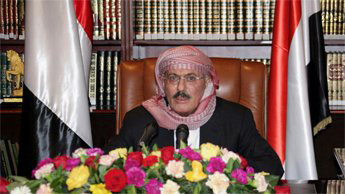
Salih’s Latest Speech


[Over at Waq al-Waq, Greg Johnsen has a good read on Salih’s latest speech after his return to Yemen.]

Salih’s Speech (Instant Analysis)
by Gregory Johnsen, Waq al-Waq, September 25, 2011

Days after dramatically returning from Saudi Arabia, President Ali Abdullah Salih did what he does in these situations: he gave a speech.

The international media will likely lead with the fact that Salih called for early elections (in fact, here is an early al-Jazeera piece saying just that). But what this analysis misses is the caveat – that ever present out – that Salih gave himself, saying that elections would only take place in the context of the GCC deal.

The GCC deal, as those of you who read Waq al-waq frequently know, is worthless. Not only is it impossible to enforce – as Salih’s will-I, won’t-I dance illustrates – but there are so many loopholes in the plan that even if Salih did sign it he could easily manipulate the aftermath of the deal to ensure that a trusted ally or relative succeeded him as president, or find some excuse to continue in power.

To that end, Salih reaffirmed that his vice president Hadi is authorized to negotiate and eventually sign the GCC deal. This is worthless. And Salih knows it.

Numerous high-level Yemeni figures have already signed the deal, the signature that is missing is Salih’s. This is yet one more evasion from a president who sees his strategy of duck and delay starting to pay-off. Continue reading Salih’s Latest Speech

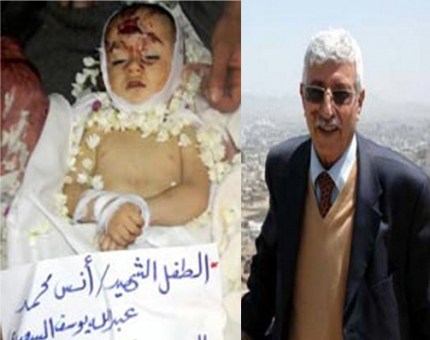
يا قاتل الأطفال يا مهدم الحياة والديار


عبدالعزيز المقالح: ذهبت مثلما أتيت ملعون المساء والنهار .. يا قاتل الأطفال يا مهدم الحياة والديار

Yemen Press, Saturday, 24 September, 2011

ذهبت مثلما أتيت ملعون المساء والنهار…
أيامك الطوال عار..
وعهدك القصير عار..
أكبر منك نملة..
أشهر منك ريشة على جدار..
يا أمسنا الذبيح..
يا فأرنا القبيح..
يا قاتل الأطفال يا مهدم الحياة والديار..
ظننت أنك الإله .. أننا العبيد..
تفعل ما تريد..
تعبث في مصائر العباد..
فخانك الظن وخانك الرشاد..
أصبحت كومة من الرماد..
تنام في انفراد..
تصحو على انفراد..
تسألك الريح ، يسألك الجماد..
ماذا صنعت قل ..
ماذا صنعت للبلاد؟,,
ماذا تركت من ذكرى على ضميرها ومن أمجاد؟..
لا شيء يا صغير..
لا شيء غير لعبة المزاد..
رفاقك القرًاد والقوًاد..
وعاصف الفساد..
ماذا تركت للذين يقرأون؟..
ماذا سيكتب الأطفال عنك حين يكبرون؟..
سيكتبون .. مر من هنا منتفخا..
فأر صغير يرتدي ثوب مغامر جلاد..

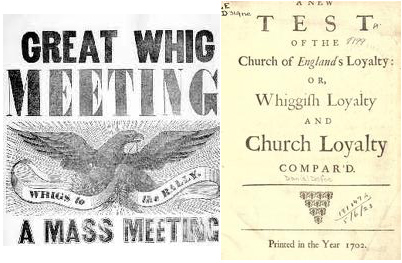
Are you Whiggish?


[One of my favorite works on the philosophy of history is Herbert Butterfield’s prescient 1931 The Whig Interpretation of History. While most people today probably have no clue what a “Whig” is, his reflections on how we look at and write about history are as relevant today as when he wrote them eight decades ago. The whole text is available online, but I provide some excerpts from the Introduction here to whet your appetite.]

1. INTRODUCTION

It has been said that the historian is the avenger, and that standing as a judge between the parties and rivalries and causes of bygone generations he can lift up the fallen and beat down the proud, and by his exposures and his verdicts, his satire and his moral indignation, can punish unrighteousness, avenge the injured or reward the innocent. One may be forgiven for not being too happy about any division of mankind into good and evil, progressive and reactionary, black and white; and it is not clear that moral indignation is not a dispersion of one’s energies to the great confusion of one’s judgement. There can be no complaint against the historian who personally and privately has his preferences and antipathies, and who as a human being merely has a fancy to take part in the game that he is describing; it is pleasant to see him give way to his prejudices and take them emotionally, so that they splash into colour as he writes; provided that when he steps in this way into the arena he recognizes that he is stepping into a world of partial judgements and purely personal appreciations and does not imagine that he is speaking ex cathedra. But if the historian can rear himself up like a god and judge, or stand as the official avenger of the crimes of the past, then one can require that he shall be still more godlike and regard himself rather as the reconciler than as the avenger; taking it that his aim is to achieve the understanding of the men and parties and causes of the past, and that in this understanding, if it can be complete, all things will ultimately be reconciled. It seems to be assumed that in history we can have something more than the private points of view of particular historian; that there are “verdicts of history” and that history itself, considered impersonally, has something to say to men. Continue reading Are you Whiggish?

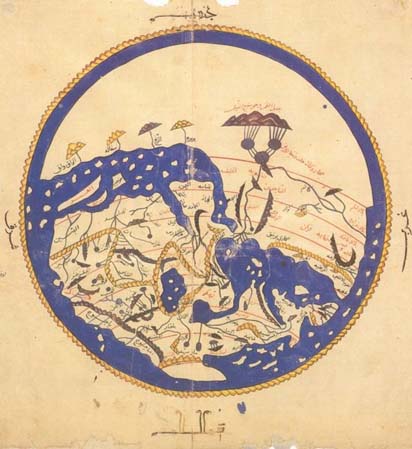
History of Islamic Cartography Online


Al-Idrisi’s map of the world, 1154 CE

A very useful volume on Islamic cartography is now online. Below is the table of contents, each chapter available in pdf.

Volume Two, Book One
Cartography in the Traditional Islamic and South Asian Societies
Edited by J. B. Harley and David Woodward

Volume 1

Front Matter
Gallery of Color Illustrations (Plates 1–24)
Gallery of Color Illustrations (Plates 25–40)

Preface
J. B. Harley and David Woodward

Part One – Islamic Cartography

Chapter 1. Introduction to Islamic Maps
Ahmet T. Karamustafa

Chapter 2. Celestial Mapping
Emilie Savage-Smith

Chapter 3. Cosmographical Diagrams
Ahmet T. Karamustafa

Early Geographical Mapping

Chapter 4. The Beginnings of a Cartographic Tradition
Gerald R. Tibbetts Continue reading History of Islamic Cartography Online

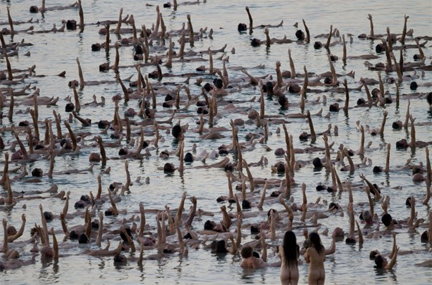
Lively action at the Dead Sea

Palestine and Israel are back in the news. As Abbas prepares to request recognition for Palestine from the U.N. and Israelis themselves stage protests following the “Arab Spring,” the installation (sans clothing) photographer Spencer Tunick has returned to the legendary site of Sodom and Gomorrah to unclothe the political tensions in the area. I think he is on to something by having his subjects take everything off. Forget about turning swords into plowshares, just strip and dive in. And here is one part of the region where you are guaranteed not to sink.

Montesquieu, St. Augustine and Libya


Photograph by Murad Sezer/Reuters

A Man of God and Technology, Trying to Steady Libya
By ANNE BARNARD, The New York Times, September 16, 2011

Tripoli, Libya

AREF NAYED was sipping cappuccino in the soaring marble lobby of the Corinthia Hotel near Tripoli’s seafront, quoting Montesquieu on law and Augustine on forgiveness in a conversation that had begun with earthier subjects, like the challenges of restoring Libya’s water supply and counting its dead.

He held forth on how Bedouin poetry shaped a moderate Islam in Libya, and he was just starting to explain the relevance to Libyan politics of the mathematical theory of complexity — it had to do with something called “flocking phenomena” — when his cellphone rang.

“I have to take this,” he said, glancing at the number. “Somebody wants to surrender.”

An associate of Col. Muammar el-Qaddafi, the deposed Libyan leader, wanted safety guarantees before turning himself in. Mr. Nayed wanted to make it happen, and not just because fostering reconciliation is one of his many jobs for Libya’s de facto government.

He is also a Muslim theologian who, in addition to running a technology business, spent his time before the Libyan rebellion writing erudite papers arguing that compassion is the paramount value in Islam, that pious Muslims can thrive within a liberal secular state and that even the most righteous ones should adopt a “humble recognition” of their own fallibility.

Now, as the Transitional National Council’s coordinator of a Libyan stabilization team being asked to solve problems like fuel shortages and human rights abuses, he suddenly finds himself in an ideal laboratory to test his signature theological propositions — and to try to make them government policy.

“I don’t think there should be a witch hunt, purges or cleansings,” he said Monday at the hotel cafe, adding that those who committed crimes under Colonel Qaddafi should be tried. “Any time you deal with human beings with that kind of terminology, you end up with unfairness and persecution.” Continue reading Montesquieu, St. Augustine and Libya

Tabsir Redux: Déjà Voodoo

Consider the opening line of the lead story in yesterday’s New York Times:

BAGHDAD — Saudi Arabia and Libya, both considered allies by the United States in its fight against terrorism, were the source of about 60 percent of the foreign fighters who came to Iraq in the past year to serve as suicide bombers or to facilitate other attacks, according to senior American military officials.

In the long durée, as Napoleon might say if he were alive today, politics makes strange embedded fellows of nation states. There are three nations at play here in the field of lording over by the world’s reigning super power. Iraq and Libya had European imposed (and later revolution-deposed) monarchs at mid-stream in the 20th century. At the same time Saudi Arabia’s royal line evolved an iconclastic religiously mandated kingship that has withstood toppling and seems likely to do so far into the security based future. All three states are where they are today largely because of the world’s thirst for crude oil. The same three states, should Iraq survive de facto federation, face a future defined by a mega-politicized war on terrorism, a war with no state-like enemies being fought by a coalition of nation states willing to arm themselves to the teeth with conventional weapons and make airline passengers take their shoes off each and every time they fly. Two centuries from now a future Napoleon, whatever his or her nationality, may look back on the current political climate and have a hindsight sense of déjà vu, or will it be more of the voodoo politics mass mediated today? Continue reading Tabsir Redux: Déjà Voodoo