All posts by tabsir

Is There a Middle East?


Announcing a new book from Stanford University Press…

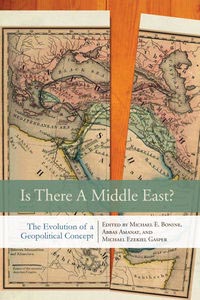
Is There a Middle East?: The Evolution of a Geopolitical Concept
Edited by Michael E. Bonine, Abbas Amanat, and Michael Ezekiel Gasper
Stanford: Stanford University Press, 2011.

Is the idea of the “Middle East” simply a geopolitical construct conceived by the West to serve particular strategic and economic interests—or can we identify geographical, historical, cultural, and political patterns to indicate some sort of internal coherence to this label? While the term has achieved common usage, no one studying the region has yet addressed whether this conceptualization has real meaning—and then articulated what and where the Middle East is, or is not.

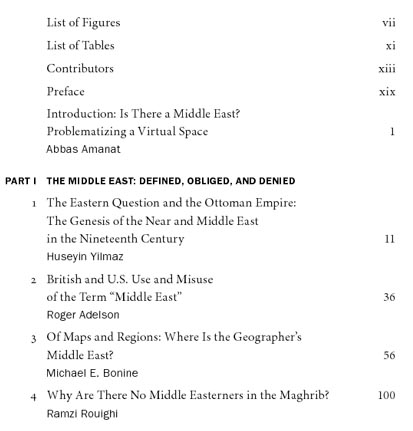
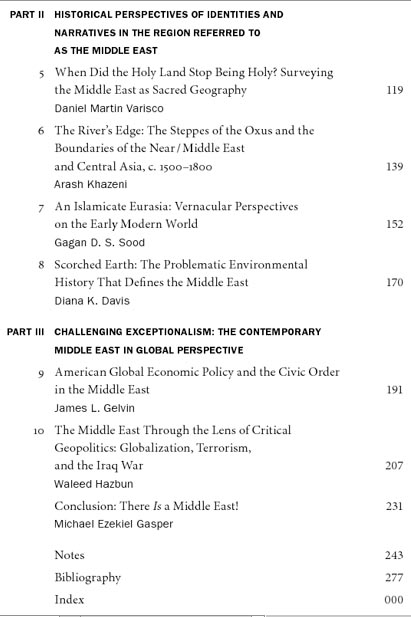
This volume fills the void, offering a diverse set of voices—from political and cultural historians, to social scientists, geographers, and political economists—to debate the possible manifestations and meanings of the Middle East. At a time when geopolitical forces, social currents, and environmental concerns have brought attention to the region, this volume examines the very definition and geographic and cultural boundaries of the Middle East in an unprecedented way.


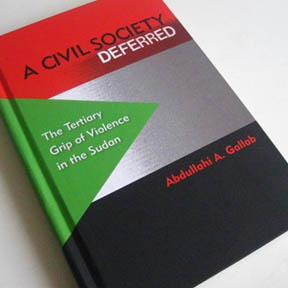
A CIVIL SOCIETY DEFERRED


A View of Abdullahi Gallab’s A CIVIL SOCIETY DEFERRED from a precolonial perspective

By Jay Spaulding, African Arguments, November 28, 2011,

“Men make their own history, “ wrote a famous individual long ago, “but they do not make it as they please; they do not make it under self-selected circumstances, but under circumstances existing already, given and transmitted from the past.” Subsequent historians have endeavored to elaborate hierarchies of historical causation within which diverse material, socioeconomic and conceptual entities are seen to constrain the exercise of free will. Nowhere has the examination of constraint received greater attention than among the colonized communities of the not-so-distant past, including the Sudan. One of the virtues of Abdullahi Gallab’s A CIVIL SOCIETY DEFERRED lies in the author’s mastery of a wide variety of theorists of historical causation and colonial constraint. The wealth of their insights has allowed him to rearrange largely familiar information about the Sudan into an original and impressive interpretive architecture. His approach, the opposite of reductionist, resonates at many levels of understanding. A second virtue of A CIVIL SOCIETY DEFERRED is that the author knows, profits from, and builds upon the efforts of previous Sudan scholarship. The book consciously joins and illuminates an extended ongoing discussion.

The author’s central effort is to discern the colonial origins of the current Sudanese state. Few will challenge this thesis, and other contributors to this discussion will undoubtedly address the theme at length. But is there anything that one might add to perhaps embellish A CIVIL SOCIETY DEFERRED from the remote perspective of precolonial Sudanese history? I would like to propose two ideas for possible consideration. Continue reading A CIVIL SOCIETY DEFERRED

English and the Hijab in Cairo

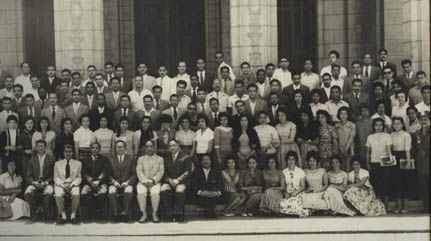
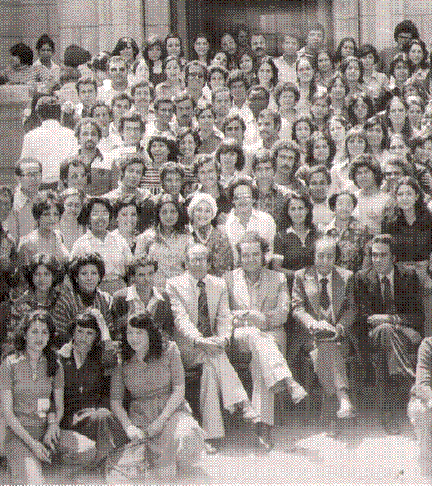
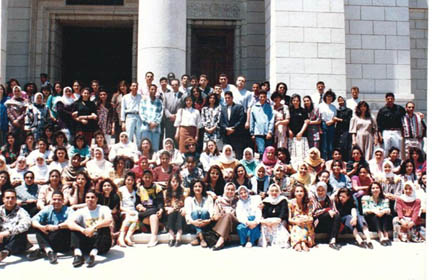
The ongoing political protests in Egypt have captured the imagination of people everywhere. A dictator is toppled and young people twitter their way into a people power not imaginable in the past. And now actual elections with more than 40 parties involved. The final results of the transition are yet to be felt, as many observers fear that there will be a conservative religious regime which will impose more restrictions on women, people’s expressive behavior and non-Muslim minorities. Egypt’s recent past is reflected in a post-Nasser conservative shift that Sadat originally encouraged and that eventually even Mubarak could not control. A visual portrayal of this can be seen in the pictures below of students graduating from the English Department of Cairo University in 1959, 1978 and 2004. Note the fashioning of a more conservative approach even to English literature over the past five decades.


Class of 1958


Class of 1978


Class of 2004

Postcard from Tehran


Mellat Park Cineplex by Fluid Motion Architects, Iran

by Wiiliam O. Beeman, Chair of Anthropology, University of Minnesota

Dear Friends

My musings seem to have been of interest to a number of you, so I hope you will indulge me with another postcard. I’ll be here until Sunday

Two other Americans showed up for our conference, entitled “The First International Conference on Human Rights and Cultures: Cultures in Support of Humanity.” It is being held at the Ministry of Foreign Affairs and heavy in attendance are the students from the Foreign Policy School run by the Ministry. Some G2K members may find the subject of the conference “ironic,” but in fact the organizers, the Non Aligned Movement Center for Human Rights and Cultural Diversity, has assembled quite a large and stellar international group of scholars, NGO officers, Peace Movement functionaries and government officials for this.

The 64 presentations have been on a high level, and would meet a significant academic standard anywhere.Some titles:

“Protection of Cultural Property in Armed Conflicts”
“Constructing the Other”
“The Role of Cultural Diversity in Promoting a Culture of Peace”
“Establishing a Normative Framework for Evaluating Diverse Cases of Transitional Justice” 

The graduate students in international relations are especially impressive. They all have impeccable English, are extremely charming, and are working on serious dissertation topics, such as: “Iran’s Developing Relations with Egypt 2000-2011,” “International Economics in non-petroleum sector in the Gulf Region,” “Iran’s prospects in West Africa” and many more. A group of them at dinner surprised me: “Do you speak Spanish?” Well I do, and so do they–quite impressively! They are all learning Spanish and plan trips to Latin America in the Near Future–even the young man posted as political officer in Sweden.

The young women graduate students have been formidable. Several are giving papers. They make up more than half of the student body. They ask great questions, don’t back down and have facts and figures at the fingertips. Forgive me for noticing sartorial details, but although they are dressed in impeccable hejab, every one of them has something that makes her dress stand out. It seems the fashion is now to turn the naghma’eh into a flattering accessory. There is the naghma’eh with a kind of rhinestone band at the forehead, one with little extensions in the front that can be wrapped in a clever loose bow, one with discreet embroidery around the edge. The women pair long skirts and jackets with front panels in white or pastel colors. They are in effect wearing the equivalent of the skirted suit. It is very smart and very professional while being distinctive. Continue reading Postcard from Tehran

Signing off?


The fat lady has sung…

Yemen’s beleaguered president Ali Abdullah Salih has finally signed off on his role after several aborted efforts earlier this year. He has arrived in Saudi Arabia and even the official Saba news agency is reporting that he has agreed to finally sign the GCC-brokered resolution. One can still find a November 15 item in which Salih denies not agreeing to sign the deal. It is hard to imagine that he can back out of this after signing it, especially on Saudi soil. If the fat lady is not singing, she is at least clearing her throat and it sounds like music to those opposing him … But signing does not make it a “done deal” given the stalemate within the army and the dissension between the groups opposing Salih. The next few days will be vital, as the various groups jostle for power and influence, no matter what the GCC deal entails in principle. One result is that Salih receives immunity, a rather sore point that will not go away. The historic deal was covered live on al Jazeera. Stay tuned…

A Madventure in Yemen


Take two rather weird Finns, a camera and a mountain of jocularity. The result is one of the stranger travelogues you will ever encounter: Madventures YEMEN. This film was made shortly after the attack on the U.S. Embassy in 2008. The two travelers are hardly experts on Yemen and much of what they say (about tribes and geography, for example) should be taken with a grain (at times a pillar worthy of Lot’s wife) of salt. But I love this film, once you get by the Ali-G-ness of the two f-ing (a word they use to the hilt) Finns. First, the cinematography is fantastic and you hear from a number of Yemenis, who often make far more sense than their guests. Second, it does not treat qat as a drug and the Yemenis come across as anything but the “terrorists” portrayed in the media. Indeed, at one point, the traveler Rika notes that despite the number of weapons in Yemen it probably has less crime than the country you are watching the film from.

Check it out and enjoy…

There are three parts to the film available on Youtube: Part 1, Part 2, Part 3.