All posts by tabsir

Tabsir Redux:Mary in the Qur’an

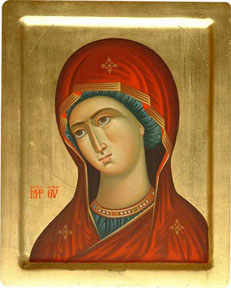
Illustration: Theotokos, Virgin Mary, Albanian icon

Bismillah al-Rahman al-Raheem. In the name of God, the Merciful, the Compassionate.

. . .And make mention of Mary in the Scripture, when she had withdrawn from her people to a place in the East, and had chosen seclusion from them. Then We [God] sent unto her Our Spirit and it assumed for her the likeness of a perfect human being. She said: “Truly I seek refuge in the Merciful One from you, if you are God-fearing”. He said: “I am only a messenger of your Lord, to give to you a pure son”. She said: “How can I have a son when no man has touched me, neither have I been unchaste”? He said: “Even so. Your Lord says: ‘It is easy for Me. And that We may make of him a revelation for humanity and a mercy from Us, and it is a thing ordained’”. And she conceived him, and she withdrew pregnant with him to a distant place. And the pains of childbirth drove her to the trunk of a palm-tree: She cried out: “Oh! Would that I had died before this! Would that I had been a thing forgotten and unseen!” Then (a voice) called out to her from beneath her: “Do not grieve, for surely your Lord has made a stream to flow beneath you; And shake towards you the trunk of the palm tree, it will drop on you fresh ripe dates: So eat and drink and refresh yourself. Then if you see any person, say: ‘Surely I have vowed a fast to the Merciful One, so I shall not speak to any one today’”. Then she brought the child to her own people, carrying him. They said: “O Mary! You have come with an amazing thing. O sister of Aaron! Your father was not a wicked man nor was your mother an unchaste woman”. Then she pointed to the child. “But they said, ‘How shall we speak to one who is still in the cradle, a little child?’ Jesus said, ‘Behold, I am God’s servant; God has given me the book and made me a prophet. God has made me blessed, wherever I may be; and God has enjoined me to pray and to give alms so long as I live, and likewise to cherish my mother; God has not made me arrogant or unblessed. Peace be upon me the day I was born, and the day I die, and the day I am raised up alive’”. Qur’an, Chapter of Mary, (19:16—35)

Good evening, al-salaamu alaikum, peace be upon you all.

I am, as ever, honoured to be here with you on this blessed night at Trinity-St. Paul’s. It is a great joy to be back in this church, both in the primary meaning of that word as this gathering of people, and in the secondary meaning of this amazing physical space that we share. Continue reading Tabsir Redux:Mary in the Qur’an

Fantasy, action and the possible in 2011


by Samuli SchielkeØŒ “You’ll be late for the revolution!”: Samuli Schielke’s Diary of the Egyptian Revolution, December 11, 2011

[Webshaykh’s note: The following is an excerpt from an essay by Samuli Schielke “about Lenin, Tahrir, Islamists, poetry, choice and destiny in an attempt to provide some sort of theoretical synthesis of a confusing experience. It is the very slightly modified transcript of a lecture I gave at the University of North Carolina in Charlotte on 6 December 2011.” For the full essay. click here.]

The elections are now bringing a landslide victory of Islamic religious parties. I was just reading the results of the first round – we don’t have the final results because the elections take place in three rounds, different provinces voting at different times (the electoral law requires every polling station to be supervised by a judge and there are not enough judges in the country). One third of Egypt’s provinces have voted now. The results show that about sixty per cent of the vote of the party lists go to two Islamist party alliances, one of them the Muslim Brotherhood who are conservative, and one of them the Salafis who are badass fundamentalists. This has completely surprised some people, but anybody who has actually been following the situation in the streets has not been surprised at all. Actually the Muslim Brotherhood got less votes than one would think. With 36% of the vote, they actually did badly. They should have gotten 50%.

In a country that just had a revolutionary uprising against a corrupt system that was not an uprising in religious terms but one in terms of social justice, or freedom, or human dignity, why did people vote for Islamic parties? One of them, the Muslim Brotherhood, supported the revolution (but sided with the Army very soon afterwards), the other, the Salafis, were actually supporting Mubarak. Why did people vote for them? Continue reading Fantasy, action and the possible in 2011

Is Taiz going to be the next Benghazi of Yemen?


by By Tom Finn, Time, Tuesday, Dec. 13, 2011

Read more: http://www.time.com/time/world/article/0,8599,2102183,00.html#ixzz1gXKFNc14
During the day, Taiz, a mountainous municipality nestled in the basin of Yemen’s rugged central highlands, has the feel of any other Yemeni city. Scrawny teenagers with wheelbarrows filled with oranges weave in and out of the traffic dodging debabs — local six-seater microbuses — and motorbikes as they splutter up and down the city’s steep, dusty alleyways. But once the sun begins to set and the mountains surrounding the bowl of the city darken into jagged silhouettes, the wail of the muezzins soon competes with the ominous thud of explosions.

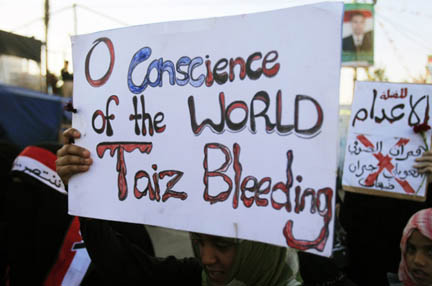
Taiz is famed for its doctors, lawyers and relative cosmopolitanism, but it was its youth who in February jump-started the movement in Yemen to oust the wily, decades-long ruler, Ali Abdullah Saleh, from power. Inspired by their counterparts in Tunis and Cairo, a group of men and women — most of them students — erected a circle of tents on a dusty boulevard in downtown Taiz and named it Freedom Square. Since then they have spent months braving a barrage of bullets, batons and tear-gas canisters from the security forces, marching through the city’s grubby streets and calling for change. (See photos of Yemen on the brink.)

But in recent weeks the conflict in Taiz has taken on a more deadly twist. Continue reading Is Taiz going to be the next Benghazi of Yemen?

Fire on Historic Gate of Zabid


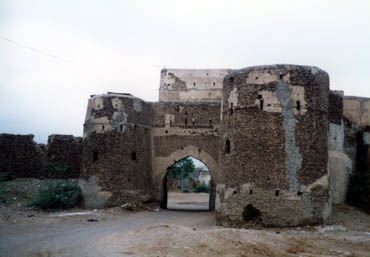
ذكرت مصادر محلية بمديرية زبيد بمحافظة الحديدة مساء يوم أمس الجمعة بأن حريقا” هائلا” تسبب في تشويه المنظر التاريخي لسقف المبنى الأثري الواقع في بوابة سهام بالجهة الشمالية لمدينة زبيد القديمة بمحافظة الحديدة ØŒ بالإضافة إلى إتلاف كمية كبيرة من الأخشاب المزينة بالنقوش الإسلامية الأثرية جراء الحريق الذي لم تعرف أسبابه حتى اللحظة .

وأشارت مصادر أمنية بالمديرية بأن ألسنة اللهب اشتعلت في المبنى الأثري التاريخي لبوابة مدينة زبيد الأثرية المعروفة ببوابة سهام ما أدى إلى احتراق سقف البوابة بالكامل إلى جانب كمية كبيرة من الأخشاب القديمة المزينة بالزخارف والنقوش التي لا تقدر بثمن.

وأضافت المصادر بأن أبناء زبيد لم يتمكنوا من أخماد الحريق الذي تصاعد بشكل مخيف في المبنى الاثري ولا تزال التحقيقات جارية لمعرفة أسباب ودوافع الحريق.

هذا وكانت زبيد قد أدرجت في قائمة التراث الإنساني العالمي في العام 1993Ù… , واعطت منظمة اليونسكو التابعة للأمم المتحدة اليمن مهلة للبدء في تنفيذ برنامج إنقاذي شامل لحماية ما تبقى من المعالم الأثرية في المدينة التاريخية والتي باتت مهددة بالاندثار قبل أن تباشر “اليونسكو” في إجراءات شطبها من قائمة التراث الإنساني بصورة نهائية.

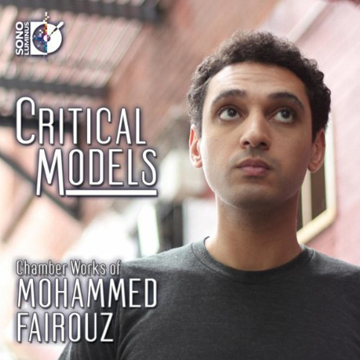
Chamber Works from Mohammed Fairouz


Q2 Music Album of the Week for December 6, 2011 | Free Download of “Four Critical Models: III. Catchword An Oriental Model”
WQXR, Tuesday, December 06, 2011

There’s an embarrassment of riches on Critical Models, the debut solo album by 20-something composer Mohammed Fairouz. And yet the chamber nature of the record’s six pieces lends an unshakable sense of intoxicating intimacy.

A contemporary of Gabriel Kahane and Nico Muhly, Fairouz is a composer with an equally distinguished pedigree (he was one of Ligeti’s last students), but with a different brand of sound that replaces Muhly’s unabashed exuberance for introspective intensity and Kahane’s droll humor for incisive wit. Album opener Litany starts off with a whisper of flute, oboe and clarinet, before opening into a richly woven woodwind tapestry of neoclassical rhythms and unsettling fluid lines. The composition ends palindrome-like on the same subtle note that begins the four-and-a-half–minute work.

Litany sets the tone for an album that is a study in contrasts, full of setting and implied text that forms the basis to many of Fairouz’s works. Title work Four Critical Models careens between Fairouz’s dual identities as American and Middle Eastern, traditional and modern, with distinct references to Edward Said and his brand of orientalist studies (the captivating third movement, An Oriental Model, is most effectively schizophrenic). Continue reading Chamber Works from Mohammed Fairouz

Tabsir Redux: Ibn Tufayl’s Fable


What would happen to a child growing up on an island outside any human society? In real life such a scenario would be absurd. No child could survive from birth on his or her own, despite exotic accounts of feral human babies being reared by animals. But as a thought experiment, it makes an intriguing story. Such is the philosophical fable spun by the Andalusian Muslim scholar Ibn Tufayl over eight centuries ago. I have just finished teaching this text and the lessons in it are fresh in my mind.

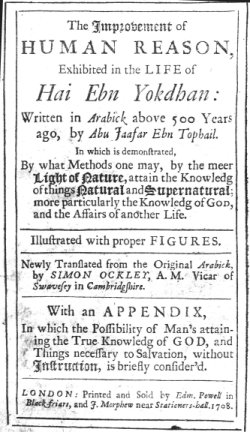
If you have never read this classic fable, it can be found online in the original 1708 translation into English by Simon Ockley. A more recent translation by Lenn Evan Goodman is available from Amazon. The author was a distinguished Muslim intellectual who borrowed from the earlier Greek icons Aristotle and Plato, as well as the commentaries by earlier Muslim philosophers like Ibn Sina (Avicenna) and al-Farabi. His fable combines logical arguments, inductive scientific observation and a form of intuition that leads to a union with the One. Continue reading Tabsir Redux: Ibn Tufayl’s Fable

Will Saudi Women Lose Their Virginity En Masse If They Start Driving?


by Melody Moezzi, MS.blog Online, December 3, 2011

My first thought is “no,” followed by a swift “none of your business.” But that wasn’t the conclusion of a recent report prepared for Saudi Arabia’s legislative assembly by a well-known academic. He predicted that if Saudi women were given the right to drive, those who had never had sex would quickly start losing their virginity as easily as they might their car keys.

Let’s start with the basics here: It’s a hell of a lot harder to lose your virginity in the front seat, as opposed to the back. Especially while driving. I mean, it’s difficult enough to text and drive.

But if that isn’t enough to sway the Saudi government, I recently polled several of my female friends, and I’ve come up with a report of my own. I submit the following report to the Saudi legislative assembly, which I suspect is far more scientific than the aforementioned prominent academic’s: NONE of the friends I polled, a large number of whom happen to be Muslim women originally from the Middle East, has lost her virginity while driving. Nor did a single one of them lose her virginity immediately after obtaining a driver’s license. Shocking, I know. Continue reading Will Saudi Women Lose Their Virginity En Masse If They Start Driving?

New Books in Islamic Studies


A new website has been launched called New Books in Islamic Studies, hosted by Kristian Petersen of Gustavus Adolphus College in St. Peter, Minnesota. The site contains short descriptions of relevant books, the most recent on the site being Laury Silvers, A Soaring Minaret: Abu Bakr al-Wasiti and the Rise of Baghdadi Sufism (SUNY Press, 2010).

Here is the description of Laury’s new book:

A broad portrait of early Islamic mysticism is fairly well-know. However, there are only a few key figures that have been explored in great detail and their activities shape how we understand this early history of Sufism. Laury Silvers, Professor of Religion at the University of Toronto, makes a significant contribution to the early development of Sufism by focusing on an influential but lesser-known figure, Abu Bakr al-Wasiti (d. ca. 320 AH/932 CE), the “soaring minaret.” In her new book, A Soaring Minaret: Abu Bakr al-Wasiti and the Rise of Baghdadi Sufism (SUNY Press, 2010), she situates Wasiti and his contributions within the broader historical developments in the formative period of Sufism. By doing so she deepens our knowledge of the development and spread of Baghdadi Ahl al-Hadith culture East to Khurasan, the consolidation of Baghdadi Sufism and the internalization of Khurasani traditions during the formative period. Continue reading New Books in Islamic Studies