All posts by tabsir

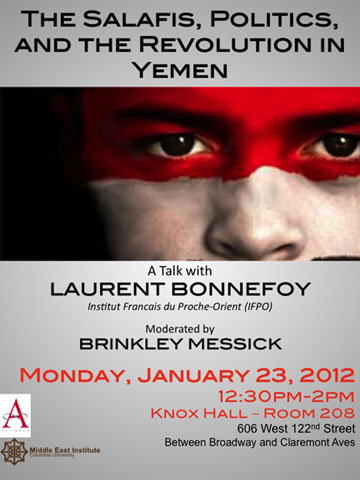
The Salafis, Politics and the Revolution in Yemen

The Salafis, Politics and the Revolution in Yemen

Monday, January 23rd; 12:30pm-2pm
208 Knox Hall ~ 606 West 122nd Street, New York, NY

A lecture by Laurent Bonnefoy
Moderated by Brinkley Messick

Since the early 1980s, Salafism in Yemen has developed as a mostly apolitical movement. Yet, the revolutionary process that emerged in 2011 is changing much of its face in the country and fostering deep recompositions in the Islamist field. This lecture will analyze these changes and concentrate on showing why this political movement matters beyond issues of counter-terrorism.

Laurent Bonnefoy (PhD), born in 1980, is a researcher in political science at the Institut Français du Proche-Orient (IFPO) based in Palestine. Building on four years spent in Yemen, his research focuses primarily on contemporary religious identities in the Arabian Peninsula. He is the author of Salafism in Yemen. Transnationalism and Religious Identity (Columbia University Press, 2012).

Co-sponsored by the Middle East Institute and the Alliance Program.

Cool as a Camel

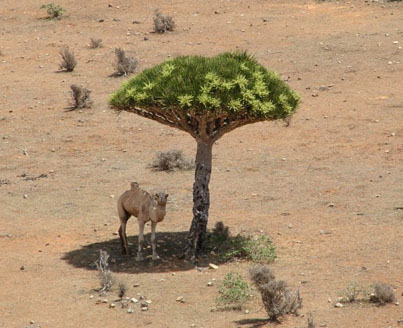
How the camel kept its cool: Dromedary in the desert finds shade under rare tree that does the job of a parasol

By Chris Parsons, Daily Mail, January 4. 2012

When the temperature soars around the sweltering 40C mark, you’ll take anywhere as respite from the scorching rays no matter how unusual it looks.

This camel sought refuge in the baking heat on the Island of Soqotra in Yemen by sheltering in the shade under an unusual tree which looks like a giant mushroom. Continue reading Cool as a Camel

Worldwide Association for the Study of Religion


Whatever you think about “religion,” you must admit that “religion” is not something that can be avoided. There are countries where a person has little choice but to accept the dominant religion imposed and there are places where one can shop for religion more easily than clothes. As an anthropologist I accept the fact not only that we have evolved (even if Darwin did not start a religion) and that all members of Homo sapiens that have been encountered and studied have something that deserves to be called “religion,” even if only in the minimalist sense of Victorian Quaker Edward Tylor that religion is at bottom a belief in spirits. There are many religions out there and several important scholarly organizations devoted to the study of religion in one way or another, but add a new one to the mix.

Anthropologist Gabriele Marranci, founder of the journal Contemporary Islam, has formed the Worldwide Association for the Study of Religion (WASR perhaps for those who like acronyms) If you do not have a Facebook account, join the Wiki.

This group is open to scholars studying religion or with an interest in religion and aims to develop a worldwide association accessible to any scholar or student wherever they might live. This is a working group to develop ideas and the structure for this new association, which aims also to remove the gap between scholars working in developing countries and those in the West. This group is open to scholars studying religion or with an interest in religion and aims to develop a worldwide association accessible to any scholar or student wherever they might live. As scholars the goal of the association to study religion in all its forms and not to lobby for any particular religion or even for the absence of religion. This is a working group to develop ideas and the structure for this new association, which aims also to remove the gap between scholars working in developing countries and those in the West.

As Marranci notes, his effort is not to replace organizations like the American Academy of Religion, but to expand the network of scholars who study religion worldwide. With the Internet and Skype, scholars are no longer captive to meeting colleagues at professional meetings, important as these remain. Feel free to join today and tell your friends.

On Facebook; you can request joining (which is free) by clicking here. You can also join via the Wiki.

Islamic Manuscripts at Cambridge


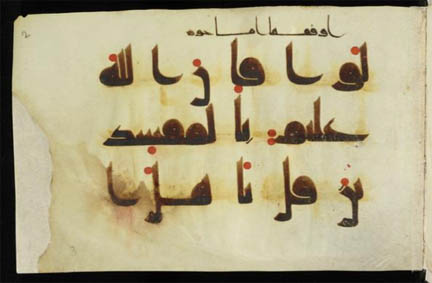
The Cambridge Digital Library now has online access to some of their Islamic manuscripts. Details below, as described on the website:

Cambridge University Library’s collection of Islamic manuscripts dates from the origins of Arabic scholarship in Cambridge in the 1630s when the University founded a Professorship in Arabic and William Bedwell donated a Qur’an to the Library. Since that time the collection has grown in size and diversity to over 5,000 works, including the collections of Thomas Erpenius, J.L.Burckhardt, E.H.Palmer and E.G. Browne. These manuscripts shed light on many aspects of the Islamic world, its beliefs and learning.

The collection was further enriched over the centuries through the activities of scholarly collectors and skilled librarians, adding more depth to the already impressive range of manuscripts. Yet this extraordinary collection has remained relatively unknown outside Cambridge. Now we hope to draw better attention to its treasures through cataloguing and digitisation. We have collaborated with the Bodleian at Oxford and other research libraries to provide an online catalogue of the collection. We will be offering a selection of digitised manuscripts through the Foundations project and will seek funding for further digitisation. Continue reading Islamic Manuscripts at Cambridge

Tabsir Redux: A Candid[e] View of an Honest Turk

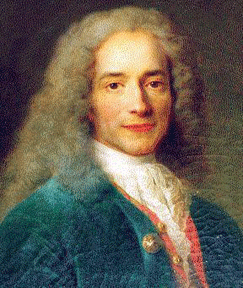
[One of the great moral tales of the 18th century is Voltaire’s (1759) Candide, a book well worth reading and rereading from time to time. Here is an excerpt from the end of the book, but it is not Orientalism in the Saidian sense of negative portrayal; indeed it is the honest Turk which stands in contrast to tyrants of all stripes.]

During this conversation, news was spread abroad that two viziers of the bench and the mufti had just been strangled at Constantinople, and several of their friends impaled. This catastrophe made a great noise for some hours. Pangloss, Candide, and Martin, as they were returning to the little farm, met with a good-looking old man, who was taking the air at his door, under an alcove formed of the boughs of orange trees. Pangloss, who was as inquisitive as he was disputative, asked him what was the name of the mufti who was lately strangled.

“I cannot tell,” answered the good old man; “I never knew the name of any mufti, or vizier breathing. I am entirely ignorant of the event you speak of; I presume that in general such as are concerned in public affairs sometimes come to a miserable end; and that they deserve it: but I never inquire what is doing at Constantinople; I am contented with sending thither the produce of my garden, which I cultivate with my own hands.” Continue reading Tabsir Redux: A Candid[e] View of an Honest Turk

Best of the Blogs


Cartoon source: http://www.trafficgenerationcafe.com/blog-website-faceoff/

Bassam Gergi and Mazen Zoabi unroll their guide to the Arabic blogosphere

Open Democracy, 12/30/11

Jadaliyya aims to shape the debate in the west by providing a window into regional scholarship and knowledge. Where others see data points, they see “living communities and dynamic societies.” The site currently publishes posts in both Arabic and English.

Mamfakinch is run by a group of young Moroccan activists who founded the #Feb20 movement calling for broad political, economic and social change. It aims to highlight information often ignored or distorted by official media sources. The site currently publishes posts in French, Arabic and English.

Nawaat, which means ‘the core’, was created to provide a platform for Tunisian bloggers and cyber-activists. It played a critical role in the Tunisian uprising and recognises that the “conquest of freedom is a battle to be fought every day. It currently publishes posts both in French and Arabic. Continue reading Best of the Blogs

A Buick in Kabul


One of the most famous round-the-world journalists of the last century (or any century) was Lowell Thomas, most known for his blockbuster show on “Lawrence of Arabia.” In 1922 Thomas traveled to Afghanistan and visited the Emir Amanullah. A digital archive of 73 photographs from that trip is available online at Harvard University. Here are pictures of Kabul and other parts of Afghanistan from 90 years ago. Several of the photographs show the American Buick that Thomas drove for his visit. If you happen to be old car buff and interested in Afghanistan, this will be a visual feast.


Continue reading A Buick in Kabul