All posts by tabsir

Israel’s Moral Peril

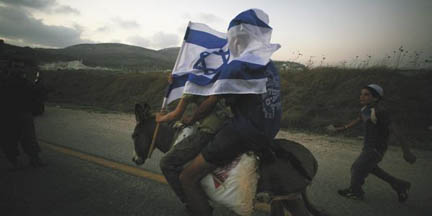
Children hold an Israeli flag in the Jewish settlement of Itamar on the West Bank; Photo by Rina Castelnuovo, The New York Times

By Alan Wolfe, The Chronicle of Higher Education, March 25

In the past few years, a trickle of dissent with respect to Israel has turned into a running stream. Books, articles, and Web sites critical of Israel’s treatment of the Palestinians, its acquiescence in the messianic designs of its settlers, its foreign-policy decisions on Gaza, Iran, and much more, and the increasing influence of the ultra-Orthodox over the character of its domestic life have begun to appear in significant numbers in America. Some, but not all, of these efforts, moreover, come from writers unused to being in the critical camp. The question is rapidly becoming not whether one should find fault with Israel, but how.

Two quite contrasting points of view have emerged among the critics. One can be called liberal and the other leftist. Liberals accept Israel’s legitimacy, search for ways that it can respect the rights of its non-Jewish citizens, and believe that the only viable future for the country is a two-state solution, one primarily Jewish, the other primarily Palestinian. Leftists view Israel’s creation in 1948 as an outgrowth of European colonialism, insist that as a Jewish state its character is inevitably racist, and lean toward the eventual creation of one state containing both Jews and Arabs. Should Israel’s actions continue to provoke opposition around the world, the question of which of these approaches will attract the most followers will become increasingly important.

I have a personal interest in this topic because I now count myself among the critics. For decades, I managed to write about some of the more controversial issues dominating the world without writing about the Middle East. The reason was simple: I was too intellectually paralyzed to do so. As a child, I had displayed an Israeli flag and carried blue-and-white coin boxes whose proceeds would plant trees in the new state. That, however, was about it: Serious Hebrew lessons, Zionist summer camps, and trips to the Middle East were of little interest to either my secular parents or me. Yet for all my family’s tendencies toward assimilation, Israel’s legitimacy was never questioned. Jews had been the victims of the greatest monster in history. Supporting the new state was the least the world could do to make up for it. We were, as I recall, vaguely aware that Arabs already lived on the land Israel claimed, but their complaints, to the degree that we heard them at all, seemed trivial by comparison to what had happened to our people. Continue reading Israel’s Moral Peril

Women in Yemen’s Arab Spring


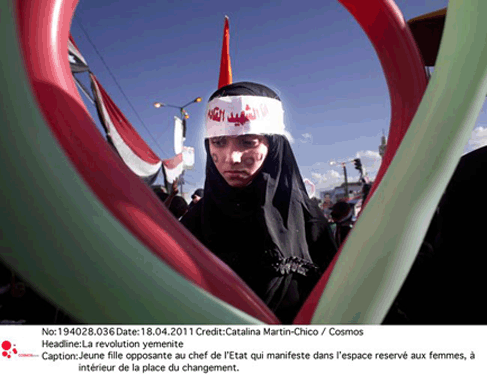
The website arabwomenspring has posted a summary of Yemeni women’s participation in the recent political protests and historical background on their role in governance. Below is an outline of the contents of the online report:

1 Women’s participation in demonstrations
1.1 Time-line of key events
2 Women’s participation in political life: opportunities and obstacles
2.1 Representation in government
2.2 Representation in parliament
2.3 Representation in local councils
2.4 Representation in the judiciary
3 A discriminatory legal framework
3.1 CEDAW
3.2 The Constitution
3.3 Other discriminatory laws
4 Further reading

Ernst on Reading the Qu’ran


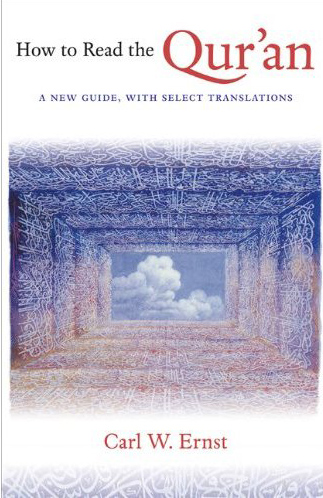
Carl Ernst, How to Read the Qur’an: A New Guide, with Select Translations. University of North Carolina Press, 2011

by Kristian Petersen, New Books in Islamic Studies, February 27, 2012

Recent events revolving around the Qur’an, such as the accidental burning of it in Afghanistan or the intentional provocations of radical American Christian pastors, suggest that Westerns often still fail to understand the role of the Qur’an in Muslims lives. On occasion, the mere suggestion of having Westerners read the Qur’an in order to gain a better understanding of its message has incited anger and lawsuits, as was the case at the University of North Carolina in 2002.

The inability to bridge these cultural differences and the many inherent challenges the Qur’an possesses inspired Carl W. Ernst, Kenan Distinguished Professor of Islamic Studies at the University of North Carolina, to write his new book How to Read the Qur’an: A New Guide, with Select Translations (University of North Carolina Press, 2011). He wondered how should the non-Muslim read the Qur’an? This comprehensive introduction presents a literary historical approach that enables the reader to understand how the Qur’an’s initial audience encountered it through a chronological reading, traditionally understood through the early Meccan, later Meccan, and Medinan periods of Muhammad’s career. It introduces a reading that understands the structure and form of the text as informing the meaning. Thus, Ernst examines the symmetry and balanced composition of verses, the tripartite structure of certain chapters, intertexuality within the Qur’an, and uses rhetorical analysis and ring composition as a means to approach and understand seemingly contradictory religious claims. Ernst’s text is engaging and informative while achieving its goal of making the Qur’an accessible to the non-Muslim. His new book will certainly motivate a future group of Qur’anic studies scholars and will allow the uninitiated reader to better understand what the previously veiled text says about the cosmos and Muslims position in it.

Note: To hear an audio interview with Carl Ernst about his book, click here and scroll to the bottom.

Lady Burton in Jeddah


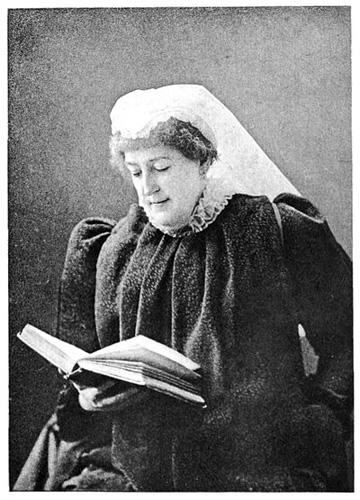
Lady Isabel Burton, wife of Sir Richard Francis Burton

[The following is an excerpt from The Romance of Lady Isabel with her reflections on visiting Jedda on the way to India in 1876. The entire book is available online.]

I was delighted with my first view of Jeddah. It is the most bizarre and fascinating town. It looks as if it were an ancient model carved in old ivory, so white and fanciful are the houses, with here and there a minaret. It was doubly interesting to me, because Richard came here by land from his famous pilgrimage to Mecca. Mecca lies in a valley between two distant ranges of mountains. My impression of Jeddah will always be that of an ivory town embedded in golden sand.

We anchored at Jeddah for eight days, which time we spent at the British Consulate on a visit. The Consulate was the best house in all Jeddah, close to the sea, with a staircase so steep that it was like ascending the Pyramids. I called it the Eagle’s Nest, because of the good air and view. It was a sort of bachelors’ establishment; for in addition to the Consul and Vice-Consul and others, there were five bachelors who resided in the building, whom I used to call the “Wreckers,” because they were always looking out for ships with a telescope. They kept a pack of bull-terriers, donkeys, ponies, gazelles, rabbits, pigeons; in fact a regular menagerie. They combined Eastern and European comfort, and had the usual establishment of dragomans, kawwasses, and servants of all sizes, shapes, and colour. I was the only lady in the house, but we were nevertheless a very jolly party. Continue reading Lady Burton in Jeddah

Happy Birthday Sir Richard Francis Burton


Burton in Aden

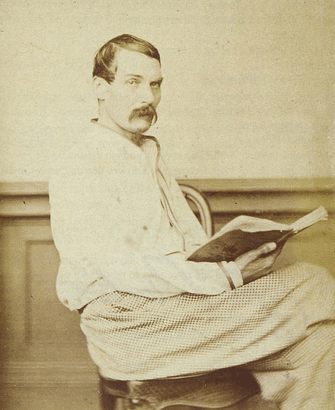
Today is March 19. Exactly 191 years ago, at 9:30 in the evening in the British town of Torquay in Devon the future Sir Richard Francis Burton was born. Like his 2oth century acting namesake, Burton was a character for the ages. He reveled in adventure and eroticism, for which he was much reviled in public and no doubt admired in private. If any one word can be used to described the persona that Burton pursued it would be “swashbuckling” in life as in spirit. My point today is neither to praise this flamboyant quasi-Victorian Caesar nor bury him (his grave is indeed a monumental site to behold). May his dry bones rest in the kind of peace he never seems to have found in life.

Burton’s biographers are numerous, as befits someone who is remembered as larger than life. His prolific corpus is now almost entirely online in various formats, but the place to start is burtoniana.org. There is much to question and quibble about in Burton’s exploits. Was his surreptitious entry into Mecca, disguised as a pilgrim, a travesty of Islamic values? Did his fascination with erotica in an age of gentlemananged taboos overstep ethical bounds? Was he the bad kind of “Orientalist,” a discourse cum intercourse voyeur that warrants calling him “Dirty Dick”, as Edward Said does in Orientalism (p. 190)? Was he, perhaps, a bit mad in that ubiquitous England manner?

Whatever you might think of the man, it is probably because of what you have read about him rather than what he actually wrote. Regardless of what he is saying, it must be noted that he had an extraordinary capacity for learning languages. Below is a list of the languages and dialects he is said to have mastered to some extent:

English, French, Italian, Latin, Greek, Jataki dialect (he wrote a grammar), Hindustani, Marathi, Urdu, Arabic, Persian, Pushtu, Sanskrit, Portuguese, Spanish, German, Icelandic, Swahili, Amharic, Fan, Egba, Ashanti, Hebrew, Aramaic, Many other West African & Indian dialects

I suspect he would get into Harvard, no matter what his SAT score.

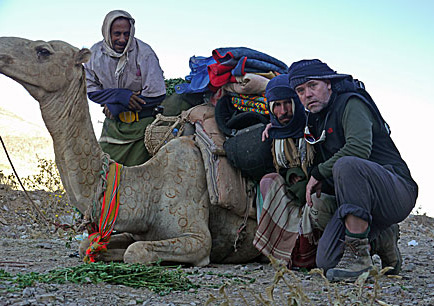
A Swede and a camel in Yemen


by Iona Craig, The National, January 9, 2012

A Swedish adventurer crossing Yemen by camel hopes his journey will encourage tourists to see beyond the political turmoil and violence that has engulfed the country for nearly a year.

Mikael Strandberg set out on December 7 on a 380-kilometre trek across the treacherous highlands, the first leg of his Yemen venture, to disprove the purveyors of pessimism.

“I don’t know what they [the tourists] are waiting for … it is such a wonderful country with great potential,” he said, after arriving in Sanaa after a two-week march through the toughest terrain in the Arabian Peninsula.
Along with two Yemeni companions, Mr Strandberg is in the initial phase of a journey that will cross the country from the western coastal plains of Hodeida to the edge of the world’s largest sand desert, the Rub’ Al Khali, or Empty Quarter, and beyond to Oman.

The explorer, 48, who fell in love with both the country and his wife Pamela, an American, during a visit to
Yemen three years ago, holds fond memories of Sanaa and the Yemeni people.

“We decided to go and try to make a difference and give a different perspective from the one portrayed by the media,” said Mr Strandberg. Continue reading A Swede and a camel in Yemen

Numismatics at Hofstra


Sogdiana, Chach 3rd century

The Middle Eastern and Central Asian Studies program at Hofstra announces
the Fourth Seminar on Central Asian and Middle Eastern Numismatics in Memoriam Boris Kochnev

Hofstra University, Breslin Hall 217, March 17, 2012
(Directions to Hofstra)

Attendance is free and all are welcome.

11:00 am
Daniel Varisco (Hofstra University)
Opening Remarks

11:15 am
Vladimir Belyaev (Zeno.ru, Sankt-Petersburg) and Aleksandr Naymark (Hofstra University)
Ancient Sogdian Coins from the Center of Kashka-darya Valley

12:00 noon
Stefan Heidemann (Hamburg University)
A Hoard from the Time of the Collapse of the Sasanian Empire

12:45 pm Lunch Break

1:30 pm
Michael Bates (American Numismatic Society, New York )
How Ziyad Made a Name for Himself:
Coins and the Chronology of Ziyad ‘son of his father’/’son of Abi Sufyan’ Continue reading Numismatics at Hofstra