All posts by tabsir

Tabsir Redux: Mocha Musings #1: Mecca and Arabia

Arbuckles’ Ariosa (air-ee-o-sa) Coffee packages bore a yellow label with the name ARBUCKLES’ in large red letters across the front, beneath which flew a Flying Angel trademark over the words ARIOSA COFFEE in black letters. Shipped all over the country in sturdy wooden crates, one hundred packages to a crate, ARBUCKLES’ ARIOSA COFFEE became so dominant, particularly in the west, that many Cowboys were not aware there was any other kind. Keen marketing minds, the Arbuckle Brothers printed signature coupons on the bags of coffee redeemable for all manner of notions including handkerchiefs, razors, scissors, and wedding rings. To sweeten the deal, each package of ARBUCKLES’ contained a stick of peppermint candy. Due to the demands on chuck wagon cooks to keep a ready supply of hot ARBUCKLES’ on hand around the campfire, the peppermint stick became a means by which the steady coffee supply was ground. Upon hearing the cook’s call, “Who wants the candy?” some of the toughest Cowboys on the trail were known to vie for the opportunity of manning the coffee grinder in exchange for satisfying a sweet tooth.

While sorting through a bevy of late 19th century advertising cards and magazine illustrations collected by my great, great aunt in several yellowing albums, I came across several for the Middle East that were published for Arbuckle’s coffee. Continue reading Tabsir Redux: Mocha Musings #1: Mecca and Arabia

First words since…..burying a 16-year old angel


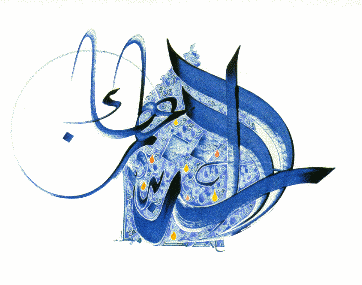
Calligraphy by Hassan Massoudy, an Iraqi artist based in Paris

by Omid Safi, Religion News Service, April 22, 2011

On Thursday, I went to the funeral of a 16-year old angel.

This was not a child, faceless and nameless, that you see buried in a newspaper. This was a child born to a family that I adore, a family whose whole lives has been spent in service to humanity. I was there when this angel came home from the hospital, and I used to babysit her when her mother, a leading scholar of Islamic studies, was finishing her PhD.

This was a child that every one of her teachers called the single most brilliant, creative, and inspiring child they had ever taught.

We put her body in the ground, the machines lowered a cement block on top of the coffin, and each of us scattered a handful of dirt, a rose, and tears, on her grave. Her adopted aunts and uncles sat by the graveside, and recited Qur’an verses to keep her soul company on the journey back to God.

We wept as few of us have ever wept before. We have not stopped crying. This is the kind of weeping that taps into a shattering of a heart.

High school kids with tattoos and dyed hair wept. Those of us who are parents wept for this child, for this family, confronting what is every parent’s absolute worst nightmare. Teachers wept.

Her mother stood up before us, beginning in the name of God, and catching her breath several times as she spoke through tears, softly and clearly. She thanked God for the gift of this beautiful child, for each one of the 16 years. She acknowledged that each of us felt that parents should not bury their own children, but we are not given any guarantees. She said gracefully that while she “strongly disagrees” with God’s plan to call her angel home, she abides in faith and is grateful.

I am a scholar of religion. Pondering these large questions of life—and sadly, death—is what I do, what I am supposed to do. I have looked into my own tradition, Islam, as well as Christianity, Judaism, Buddhism, and others, to find some semblance of explanation, of meaning. Continue reading First words since…..burying a 16-year old angel

Tabsir Redux: A Rose for the Last Days

by Rana al-Tonsi [Translated from Arabic by Sinan Antoon]

On one foot
like a humiliated beggar I limp
past all the swinging doors
and the flags that are taken down from their masts . . .
The sidewalk was never my friend
but it embraced me those times
when the crying was tough and bitter

In my country
soldiers go to a war
where they never fight
In every coffeehouse or square
under the feet of the sick, the sad and insane
you can glimpse the trace of a rose
thrown into the arms of nurses
in lonely rooms inhabited by wailing,
a rose drawn in blood. Continue reading Tabsir Redux: A Rose for the Last Days

Tribalism in Yemen has changed deeply


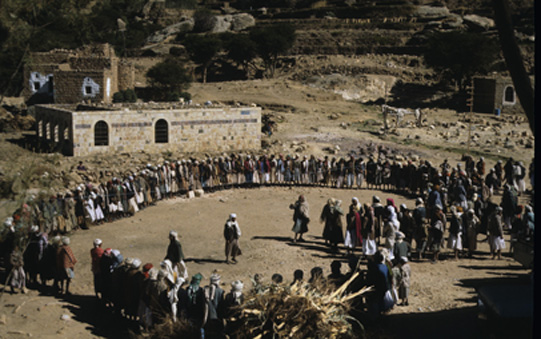
Tribesmen voting in al-Ahjur, Central Highlands, 1978

By Elham Manea, The Daily Star, April 6, 2012

February’s presidential election in Yemen by no means marks the end of the country’s troubles. However, the suggestion that the United States host a new arrangement based on decentralized negotiation between tribal and regional leaders is not the way to solve them.

Such a call ignores lessons from Yemen’s past and underestimates the deep changes that have taken place in Yemeni society over the last decades. Although the tribal system continues to operate as the prevalent mode of social organization, it is crucial to recognize that the nature of tribal networks and institutions has changed drastically.

Historically, tribal networks compensated for the state’s lack of capacity. The tribe assumed the role of protector and provider: securing tribal territory, protecting water wells, and resolving conflicts between its members or with other tribes. In many ways, the tribe was the institution of first resort for financial backing and social support in times of crisis. It is perhaps very telling that Aden – where the nuclear family has displaced the tribe as the main social unit – is more affected by poverty than regions that have preserved tribalism, such as Shabwah, Mahra and Al-Dali.

Tribal sheikhs were also once accountable to their constituents: They were elected and could be voted out. Thus, a sheikh was often regarded as a first among equals, rather than an absolute ruler. Custom (Irf) governed the mediation of conflict within or outside the tribe and could not be violated without loss of honor – a distinct disgrace – and threat of severe penalty. Continue reading Tribalism in Yemen has changed deeply

“My Name is Khan” déjà vu


Shah Rukh Khan as sex symbol

Someone really needs to read the riot act to The Patriot Act. Yes, the threat of terrorism is real and we millions of passengers dutifully take off our shoes and spread out our arms for see-through scanning or pat-down frisking in airports. But screening does not have to be irrational. How many times must a world-famous actor like Shah Rukh Khan be detained by security when he enters the United States? This is not the first time. What status is there to check out? Does the image above look like a serious threat? Would Salman Rushdie be rushed into detention?

Here is the report on Al-Jazzera :

He is one of the most famous men on the planet. Adored by millions. His films are almost always box office smashes. But when Bollywood star Shah Rukh Khan travelled to the US on Thursday, he was detained by security for two hours while they checked out his “status”.

Ironic, considering his biggest hit film was the story of a man determined to visit the US president and give him a very simple message: My Name is Khan and I’m not a terrorist.

The film is a powerful look at what it means to be Muslim in the land of the free and the home of the brave. I wonder if he told Homeland Security that he wasn’t a terrorist.

He says he feels angry and humiliated. I know how he feels. In the last three years I have travelled to the US six times. Each time, bar one, I was stopped. I was asked to go to a holding facility and my passport was taken. You are asked to sit down by a polite but hostile official. Continue reading “My Name is Khan” déjà vu

Winter in Syria


Maya Youssef, Syrian kanun player

Amidst all the strife that the Syrian people have been suffering over the past year, imagine a musical break. Imagine Vivaldi in Syria. Imagine a performance of Vivaldi’s “winter” from his Four Seasons. Imagine this played by the Syrian National Orchestra and accompanied by a kanun. Well, imagine no more. You can listen to Maya Youssef playing this right now. Enjoy.

For more information on Maya Youssef, click here.