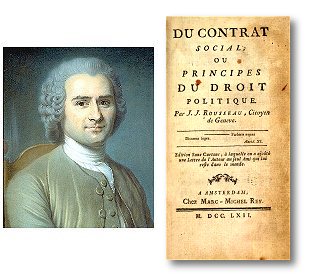
Remember your Rousseau: “man is born free, but he is everywhere in chains.” Updating the male-oriented language of his day, women must also be born free. Feminists would argue that everywhere she is also bound in chauvanistic chains, but what would Rousseau say about women who in some places are hidden away head to toe in full-length veils? To veil or not to veil: that has become more than a philosophical question these days. A recent legal opinion in France denied Faiza Silmi, a Moroccan woman, French citizenship because of her insistence on wearing the niqab, which obscured all but a narrow slit-view of her eyes in public. In a similar context, a Muslim woman in Florida was not allowed to have her driver’s license picture taken without showing her face. While relatively few Muslim women in Western societies choose to be chador laden or walk around in full-length woven tents, the few that do invariably stir strong feelings. If the intention is to be invisible, the opposite response is inevitable. In both these cases the issue was not one of physically removing their choice of dress in public, but one of a lack of the conformity necessary for negotiating individuality in the public sphere. If you want to become a French citizen, an option rather than a natural right, then you must accept the range of behavior agreed upon as acceptable in secular French culture. Dressing like Muhammad’s wives supposedly did in the 7th century may convince the authorities in Saudi Arabia, but modern France freed itself from the bloody history of religious bigotry that such symbols often cover. If you want the privilege of driving a car, then you need to pass a driving test and not obstruct your vision or prevent authorities from identifying you by failing to show your face.
Is this discrimination against Muslims who choose to practice a very conservative style of faith? Should a woman be allowed to wear the niqab, covering completely in public, is she so chooses? The answer, I believe, is a resounding ‘no’ both in France and the United States, and indeed any secular state. First of all, by far the vast majority of Muslims in secular societies do conform in public. Responding to the case in Morocco, Ms. Fadela Amara, France’s Minister of Urban Affairs, said: “It is not a religious insignia but the insignia of a totalitarian political project that promotes inequality between the sexes and is totally lacking in democracy.†To the extent wearing such garb in public is viewed as extreme by fellow Muslims in France, the issue is not simple discrimination against Islam. Second, a key component of secular society is not the absence of religion, but its cultural domestication for the good of the many. In the case of total covering of the body to the point of not being recognizable, such a nonconformist act is not a simple religious symbol. The act treats the public sphere, which is necessarily shared by a range of citizens, with disdain.
The logic of ethics in a pluralistic society suggests that if an individual has a right to break the conformity of acceptable dress by wearing too much then that same right must be granted to those who would choose to wear nothing at all. To argue that any man who sees a woman’s face or hands is necessarily exposing a woman to evil has no moral priority over the idea that a woman or man should be allowed not to feel shame about their body in public. Here Rousseau is right: public presence needs to be moderated by a culturally negotiated social contract for the public good and not simply for the peculiar practice of an individual. The same conformity considerations which do not allow a woman to bare her breasts in the normal public sphere cover the case of someone who would float through the public sphere in a virtual tent without any recognizability. In a secular state public space is for the public good, and total concealment is as much a threat to the social order as nudity. The issue is not what is natural, as the very choice of wearing clothing at all is cultural. I may personally believe that there is no Eden-induced shame in exposing my genitals, but the cultural trajectory of society at large has not yet arrived at a point when clothing can be considered optional in public. Nor, in secular Western societies has the anti-social notion that a woman’s body (but not a man’s) must be totally removed from view in public.
Faiza Silmi insists that wearing the niqab is her choice and not the dictate of her husband. On an abstract level this raises the issue of when a choice is a choice and how anyone can determine that free will is indeed free and not coerced in some way? As philosophical and theological questions, the debate over these kind of quotidian but ambiguous ethical principles has long been engaged. In the past heads have been lopped off and whole bodies roasted as heretical, often with the mantra of God’s will being done. The problem is that when an individual chooses, even if she only thinks she is choosing, to wear niqab in a social context where it is seen as aberrant or an affront to shared public space, it is not simply a statement of faith; such a nonconformist act can and will be read as a challenge to the established norms of a secular society. Had Faiza chosen to parade naked down Les Champs-Elysees, the problem would be the same.
In the case of Ms. Silmi, her quest for French citizenship needs to include acceptance of what Rousseau so eloquently stated almost two and a half centuries ago:
“Each of us puts his person and all his power in common under the supreme direction of the general will, and, in our corporate capacity, we receive each member as an indivisible part of the whole.”
At once, in place of the individual personality of each contracting party, this act of association creates a moral and collective body, composed of as many members as the assembly contains votes, and receiving from this act its unity, its common identity, its life and its will. This public person, so formed by the union of all other persons formerly took the name of city,4 and now takes that of Republic or body politic; it is called by its members State when passive. Sovereign when active, and Power when compared with others like itself. Those who are associated in it take collectively the name of people, and severally are called citizens, as sharing in the sovereign power, and subjects, as being under the laws of the State.
Modesty in dress is a principle that crosses religious borders and allows Muslim women, as well as all others, access to a shared space. Muslim men who have a problem with this should lower their gaze, as the Quran recommends, rather than making women invisible. The human body must, within reason, be subject to the body politic.
Daniel Martin Varisco