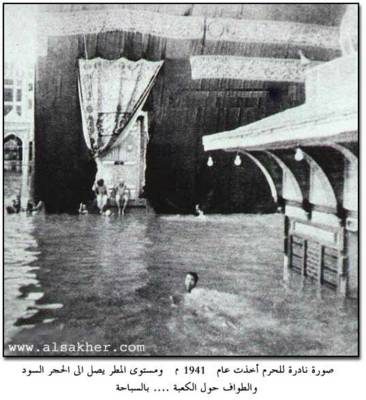
Flooding in Mecca in 1941, in which the circumambulation had to be swum
In many parts of the Middle East, where water is not an easily accessible resource, rain is baraka. The Arabic term baraka is only vaguely understood in the English sense of “blessing,” the lexical translation. Context makes this heaven-sent product a blessing some times and a curse other times. Pilgrims to Mecca this year have witnessed torrential rain, dampening the make-shift hotel tents and ihram garb, but perhaps not the enthusiasm of the hajjis and hajjiyyas. An article on today’s Al-Jazeera website notes that about three million Muslims are performing the pilgrimage; as for the number of umbrellas being used, Allahu a’lama. Normally, extra rain in the arid environs of Mecca and Medina would seem something to evoke al-hamdillah from the faithful, but in this case timing is a problem. Some 50 people have already been killed due to these rains, and the fear of spreading disease during an already concurrent high flu season is no doubt troubling to the health officials. The H1N1 flu has already claimed four pilgrims and some 67 have been diagnosed with the virus. Perhaps the Egyptian government missed a few of those dangerous swine of the Christian Zabbalin.
So if one assumes that this ordained ritual is important in the eyes of Allah, an old and nagging question arises: why does the rain fall on the just as well as the unjust. This ethical dilemma played out on the monotheistic stage has a long history. In the Gospels Jesus reminded his followers that God is an equal opportunity Creator:
“That ye may be the children of your Father which is in heaven: for he maketh his sun to rise on the evil and on the good, and sendeth rain on the just and on the unjust. “ Matthew 5:45.
The moral lesson, at least one of several possibilities, is that mere humans cannot change the basic parts of Nature. As long as the sun rises, it will nourish or dessicate whether one is an evil person or good and the rain will fall on the unjust as well as the just. As much as some religious practitioners would like their God to reserve killer floods to the evil doers (as theoretically in the days of Noah) and the gentle crop-maximizing drizzle for the good guys, the world does not work that way outside sacred texts. The rain it falls on the unjust and the just, so sometimes the unjust get the benefit and sometimes the just get the pain and suffering.
As I was reading this description of the pilgrimage, I was struck by a commentary posted by Nicholas Kristoff in today’s New York Times on the textual turn in the religious wars. The “God is dead” vs “No, he’s just taking his time but just you wait” debate in the secular West has been dominated recently by the extremes, as Kristoff notes. In the past couple of years major bestsellers by Richard Dawkins, Christopher Hitchens and Sam Harris have touted atheism as the right path over the Left Behind apocalypse mongers, but now Karen Armstrong and Robert Wright have countered with best sellers with the mantra “look at all the ways in which religion has improved since those Jehovah smiting the Amalekites days.” Since the monotheistic God is still keeping silent (unless you think AIDS, H1N1 are signs of divine wrath), scholarly seconds are filling the shelves of Borders and Walmart for the Christmas and perhaps even the Eid shopping rush.
But let’s go back to the heavy rains in Mecca. A secularist who does not believe in the kind of old-fashioned morally indignant God that Judaism, Christianity and Islam presented most forcibly in the past would view the inconvenience and death toll of heavy rains during the required pilgrimage season as mere coincidence, especially since the lunar calendar places the pilgrimage at different times each year. Similarly thunder showers at the rock festival of Woodstock and major hurricane damage to New Orleans are just the luck or unluck of natural events. Those who believe that their God is not asleep at the cosmic wheel might be tempted to see the timing and severity as a sign of divine wrath. Pat Robertson would no doubt suggest that his God has sent the heavy rains to teach those pesky Muslims a lesson, as in the days of yore when the God of Moses and Joshua zapped the pagan Canaanites (who perpetrated the very first intifada in the Holy Land). Osama bin Laden, from his hidden cave in Swat or wherever, is no doubt thrilled that Allah has taken to task the infidel-backed Saudi princes who deign to consider themselves regents of the two holy cities. No doubt some among the three million current pilgrims are looking to blame someone, from Salman Rushdie to Mahmoud Ahmadinejad and perhaps even Mahmoud Abbas.
The blame game is quite understandable. It is so much a part of human nature (even chimps engage in this social mechanism) that we would hardly be recognizable as human if we did not blame our ills on others. So is the current flooding “just” rain, just part of the natural cycle like the permanent stage we play out our lives on for only a few moments in the sun? Or is the rain a message to the “just” whether to shape up or get treated like the “unjust”? Or is it more of a Job description: the long suffering of a righteous man simply because the Devil wants to tempt one of God’s faithful servants? Take your pick, but don’t forget to take your umbrella next time on the hajj.
Daniel Martin Varisco