March 2009


Forget “Jews for Jesus.” Bill Maher missed the t-shirt gospel in his Religulous. If the War on Terror is the message; a t-shirt may be the best medium. Just check out the one-size-does-not-fit-all humor at smarttorso.com.

The site even comes with a disclaimer:

This site is not suggesting that the Global War on Terror is a front for spreading western Christianity to Afghanistan, Iraq, and the rest of the middle east.

That sure would be sweet, though.

(Reminder to our heroes overseas: any SmartTorso order shipping to an APO or FPO address will automatically recieve $5 off. Thanks for your service. Just don’t wear this shirt in formation, unless you have enormous balls and can get away with it.)

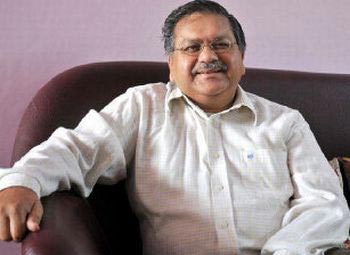
A LONG STRUGGLE AHEAD: Sultan Shahin set up a website that has taken on the religious right head-on.

Praveen Swami, The Hindu, March 24, 2009

Back in the summer of 1999, Sultan Shahin found himself being hectored by an earnest young man outside London’s Finsbury Park mosque.

“You Indian Muslims are cowards,” Shahin was told “but soon you will have just two choices: either to become a true Muslim like us, or to perish.”

For Shahin, the experience was transformative. “It became clear to me that the Islam that I believe in was under serious threat,” he says, “and that I would have to do something if the religion I loved was not to be demeaned by the evil that was being spoken in its name.”

Last year, Shahin set up a website that has taken on the religious right head-on. Though run on a shoestring budget and without the help of full-time staff, New Age Islam (http://www.newageislam.com/) is visited by hundreds of readers every day. Its electronic newsletter has over 29,000 subscribers.

New Age Islam provides its audience to a wide range of original theological and political writing that does not figure in the mainstream media. In recent weeks, New Age Islam has seen debates on Niyaz Fatehpuri, a twentieth-century literary figure with unconventional ideas on the concept of divine revelation, as well as the neo-conservative televangelist Zakir Naik. (more…)


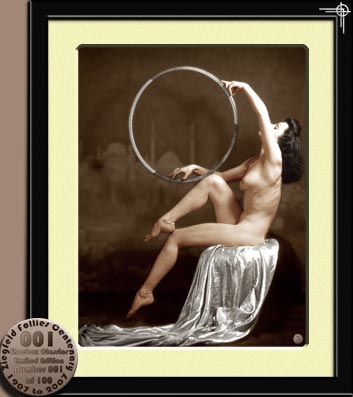
Ziegfeld Follies Girl representing Scheherazade from The Arabian Nights

On a personal note, today is my birthday. It is hard to be serious on such a foreboding occasion, especially when the magic number now exceeds the number of varieties of Heinz pickles. Besides (myself), the sun is shining and it is spring and silliness is in the air. [Isn’t it silly that we drop the ‘y’ to make silliness gramatically correct?] Since I have been preparing a powerpoint for a class on the history of ways in which the human body has been depicted, especially in the art of Adam and Eve in Eden, I have come across a number of Google-ill-begotten images, some of which are hilarious, some risque and some poignant. Take, for example, the picture above, which is not off a current porn site but actually a Ziegfield Follies Centennial print, indeed the first in the series.

So what do you see here? (more…)

‘Hello America, I’m a British Muslim’

by Imran Ahmed, BBC News, March 25, 2009

When British businessman Imran Ahmed was made redundant in January, instead of hitting the Job Centre he decided to arrange a one-man speaking tour of the United States to spread his message of peace and Muslim moderateness.

“Do you think the American drone raids in Afghanistan, in which women and children are killed, are actually obstructing the movement for an Islamic reformation?”

“What can be done about the alienation of young Muslim men in the UK?”

“Did you learn English in England?”

I’ve had an interesting range of questions at my speaking events in the US, but thankfully there have been some laughs with the audience too.

But first things first: what am I doing with a rented hybrid car on a 12,000-mile, 40-city speaking tour of America? (more…)

The following information is taken from a relatively new Muslim organization dedicated to equality and justice in the Muslim family. The name of the group is Musawa.

Musawah was initiated in March 2007 by Sisters in Islam, a Malaysian non-governmental organisation that is committed to promoting the rights of women within the framework of Islam, and a 12-member international planning committee of activists and scholars from 11 countries. The committee came together to consolidate information, experiences, and ideas that have been used by NGOs and activists in countries around the world to advance equality in the family. Women’s groups have been conducting these advocacy efforts for decades (see the background papers for more information). (more…)

Heritage in a Global Era: The Integration of Modernity and Tradition in the UAE

by el-Sayed el-Aswad, United Arab Emirates University

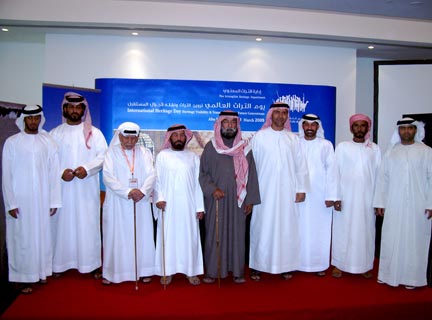
As part of the United Arab Emirate’s celebration of International Heritage Day, the Abu Dhabi Authority for Culture and Heritage (ADACH) organized a conference held on March 18-19, 2009, entitled “Heritage: From Preservation and Documentation to Promotion and Transmission to Future Generations.” The conference provided a fresh perspective by rethinking the oppositions of modernity/tradition and globalism/localism. A number of leading figures in the field of anthropology, folklore and comparative studies participated in the workshop by presenting papers and engaging in discussions and debates concerning various topics including folk tales, child folklore, falconry, symbolism, worldviews, the preservation of oral literature, and heritage promotion. Intangible heritage, more specifically oral literature, is an important component in understanding not only cultural specificities of societies but also enhancing intercultural relations. The following are some basic questions addressed in the workshop: Does the global culture depict the future as relying primarily on economic, technological, and multi-corporate forces that demand systemization, integration and uniformity? Does the traditional culture conceive the future as contingent essentially on the continuation of heritage, value-systems, religion, rituals, and social-kinship relationships? (more…)


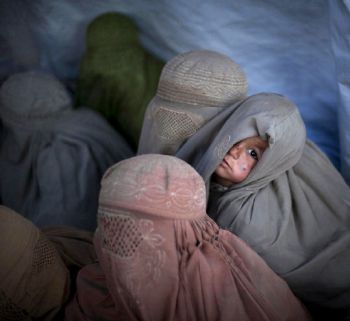
Women in burqas and children from the Bajaur and Mohmand agency areas wait to be registered at a refugee camp near Peshawar in January. Today a full-scale war is being fought in FATA, Swat and other “wild” areas of Pakistan, with thousands dying and hundreds of thousands of displaced people streaming into cities and towns. Photo by Emilio Morenatti/AP.


Towards Theocracy? State and society in Pakistan today.

by PERVEZ AMIRALI HOODBHOY, Frontline, March 14-27, 2009

FOR 20 years or more, a few of us in Pakistan have been desperately sending out SOS messages, warning of terrible times to come. Nevertheless, none anticipated how quickly and accurately our dire predictions would come true. It is a small matter that the flames of terrorism set Mumbai on fire and, more recently, destroyed Pakistan’s cricketing future. A much more important and brutal fight lies ahead as Pakistan, a nation of 175 million, struggles for its very survival. The implications for the future of South Asia are enormous. (more…)


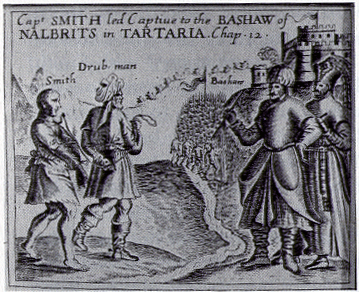
John Smith led into captivity to the Bashaw of Nalbrits by a “Drub-man” (interpreter). From The True Travels, Adventures, and Observations of Captaine John Smith, in Europe, Asia, Affrica, and America, from Anno Domino 1593 to 1629. London, 1630.

by Timothy Marr

Islam has figured in the fashioning of North American cultural definitions since as far back as the first years of European settlement. Inaugurating instances in colonial British America can be seen through brief biographical sketches of the Virginian leader John Smith and the Quaker preacher Mary Fisher.…

John Smith gained experience and credentials fighting Turks in Ottoman Europe well before he ventured across the Atlantic and he prided himself as a hearty crusader against the Muslims. After successfully launching incendiary devices against the Turkish armies in Hungary, for example, he reveled that “the lamentable noise of the miserable slaughtered Turkes was most wonderfull to heare.” (more…)


The sultan of the Ottoman Empire going to mosque the day after the constitution was announced.

Social Freedom for Turkish Women
by Mary Mills Patrick.

[The following excerpt is from “The Emancipation of Mohammedan Women,” published in the National Geographic Magazine, January 1909 (Volume XX, No. 1, p.p. 61-62).]

Their past experience has been slowly preparing the Turkish women for the larger opportunities that the constitution gives them. On the morning of the 24th of July all classes of the Turkish Empire entered into a new life, but the greatest change of all took place in the harems. Women everywhere threw off their veils. A prominent woman in Salonica openly assisted her husband in the political celebration.

One woman went so far as to have her picture published in a Paris paper. At this the members of the Reactionary party rose up in common protest and said, “If this be the result of freedom, that our women display their faces to the public with such brazen immodesty, we do not wish a constitution.”

The turkish women are true patriots, and when they saw that the question of freedom for women appeared to have such deep significance to the nation, not only from a political and social, but also from a moral point of view, they said with one accord, “Of what consequence is so small a matter as the veil! We will continue to wear our veils, and will seek the larger opportunities that the new constitution gives us.” Turkish women everywhere have accordingly resumed their veils; but it is a very different thing to wear a veil voluntarily from being obliged to do so, and eventually they will probably appear in the streets without them.

The moral freedom that the revolution has brought the Turkish women is showing itself in many different lines. The freedom of the press has been offered to women. They are writing for the papers openly and without fear of censorship, and their voices are being heard in regard to the affairs of the nation.

Mary Mills Patrick was President of the American College for Girls at Constantinople.

Sex and the country: Islamic rule did not disturb the long Indian tradition of erotic writing
By William Dalrymple, New Age Islam, August, 2008

There is nothing new about India being perceived as a place of great and growing wealth: for much of the pre-colonial period, the west was the eager consumer of the spices, silks, and luxuries of the subcontinent, while India was the prosperous supplier. You can still get a flavour of the intoxicatingly rich and sophisticated classical India that supplied these luxuries at the once-great port of Mamallapuram on the Coromandal coast. Here massive relief sculptures faced onto the port where, according to a seventh-century poet, “ships rode at anchor, bent to the point of breaking, laden as they were with wealth, with big-trunked elephants, and with mountains of gems of nine varieties”. The reliefs cover one side of a hill: at the right are two huge elephants, trunks swinging; nearby, warrior heroes and meditating sages stand below flights of gods and goddesses, godlings, nymphs, and tree spirits. There is a breezy lightness of touch at work: a flute is playing, there is dancing, and the heavenly apsara fertility spirits and goddesses are whispering fondly to their consorts. (more…)

Next Page »