January 2009
Monthly Archive
Sat 31 Jan 2009

Lebanon …Without A Daily Star Until Further Notice
By Thair Abbas, Asharq Alawsat, 30/01/2009
Beirut.
The Lebanese English-language newspaper The Daily Star has been temporarily shut down since the middle of January due to a financial lawsuit between the newspaper and Standard Charter Bank. The newspaper was the only source of internal Lebanese news for many of the Lebanese “orphans” living abroad and for foreigners living in Lebanon, who would use it to follow the news of Lebanon which is rife with contradictions, events, and crises.
This is not the first time that The Daily Star has been “temporarily” shut down, indeed the newspaper has been closed down three times since its foundation, but it returned to print each time as a result of the market’s need for a publication to fill this niche. (more…)
Fri 30 Jan 2009

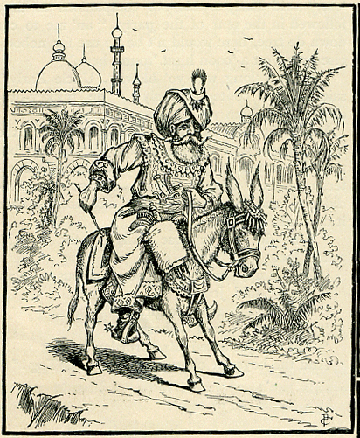
Illustration of his poem by Palmer Cox, 1882
The Sultan of the East
by Palmer Cox
There was a sultan of the East
Who used to ride a stubborn beast;
A marvel of the donkey-kind,
That much perplexed his owner’s mind.
By turns he moved a rod ahead.
Then backed a rod or so instead.
And thus the day would pass around,
The Sultan gaining little ground.
The servants on before would stray
And pitch their tents beside the way,
And pass the time as best they might
Until their master hove in sight. (more…)
Wed 28 Jan 2009

I am pleased to inform my friends and readers that my latest book Understanding Muslim Identity, Rethinking Fundamentalism, is finally on the bookshelf of (more or less virtual) book shops.
‘Another book on Islamic fundamentalism?’ I can hear the question echoing among friends, colleagues and readers. Since 2001, more than 100 books and 5,600 articles have been published on Islamic fundamentalism. Broadening the research to agnate labels – such as Islamism (about 200 books and 243 articles), political Islam (345 books and 4,670 articles) and Islamic extremism (only 16 books and 1610 articles). We can appreciate the amount of scholarly publication pressed into the past seven years.
So, why write another book? I have tried to explain the reasons in the Introduction, which you can read for free. The book provides a very different analysis of what has been labeled ‘Islamic fundamentalism’, and what I prefer to call ‘emotional Islam’. (more…)
Mon 26 Jan 2009

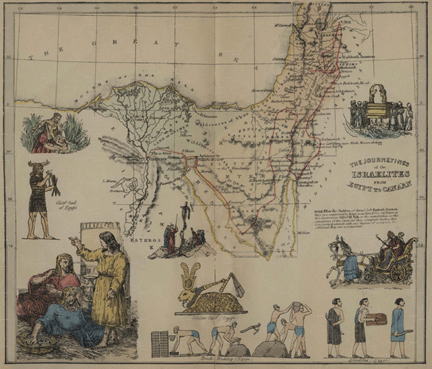
The ubiquity of GPS threatens to leave the old printed map out of the picture. This is a pity, for there is much to be learned from the way maps frame the world. As J. Z. Smith once remarked, map is not territory. True enough, but maps are the way we imagine not only territory but our place in it. When Edward Said wrote his critique of Orientalism in 1978, he cited novelists, travelers, poets and academics, but no mapmakers. But in a way Holy Land maps are what put the Holy Land on the map. Maps not only illustrated what was thought to be the lay of the land, but what people imagined was there.
A splendid example of this is an 1856 pictorial Bible map of the Journey of the Israelites from Egypt to Canaan. I reproduce the image above, but if you
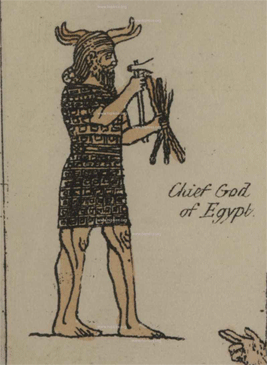
click here you can get a greatly enlarged view to see the details. Mind you, this was 1856, when few of the archeological discoveries in Bible territory had come to light. This is evident in the depiction of the “Chief God of Egypt,” (left side of map) who looks like a cross between an Assyrian and a Viking.

(more…)
Sun 25 Jan 2009

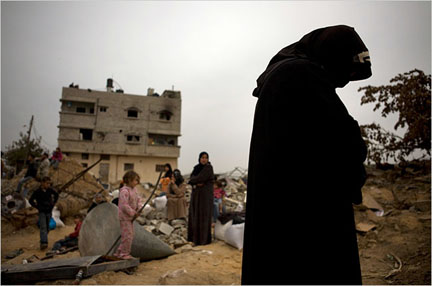
Residents returned to their homes around Gaza City on Friday. Tyler Hicks/The New York Times
Gaza is not history, nor is it likely to be soon. The bombs may have ceased on both sides, but the human toll presages a bleak future. Both sides have grievances, but the grief from death, maiming and sheer destruction of property and homes is incredibly disproportional. Even Independent observers must acknowlege this:
Up to 10 times as many Palestinians were killed as Israelis. The Palestinian Ministry of Health says 1,314 Palestinians were killed, of whom 412 were children or teenagers under 18, and 110 were women. On the Israeli side, there were 13 deaths between 27 December and 17 January, of whom three were civilians killed by rockets fired from Gaza. Of the 10 soldiers killed, four were lost to “friendly fire”.
Even if the Palestinian figure is disputed, it is clear that the death toll was massively higher for Palestinians than Israelis. Proportionality is not simply a matter of numbers, however. (more…)
Sat 24 Jan 2009

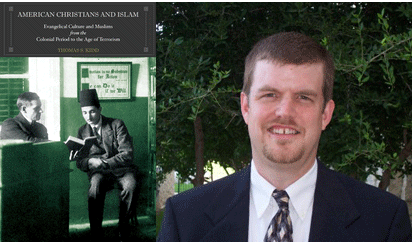
Author Thomas S. Kidd
In the wake of the September 11 terrorist attacks, many of America’s Christian evangelicals have denounced Islam as a “demonic” and inherently violent religion, provoking frustration among other Christian conservatives who wish to present a more appealing message to the world’s Muslims. Yet as Thomas Kidd reveals in this sobering book, the conflicted views expressed by today’s evangelicals have deep roots in American history.
Tracing Islam’s role in the popular imagination of American Christians from the colonial period to today, Kidd demonstrates that Protestant evangelicals have viewed Islam as a global threat–while also actively seeking to convert Muslims to the Christian faith–since the nation’s founding. (more…)
Fri 23 Jan 2009

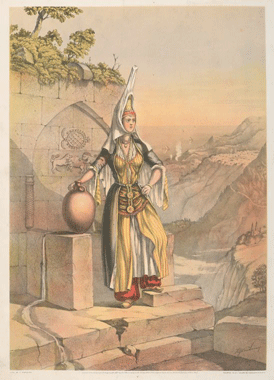
“Druse Girl”(1862) drawn by Henry J. Van-Lennep, Henry J. (1815-1889), Lithographer,
C. Parsons; Printer of plates, W. Endicott & Co. From “The Oriental Album: Twenty Illustrations, in oil colors, of the people and scenery of Turkey, with an explanatory and descriptive text.” By Rev. Henry J. Van Lennep. Online in NYPL Digital Gallery.
For Lithographica Arabica #2, click here.
Thu 22 Jan 2009

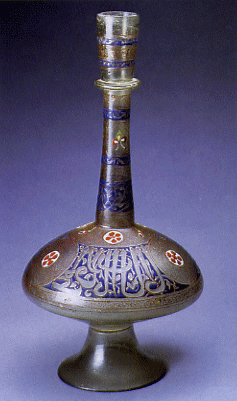
Bottle made for the Yemeni Rasulid Sultan al-Malik al-Mujahid ‘Ali ibn Dawud,
Freer Gallery of Art, Washington, DC.
One of my favorite haunts in Washington DC is the Freer Gallery of Art, part of the Smithsonian row. It boasts an extraordinary collection of Islamic art, well worth viewing and reviewing. But why wait until a trip to Washington, unless you are still braving the leftover throngs at the upcoming inaugural? The Freer’s website hosts high-quality images of many of the objects in its collection. As a Yemenophile, one of my favorites is a beautiful glass bottle made for the Yemeni Rasulid sultan al-Malik al-Mujahid ‘Ali ibn Dawud, who reigned from 1322-1363. The bottle was crafted in Syria and is “enameled and gilt colorless honey-tinted glass” (Rosamond E. Mack, Bazaar to Piazza: Islamic Trade and Italian Art, 1300-1600, Berkeley: University of California Press, 2002, p. 118).
Wed 21 Jan 2009

by el-Sayed el-Aswad, United Arab Emirates University
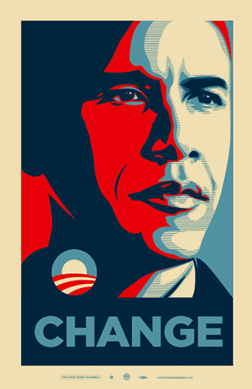
The historic victory of Barack Obama, the first African American president, is the outcome not only of a politically talented and eloquent leader hoping for and acting toward change but also of the relentless will and determination of American grassroots demanding openness, fairness, equality and freedom. American people, with their diverse, rich and dynamic culture, voted for change so as to have not just something new, but to attain liberation and reconstruct fair and peaceful relationships with all people. What is happening inside the most powerful nation in the world must be reflected and enacted in different parts of the globe. People around the world are hoping and expecting that the United States will work to promote peace and a healthy democracy through dialogue, diplomacy and persuasion after eight years of power mismanagement leading to unjustified intervention and irrational wars. (more…)
Tue 20 Jan 2009

[Note: the following parody, written in critique of proslavery arguments in congress, was one of the last articles penned by Benjamin Franklin. Were Franklin almanacking today, what would Poor Richard have to say about the current state of political stalemate in the Middle East? And what would he think of today’s inaugural?]
To the Editor of the Federal Gazette
by Historicus (Benjamin Franklin)
March 23, 1790
Sir,
Reading last night in your excellent paper the speech of Mr. Jackson in Congress, against meddling with the affair of slavery, or attempting to mend the condition of slaves, it put me in mind of a similar one made about one hundred years since, by Sidi Mehemet Ibrahim, a member of the Divan of Algiers, which may be seen in Martin’s account of his consulship, anno 1687. It was against granting the petition of the Sect called Erika or Purists, who prayed for the abolition of piracy and slavery, as being unjust. Mr. Jackson does not quote it; perhaps he has not seen it. If therefore some of its reasonings are to be found in his eloquent speech, it may only show that men’s interests and intellects operate and are operated on with surprising similarity in all countries and climates, whenever they are under similar circumstances. The African’s speech, as translated, is as follows:
“Allah Bismillah, &c. God is great, and Mahomet is his Prophet.
“Have these Erika considered the consequences of granting their petition? (more…)
Next Page »