November 2008
Monthly Archive
Sun 30 Nov 2008

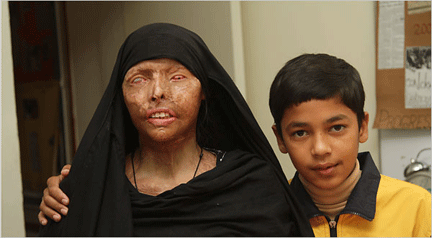
Acid attacks and wife burnings are common in parts of Asia because the victims are the most voiceless in these societies. Naeema Azar, above, was attacked by her husband after they divorced. Her 12-year-old son, Ahmed Shah, looks after her.
Terrorism That’s Personal
By NICHOLAS D. KRISTOF, The New York Times, November 30, 2008
ISLAMABAD, Pakistan
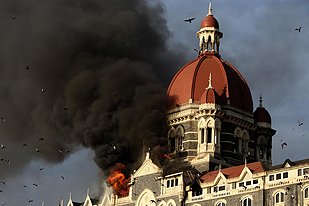
Terrorism in this part of the world usually means bombs exploding or hotels burning, as the latest horrific scenes from Mumbai attest. Yet alongside the brutal public terrorism that fills the television screens, there is an equally cruel form of terrorism that gets almost no attention and thrives as a result: flinging acid on a woman’s face to leave her hideously deformed.
Here in Pakistan, I’ve been investigating such acid attacks, which are commonly used to terrorize and subjugate women and girls in a swath of Asia from Afghanistan through Cambodia (men are almost never attacked with acid). Because women usually don’t matter in this part of the world, their attackers are rarely prosecuted and acid sales are usually not controlled. It’s a kind of terrorism that becomes accepted as part of the background noise in the region. (more…)
Sat 29 Nov 2008

Must every country have its 9/11 moment and must these tragedies continue to be the work of extremists who attack and kill as if they were commanded by Allah? This is a rhetorical question, of course. The latest events in Mumbai have trumped the economic slump in the news. Once again billowing smoke from a famous building clouds the sky; again Islam is tainted as the religion that fosters terrorists. And the blame game begins anew.
The sheer audacity of the attack, more like a Rambo commando raid than the hijacking scenario that felled the Twin Towers, is staggering. How could such landmarks have been targeted in tandem? Where was the security? These are the questions inevitably asked after the fact. As reported in Al-Jazeera, here is the unfolding of the drama: (more…)
Fri 28 Nov 2008

King Abdullah University of Science and Technology created an interactive map of its unfinished campus.
Saudi University, Not Yet Complete, Shows Itself Off With an Interactive Map
by Lawrence Biemiller, The Wired Campus, November 24, 2005
Recruiting students and faculty members for a university whose campus is still under construction isn’t easy, even if the university has $10-billion at its disposal. So officials at Saudi Arabia’s new King Abdullah University of Science and Technology — known as Kaust — commissioned an interactive map that lets users click on icons and see images of the facilities that will be constructed.
The university, due to open next year, will offer graduate-level research programs open to both men and women. Its 8,900-acre campus, located on the Red Sea, has been planned by HOK Architects. (more…)
Thu 27 Nov 2008

Dr. Jean Lambert: Adopting a National Strategy for Preserving Yemen’s Oral Heritage is Necessary
Sheba Center for Strategic Studies, November 2008
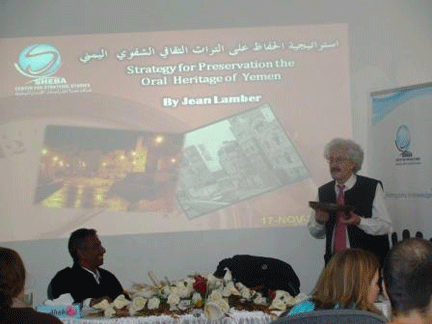
In his lecture delivered on Nov. 11, 2008, at the SCSS, French researcher and anthropologist Jean Lambert prompted the adoption of a national strategy for preserving Yemeni oral heritage and recording it in a well-studied methodology. He pointed out that Yemen’s cultural heritage contains a long and rich list of the narrated heritage which is falling into oblivion and facing extinction as a result of carelessness. He also pointed out that the areas rich with this culture are overlapped and interconnected, making it clear that singing is related to tales, stories and different walks of daily life such as poetry, dancing, and afternoon and evening entertaining sessions, and that all of these areas are fertile grounds for determining the features of any culture. (more…)
Wed 26 Nov 2008

Academics Struggle for Civil Society in Iraq
by David Moltz, Inside Higher Ed, November 25, 2008
WASHINGTON – Two of the three scholars invited from Iraq to share analysis of academic conditions there could not get visas to attend this week’s meeting of the Middle East Studies Association. Those gathered at the annual meeting for a panel on “the role of academics in building civil society in Iraq” had to settle for having the papers paraphrased to them by a colleague. This twist of fate, however, prompted the remaining panelists to reflect on the challenges that still exist for students and scholars in a post-Saddam Iraq.
Though Riyadh Aziz Hadi, a high-ranking administrator at Baghdad University, and Amer Qader, a professor at Kirkuk University, were unable to attend the event, their scholarly work was presented before the panel.
“This is kind of good for the event in a sinister way,” said Abbas Kadhim, professor of Islamic studies at the Naval Postgraduate School, in Monterey, Cal. and a product of Iraqi higher education. “This shows you some of the difficulties that remain for Iraqi academics. If someone cannot attend an event like this — because of a denied visa with one year’s notice [the case for Hadi and Qader] — you’re looking at a sequestered group of people.” (more…)
Tue 25 Nov 2008

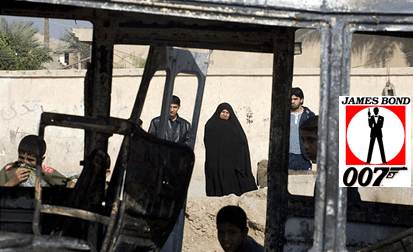
Iraqis with the remains of a minibus hit by a roadside bomb on Monday morning in Baghdad: Joao Silva for The New York Times
There are those decisive moments when something important or historic or even catastrophic happens. These are the things historians chronicle and poets bemoan. Then there is the universal act of killing time, the boring drudgery of day-to-day life but the kind of mundane routine we all long for after the unsought catastrophes. Thomas Friedman in a Saturday op-ed views the current economic crisis as a WMD dug up in our own backyard, a danger so potent that the January inaugural might be best moved up to Thanksgiving, killing two birds (a sacrificial turkey and a lame duck) with one bold act. President-elect Obama is hardly killing time, as his proposed cabinet appointees are press-conferenced to the nation in rapid-fire progression. Time in the larger sense is mercifully short, unless it stops completely in one of those mortality shocks that deadens any sense of time.
Like Monday in Baghdad, where killing time has been the rule both before and after the fall of Saddam Hussein. (more…)
Mon 24 Nov 2008

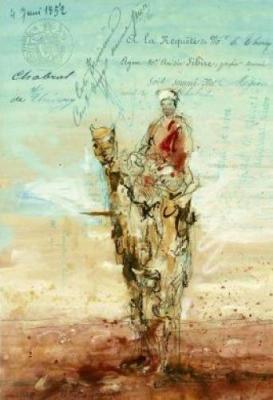
Bedouin sur son Dromadaire, Yann Letestu
“It is nothing short of amazing to find how many parts of one’s anatomy come into contact with a camel’s saddle and how quickly that same saddle removes the outer layers of one’s skin.”
J. B. Mackie, “Hasa: an Arabian Oasis,” Geographical Journal 63:193, 1924.
Sat 22 Nov 2008

Despite the fact that fertility rate in Yemen is still one of the highest in the world, due to national efforts to promote family planning the projected population for Yemen in 2050 is now 58 million, 1.5 million less than expected in 2007. Yemen Times Photo by Amira Al-Sharif
Integrating culture into development strategy for reproductive health
By: Salma Ismail, Yemen Times, November 19, 2008
SANA’A, Nov. 19 — The United Nations Population Fund (UNFPA) last week released its annual State of the World Population Report for 2008 worldwide. The launching of the report in Yemen took place at Sana’a University and was attended by a number of representatives from the ministries of health and information, the National Population Council, as well as a number of academia and researchers.
Coinciding with the 60th anniversary of the Universal Declaration of Human Rights, the fifth report of the UNFPA, entitled Reaching Common Ground: Culture, Gender and Human Rights, focuses on cultural politics and development, and examines gender inequality and cultural differences with regards to reproductive health. It asserts the importance of cultural interaction with development strategies. (more…)
Fri 21 Nov 2008

The Anthropologist’s Son
by Ruth Behar, Chronicle of Higher Education, November 28, 2008 and History News Network
Stanley Ann Dunham Soetoro earned a Ph.D. in anthropology with an 800-page dissertation about blacksmithing in Indonesia. She spent long stretches of time learning to love and rescue the cultures and communities of total strangers, at the cost of not always being around while her son was coming of age in Hawaii. Yet she had an indelible impact on him, teaching him to appreciate cultural diversity and have faith in people’s ability to understand each other across borders and identities. (more…)
Thu 20 Nov 2008

Professor John Esposito
An internationalist president
by John Esposito, The Immanent Frame, SSRC Blogs, November 7, 2008
Barack Obama’s campaign victory was epic-making in America and across the Muslim world. On November 4, as soon as the election was called for Barack Obama, I began to receive congratulatory emails from friends in the Middle East, South and Southeast Asia, and Europe. Some had stayed up through the night to hear the final results. Of course, I wasn’t surprised at the global interest and support, which had been evident on recent visits to Europe, the Middle East and Southeast Asia. Wherever I spoke, regardless of the topic, someone in the audience would ask me a question about Obama and his prospects. Privately, it was the topic of conversation. So what will all this mean?
In the Muslim world, as in Europe and much of the world, Obama is welcomed as an internationalist president. His Kenyan father, early schooling in Indonesia, race and name symbolize for many a unique internationalist presidential profile, one that contrasts sharply with his predecessor. Indeed, he is seen as the antithesis of George W. Bush-internationally informed, experienced, aware and sensitive, a measured and articulate statesman-not, as Bush is often regarded, as a swaggering Texas cowboy. (more…)
Next Page »