July 2007
Monthly Archive
Tue 31 Jul 2007

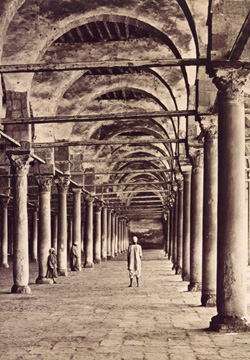
“Interior of the Amron Mosque,” Henry Bechard, ca. 1870
[Note: the following excerpt is from the introduction to my recent book on the ways in which anthropologists study and represent Islam.]
What the world does not need is yet another book which assumes Islam can be abstracted out of evolving cultural contexts and neatly essentialized into print without repeating the obvious or glossing over the obtuse. This is–I believe and I hope–not such a book. I have no interest in telling you what Islam is, what it really must be, or even what it should be. In what follows I am more attuned to what Islam hopefully is not, at least not for someone who approaches it seriously as an anthropologist and historian. I bare no obvious axe to grind as either a determined detractor against the religion or an over-anxious advocate for it. Personally, as well as academically, I consider Islam a fascinatingly diverse faith, a force in history that must be reckoned with in the present. The offensive tool I do choose to wield, if my figurative pen can stand a militant symbol, is that of a critical hammer, an iconoclastic smashing of the rhetoric that represents, over-represents and misrepresents Islam from all sides. By avoiding judgment on the sacred truth of this vibrant faith, I shift intention towards an I-view that takes no summary representation of Islam as sacred. (more…)
Mon 30 Jul 2007

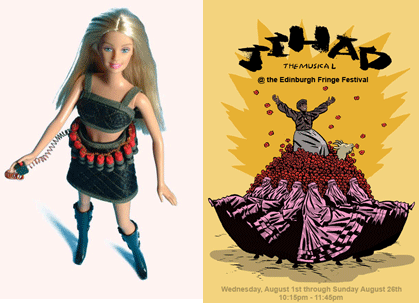
If you had taken a poll of Holocaust survivors after their liberation from death camps in World War II, chances are few would have imagined that a future comedian (and a Jewish one at that) would produce a box-office smash that included a chorus line of goose-stepping rockettes prancing to “Hitler in springtime.” For the record, Mel Brooks spares no one, including a Busby Berkeley romp with Torquemada through the Spanish Inquisition. Nor does Monty Python, who satirized Nazis and, spam-spam-spam, The Spanish Inquisition, on the other side of the Atlantic. Of course, neither Brooks nor Python would have kept their heads (or the body parts they make the most jokes about) in 15th century Spain. So if even the cruelest atrocities of history can be lampooned with hindsight humor, when is a good time to rip into Osama Bin Laden and the distorted political mantra of jihad?
Jihad: The Musical already hit New York, and now it is taking Britain at the fringes (if Edinburgh can be deemed a fringe venue) according to the latest news reports on the BBC and The Guardian. (more…)
Sun 29 Jul 2007

By Dr. Radwan al Sayyid, Asharq Al-Awsat, October 5, 2006
… It’s clear from the detailed review of Pope Benedict XVI’s lecture and its context that it has nothing to do with Islam, as seemed to me at first glance, and that it centers around the restoration of Europe to Christianity, and of Christianity to Europe. Regardless of its validity, the possibility of its implementation and the methods for acknowledging it, the same project has many close ties to Islam. It may seem that these relationships are not direct, yet the truth is very different. In order to not subject what I seek to highlight about the close relationship between the Pope’s lecture and Islam to different interpretations, I will begin by translating the introductory paragraph, which mentions Islam in the lecture. The Pope said:
“I read the edition by Professor Theodore Khoury (University of Münster) of part of the dialogue carried on – perhaps in 1391 in the winter barracks near Ankara – by the erudite emperor Manuel II Paleologus and an educated Persian in the subject of Christianity and Islam, an the truth of both. It was presumably the emperor himself who set down this dialogue, during the siege of Constantinople between 1394 and 1402; and this would explain why his arguments are given in greater detail than those of his Persian interlocutor. The dialogue ranges widely over the structures of faith contained in the bible and in the Quran, and deals especially with image of God and of man, while necessarily returning repeatedly to the relationship between – as they were called the three ‘Laws’ or ‘rules of life’: the Old Testament, the New Testament, and the Quran. In this lecture I would like to discuss only one point – itself rather marginal to the dialogue itself – which, in the context of the issue of ‘Faith and Reason’, I found interesting and which can serve as the starting-point for my reflections on this issue. (more…)
Sat 28 Jul 2007

by George El-Hage
[Note: This is a translation from the Arabic, which is available in pdf by clicking here.]
Stand up! Get up!
Carry your bed and follow me.
Let’s leave this ungrateful land
This land…
That savors the decaying cadavers of its sons
A land satiated by the blood of its children.
Let’s leave these poor people
Defeated, fragmented
Knowing nothing but selfishness,
Servicing foreigners,
And worshipping the hollow love of prestige. (more…)
Fri 27 Jul 2007

Apparently New York is being New York once again and people are mad.
New York for some reason has a lot of cultural diversity and wants to address this in the public schools. Go figure. The proposal: the Khalil Gibran International Academy (KGIA). One of the few level headed reports can be found at http://www.nysun.com/article/49971?page_no=1. Opponents are saying that this is an attempt to create a training grounds for terrorists.
(more…)
Thu 26 Jul 2007
Posted by tabsir under
Poetry ,
IraqNo Comments

[Painting by Hadi Ziaadini - Sanandaj/Senna Kurdistan, Iran]
In looking for information on how Kurdish poets remember the tragic events of their most recent holocaust I came across an interesting article by A. Salar. Rather than getting drowned out by the clamor in the daily clashes, let poets speak for the defense of our common humanity.
Kurdish Poetry and Iraq’s Totalitarianism
by A. Salar
But Iraq’s totalitarianism is not just about political control; it is also about cultural control, and here I use the term culture very broadly to include the arts, literature, city planning, appearances, etc. In terms of culture Iraq became totalitarian in the mid-1970s when the state suddenly became rich as oil prices rose dramatically. The state used the money to extend its control over all sources of information and subjected virtually all artistic and cultural activities to of ficial censorship. The result was that when Saddam Hussein went to war against Iran in September 1981 he had countless poets, intellectuals, and writers ready to turn their pen against the Iranian “enemy,” and to describe Iran as cowardly, inferior, and vicious. (more…)
Wed 25 Jul 2007

Said’s Orientalism (1978) is THE seminal work in the study of Islam. However, as other posts have suggested, it gets more play than perhaps it deserves. This leaves me with a dilemma when trying to include Said’s work in my undergraduate classes on Islam. I believe that it is always best for students to consume an author’s own words rather than try to derive their ideas from summary works. However, to assign the full book takes too much time and puts too much emphasis on Said’s ideas.
The solution is a film entitled, Edward Said: On Orientalism (1998). This film combines introductory narration, interviews with Said, and clips from news media, movies, and images from classical art to demonstrate the core of Said’s arguments. Hence, the film is far more interesting than one would expect an interview to ever be. My students found it engaging, informative, and thought provoking. By engaging Said’s ideas in a short 40 minutes, it is then possible to turn to a critique of the ideas without making Orientalism the whole of the course.
For more information, see: http://www.mediaed.org/videos/MediaRaceAndRepresentation/EdwardSaidOnOrientalism
Ron Lukens-Bull
Tue 24 Jul 2007
%20-Arte%20Naturale%20ed%20Archetipi%20Junghiani-/07%20L-urlo%20di%20corteccia.jpg)
Yesterday night I was reading some news on La Repubblica, when one of the latest news won my attention. It read: ‘an Islamist has been attacked in an English prison and is fighting for his life’. Because my recent research has focused on Muslim prisoners, I was curious to know the victim’s name, the reasons behind the attack and the prison in which it took place.
I expected that our English mass media would have promptly reported this piece of news; I was wrong. Even the BBC has briefly reported the incident only days later. I had to resort to Google News to discover, on an Australian Internet News Service, that the victim was Mr Dhiren Barot. Ironically, the BBC, likewise all the other national and local newspapers, had devoted litres of ink to this man.
(more…)
Mon 23 Jul 2007

One of the distinguishing features of Islam as a faith in contact with the real world has been a virtual prohibition against celibacy, at least the kind that creates priests and nuns in Christianity. “There is no celibacy in Islam,” said the Prophet, who also noted ”Marriage is my Sunna. Whosoever keeps away form it is not form me.” The issue would seem to be less the idea that one must have sex than one should fulfill one’s created sexual nature in this world with an emphasis on having children. So it seems quite the innovation to see that in some parts of Pakistan Muslim nuns are being created, at least in principle. The following article was published recently in Asharq Alawsat.
Married to the Quran
By Mohammed Al Shafey, Ashraq Alawsat 22/07/2007
Islamabad, Asharq Al-Awsat- In Pakistan, an act is taking place in certain provinces that deprives a Muslim woman of her social rights. This act is the so-called marriage to the Quran [known as Haq Bakshish], a practice that is widespread in the Sindh province in the south of the country.
In this type of marriage, young girls are asked to dedicate themselves to memorizing the Holy Quran. Their families then hold a ceremony to marry the girl to the holy book. A girl places her hand on the Quran and takes an oath that she is married to it until death. (more…)
Sun 22 Jul 2007
Posted by Gabriele Marranci under
Humor and Satire ,
Iraq War1 Comment

The BBC has started an interesting project focusing on the disastrous war in Iraq. In one its web pages it is monitoring the effects of the war, week by week, by looking at casualty figures, the pressure on hospitals and quality of life for ordinary civilians.
The war in Iraq has been a disaster. Bush gifts Americans and British people with grief and a dark future of fear, and the Iraqi people with genocide and a multilateral civil war. The only happy guy, were he not probably long dead, would be Mr Osama bin-Laden, who would have seen his corporation and franchise of terror wealthy as never before. But we know that the Bush family is used to exchanging gifts with the bin-Ladens. It is a long tradition, which this time, probably, has its Freudian side.
However, if President Bush still believes that his controversial surge strategy in Iraq is succeeding, it can only mean that he is still speaking to who he thinks is a god. Yet this god can only be Kūkā`ilimoku Ki`i Hulu Manu, shown above, the Hawaiian feather-headed war god.
Gabriele Marranci
Next Page »