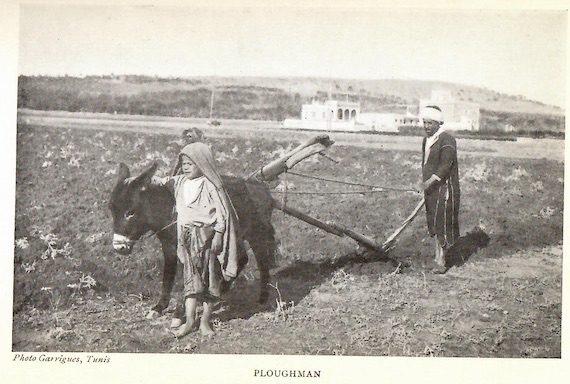
I am always intrigued by old photographs of traditional ploughs in the Middle East. The picture above is from a 1925 travel book by Norma Lorimer entitled By the Waters of Carthage. It has several photographs. The book is available at archive.org.
I am always intrigued by old photographs of traditional ploughs in the Middle East. The picture above is from a 1925 travel book by Norma Lorimer entitled By the Waters of Carthage. It has several photographs. The book is available at archive.org.
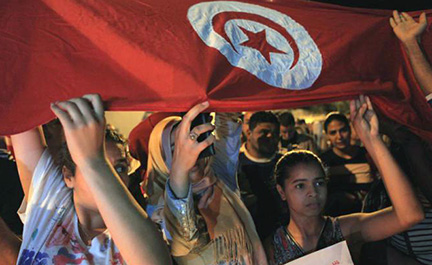
by Rachid Ghannouchi © Qantara.de 2015
Translated from the German by Nina Coon
A battle for freedom and dignity
In the wake of the attacks on Sousse and the Bardo Museum, Tunisia has to stand up to those who oppose the nation’s democratic development. The best way to counter the feelings that draw young people to extremism, writes Rachid Ghannouchi, chairman of the Ennahda Party, is to ensure participation, fair economic growth, and security without restricting the country’s hard-won freedoms
On 4 July, the United States celebrated the attainment of freedom and independence as it does every year. In Tunisia, 4 July also marked a turning point on the path to freedom and democracy – but not in the positive sense. On this day, Tunisian President Beji Caid Essebsi felt compelled, in response to the growing threat of terrorism, to declare a national state of emergency and curtail important personal freedoms.
The latest attack in Sousse has again made it clear just how stony Tunisia’s path to a secure democracy remains. After all, the bloodiest terrorist attack in the history of our nation seeks to destroy what we have built up in the few years since Ben Ali was ousted, namely an open society with a pluralist governmental system and a democratic constitution enshrining fundamental rights and freedoms.
Battle for the young generation
We were all horrified by the gruesome images of tourists murdered on the beach. But those images have also galvanised Tunisian citizens and their political representatives in their opposition to those who oppose our path to democracy. This battle is a battle for freedom and dignity, but first and foremost, it is a battle for the next generation, for the young people in Tunisia, but also in Libya, Syria and the entire Arab world. Continue reading Tunisia after the terror attacks
Islamic Africa is a peer-reviewed, multidisciplinary, academic journal published online and in print. Incorporating the journal Sudanic Africa, Islamic Africa publishes original research concerning Islam in Africa from the social sciences and the humanities, as well as primary source material and commentary essays related to Islamic Studies in Africa. The journal’s geographic scope includes the entire African continent and adjacent islands. Islamic Africa encourages intellectual excellence and seeks to promote scholarly interaction between Africa-based scholars and those located institutionally outside the continent.
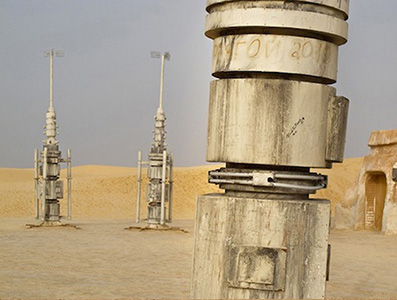
Heritagedaily.com, November 11, 2013.
“These are not the ruins you’re looking for!â€
In 2012 Italian photographer Rä di Martino spent more than a year wandering the desert towns of Morocco and Tunisia, on her journey she came across the curious remnants of another world…
‘A long time ago in a galaxy far away’ these words are so familiar as to be short hand for the beginning of a grand adventure! Much like the immortal words ‘Once upon a time’ or ‘Are you sitting comfortably?’ they are arresting and instantly significant. For generations they have peaked the interest of the movie-going public and almost like a mass pavlovian experiment, we can scarcely stop ourselves from re-playing the grand opening phrases of John Williams’ iconic score in our heads – perhaps making raspy lightsaber noises with pursed lips as we thrash our arms about… Just like a ‘real’ Jedi.
We return to Rä coming upon the ruins of ‘Tatooine’ as one might approach the standing structure of Karnak or even the megaliths of Stonehenge. Though while those ruins are of cultures from the distant past, these are of cultures from the depths of human imagination. Some stand alone in the desert while others have been incorporated into towns and homesteads. She found the juxtaposition of these remnants of ‘another world’ and ‘real’ ruins fascinating and decided to feature them in a series of photographs entitled ‘Every World’s A Stage’. Continue reading The Archaeology of Star Wars
For anyone doing research on the Middle East for the past two centuries, there is an incredible archive online. Details below:
Below is a list of Open Access historical newspapers and other periodicals in Middle Eastern Studies.
Most titles on the list have been digitized by independent projects across the globe and may not have been fully cataloged. It is often difficult to find and access them on the web or through catalogs such as HathiTrust, AMEEL, Gallica, Revues, WorldCat, etc.
We welcome your comments and suggestions of additional titles to include. Please use the comment feature at the bottom of the page.
For the list of active Open Access journals follow this link:
Alphabetical List of Open Access Journals in Middle Eastern Studies
132 titles as of May 14, 2015.

For my post on the Arab youth views of democracy, click here.
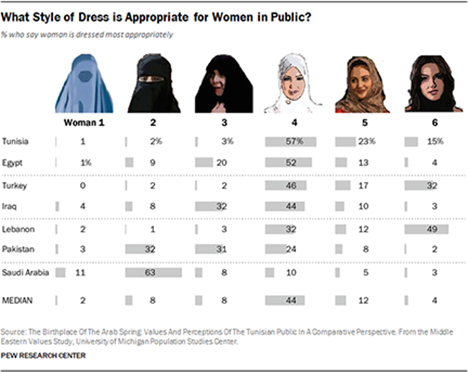
How people in Muslim countries prefer women to dress in public
By Jacob Poushter, Pew Research Center, January 8, 2014
An important issue in the Muslim world is how women should dress in public. A recent survey from the University of Michigan’s Institute for Social Research conducted in seven Muslim-majority countries (Tunisia, Egypt, Iraq, Lebanon, Pakistan, Saudi Arabia and Turkey), finds that most people prefer that a woman completely cover her hair, but not necessarily her face. Only in Turkey and Lebanon do more than one-in-four think it is appropriate for a woman to not cover her head at all in public.
The survey treated the question of women’s dress as a visual preference. Each respondent was given a card depicting six styles of women’s headdress and asked to choose the woman most appropriately outfitted for a public place. Although no labels were included on the card, the styles ranged from a fully-hooded burqa (woman #1) and niqab (#2) to the less conservative hijab (women #4 and #5). There was also the option of a woman wearing no head covering of any type. Continue reading Veiling Styles
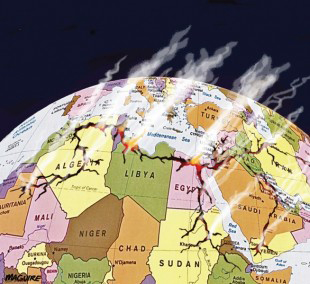
by Daniel Martin Varisco, Middle East Muddle, Anthropology News, November, 2013
As President Franklin Delano Roosevelt prophesied, December 7th, 1941 is a day that lives in infamy, even some seven decades after the event that triggered United States entry into the Second World War. Another date of more recent infamy is December 17, 2010, when a harassed Tunisian vegetable hawker named Mohamed Bouazizi set himself on fire in front of the municipal building in the picturesque town of Sidi Bouzid. Although badly burned, he survived until January 4, just ten days before Ben Ali, the Tunisian dictator for some 23 years, boarded a plane for exile in Saudi Arabia. The first kind of infamy was the beginning of a devastating war, the second became the stimulus for what was hoped to be a sweeping political revolution across the Middle East. Three years later it seems to be politics as usual, a chilly seasonal change from the jasmine scent of the Arab Spring that blew across Tunisia, Egypt, Libya and Yemen and now swirls through the political maelstrom enveloping a surviving dictator in Syria, ongoing instability in Iraq and Afghanistan and a new regime outlook in Iran.
Seasoned pundits know that in many parts of the world spring’s prospects yield to the heat of summer, the cooling autumn and eventually the chilly reality of winter in a never-ending cycle. The Arab Spring is not one season fits all, but the overall effects have been more chilling than thrilling this year. In Tunisia the Islamic party leading the country is in a state of national paralysis following the July killing of opposition MP Mohamed Brahmi. In Egypt the elected president, Muhammad Morsi, remains in military custody and his major party of support, the Muslim Brotherhood, has been banned. The military, under General Sisi, has reinstated martial law in a move that most Egyptians, it seems, support. In both Tunisia and Egypt, the transition to power by Islamic groups who promised not to dismantle the civil state structure has angered a wide range of groups, especially secularists and more moderate Muslims. Continue reading Chilling Prospects for the Arab Spring